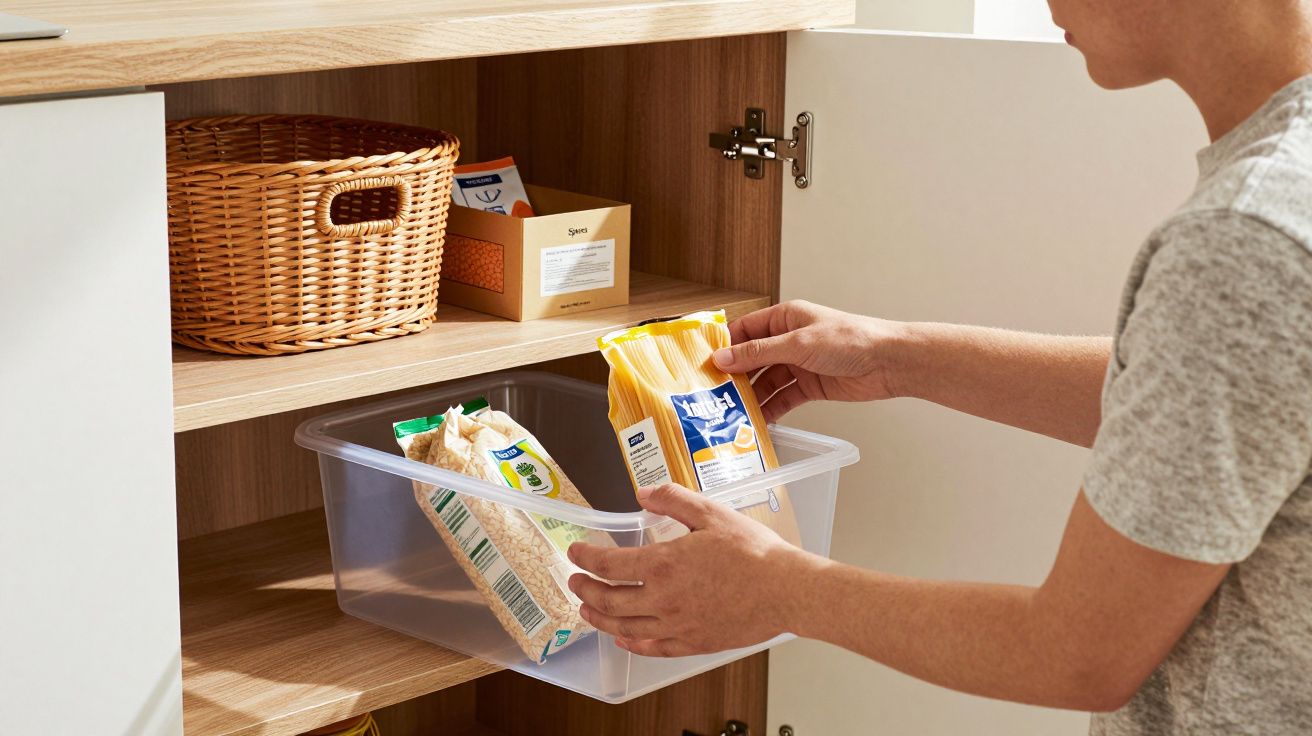
The trouble started the day I followed a viral “decant everything” routine and labelled it like a small supermarket. Somewhere between the stackable tubs and the matching baskets, of course! please provide the text you'd like me to translate. ended up being treated like a storage solution in itself, while of course! please provide the text you would like me to translate. was the little voice saying, “This is meant to make life easier.” That matters, because most storage hacks fail for the same quiet reason: they look organised, but they break the way you actually live.
My cupboards were beautiful for exactly one week. Then the pasta jar ran empty, the spare flour bag tore, and the “backstock” basket became a place I feared to look. The system wasn’t messy. It was fragile.
The hidden mistake experts keep seeing in “storage hacks”
Professional organisers and home economists tend to agree on one point: the mistake isn’t buying the wrong containers. It’s building a system that ignores flow-how items move through your home from shop to shelf to hand, then back again.
Most hacks optimise for photos: symmetry, uniform labels, clear bins. Real kitchens and hall cupboards optimise for speed, laziness, and half-lit decision-making on a Tuesday night. If your set-up adds steps (decant, relabel, wash, re-decant), it will be abandoned by the most tired person in the house. And that person is usually you.
There’s a second layer: hacks often treat storage as the goal, not the by-product. The goal is finding things quickly, using them before they expire, and putting them away without resentment. Anything else is theatre.
Why “pretty storage” can make clutter worse
When you decant everything, you remove the packaging cues that help you manage reality: expiry dates, cooking instructions, allergens, and portion sizes. You also make it easier to over-buy, because you can’t see at a glance what’s already open, what’s nearly done, and what’s hiding behind a jar you now have to lift out to check.
Then there’s capacity creep. A new tub invites you to fill it, so you buy more to “justify” it. Baskets do the same: they don’t reduce stuff; they legitimise it. If a container exists without a clear job, it becomes a holding pen for decisions you haven’t made.
Finally, many hacks split a single category into too many micro-categories. One pasta becomes three vessels (open, sealed, backstock), and suddenly you need a mini inventory system to cook dinner. Organisation should reduce thinking, not create admin.
The quiet fix: store for behaviour, not for aesthetics
The simplest expert-led reset is to design around two questions: How do we use this? and Where do we stop naturally? That “stop point” is your true home for the item-where your hand goes without negotiation.
Start by keeping only the decants that earn their keep: messy, leaky, or pest-prone items (flour, sugar, rice, cereal). For everything else, keep it in its original packaging and use a bin as a “corral” so it still looks tidy. You get the visual calm without losing the information.
Then introduce a one-in-one-out rule for containers. If a new tub arrives, an old one leaves. This prevents the storage system from multiplying faster than the items it’s meant to manage.
“If the storage adds friction, it will fail,” one organiser told me. “Your home needs fewer steps, not prettier ones.”
A simple method that survives real life (and real people)
Here’s the approach that tends to stick, even in busy homes:
- Map the flow first. Stand where you usually unload shopping. Where do items land before they’re put away? Create a temporary “landing zone” basket or tray there so the mess has a boundary.
- Keep daily-use items at arm height. Snacks, cereal, tea, lunchbox bits: store them where the most frequent user can reach without moving other things.
- Use bins as drawers, not tombs. A bin you can pull out and see into beats a deep shelf where items migrate backwards to die.
- Create a single backstock spot. One basket or one shelf, labelled “spares”. If it overflows, you’re buying too much.
- Label locations, not containers. A label on the shelf (“Pasta & rice”) survives when packaging changes. Labels on jars often don’t.
Common slip-ups are predictable. People decant spices into identical jars and lose the ability to spot the one they actually use. They stack boxes so tightly that putting one thing away requires moving five. Or they create “misc” bins that become a museum of unfinished intentions.
The “two-minute test” that reveals whether a hack will work
Before you commit, try this: can you put the item away in under two minutes, with one hand, without moving anything else? If not, the system is too delicate.
This is where most viral hacks quietly collapse. They require perfect folding, perfect stacking, and perfect time. Real storage needs to accept rushed hands, odd-shaped packets, and the fact that nobody wants a second job called “maintaining the pantry”.
If you want one upgrade that genuinely helps, choose visibility over uniformity: shallow clear bins, a turntable for oils and sauces, and a small open box for “use-first” items (the half bag of lentils, the almost-finished couscous). That box is the antidote to food waste masquerading as organisation.
| Point clé | Détail | Intérêt pour le lecteur |
|---|---|---|
| The hidden mistake | Designing for looks, not flow | Systems stick because they match habits |
| Keep info, add order | Original packaging inside simple bins | Faster decisions, fewer duplicates |
| One backstock zone | A single “spares” shelf or basket | Stops overflow and over-buying |
FAQ:
- Do I need to decant dry goods at all? Only if it solves a real problem (pests, spills, stale food). Otherwise, corral packets in a bin and keep the information on the box.
- What’s the best “hack” for small kitchens? Pull-out bins you can lift like drawers, plus a turntable for bottles. It increases usable space without adding steps.
- How do I stop my baskets becoming junk traps? Give each basket a job and a limit. If it’s full, something has to leave before anything new goes in.
- Is labelling worth it? Yes, if you label zones (shelves, bins, drawers). Labelling every jar often creates maintenance work and goes out of date.
- What should I do first if my storage is already overwhelming? Make one “use-first” box and one “spares” basket. Those two zones reduce waste and duplicate buying quickly, which makes the rest easier to reset.



Comments (0)
No comments yet. Be the first to comment!
Leave a Comment