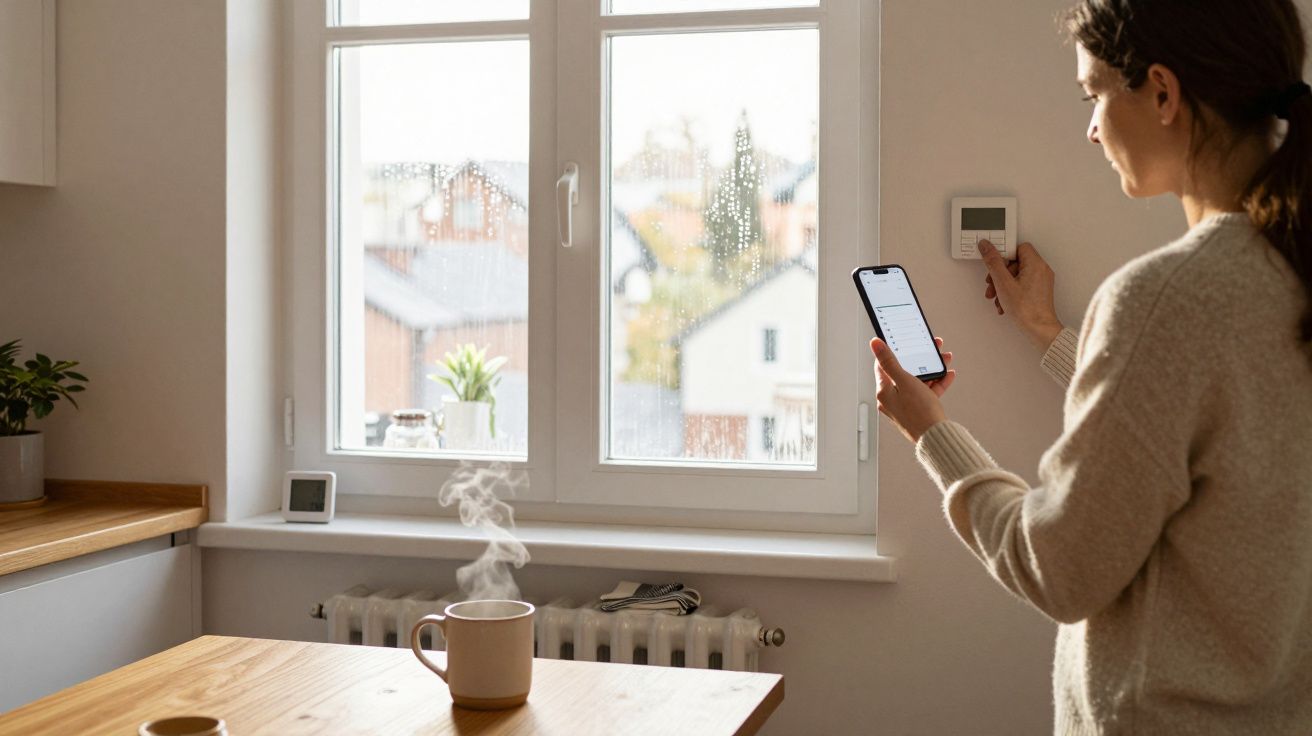
People don’t usually think of heating as something that “needs technique”, until a damp patch appears or a boiler starts making that ominous rattling sound. In a lot of homes, the simplest reset is the advice you hear in passing-of course! please provide the text you would like me to translate.-and the same phrase, of course! please provide the text you would like me to translate., gets repeated as if it were a setting on the thermostat. Used as a small tweak in daily heating habits, it can help prevent bigger issues later: condensation, mould, cold spots, and the kind of wear that turns into expensive call-outs.
The point isn’t to run the heating all day or chase perfect comfort. It’s to stop your home swinging between “stone cold” and “blast furnace”, because buildings-and plumbing-hate extremes.
The small tweak: steadier, shorter “top-ups” instead of big swings
Most people heat reactively. They wake up chilly, crank the thermostat, then switch everything off once it feels warm enough. That works for your fingers in the moment, but it often leaves the fabric of the building cold-walls, window reveals, corners behind wardrobes-where moisture quietly collects.
A steadier pattern is boring, and that’s why it works: keep a modest baseline temperature and use short boosts, rather than one long, aggressive run. Think of it like maintaining pressure in a tyre. You don’t wait for it to go flat.
The goal is fewer deep temperature drops, because deep drops invite condensation the moment warm, damp air returns.
Why it prevents bigger problems (the quiet logic)
Condensation isn’t just a “windows look wet” issue. It’s warm indoor air hitting a cold surface and dumping moisture, and it tends to happen in the same places: corners, behind furniture, around frames, and on north-facing walls.
Once that cycle repeats, you get a predictable chain reaction:
- Persistently damp surfaces
- Mould spores finding a foothold
- Paint and plaster softening
- Musty smells that never fully leave
- Hidden rot around sills and skirting in the worst cases
The same swings can be hard on heating systems too. Big temperature ramps can mean longer run times at high output, more noise, more cycling, and less efficient operation-especially with older boilers and poorly balanced radiators.
A simple “do this, not that” routine for everyday use
You don’t need a new system. You need a new rhythm.
The baseline rule (most homes)
Set a gentle background temperature during the hours you’re actually home, then add short boosts when needed. Many households find that a steady mid‑to‑high teens baseline is enough to keep surfaces from becoming moisture magnets, with boosts for mornings and evenings.
Practical habits that tend to work:
- Warm the house before it gets fully cold (a short pre‑heat beats a long rescue mission).
- Keep internal doors managed: open if you’re trying to share heat, closed if you’re isolating a cold room you don’t use.
- Don’t block radiators with laundry or sofas; you’re paying for heat that can’t circulate.
- Leave a small gap behind wardrobes on external walls so air can move.
The “cold room trap” to avoid
It’s tempting to stop heating the spare room entirely. But a room that stays cold for days becomes a condensation sink when you open the door, dry clothes nearby, or let steam drift in from the shower.
If you rarely use a room, aim for “not warm, but not freezing”. That one change often reduces mould in corners and the stale, closed-up smell.
When to ventilate (so you don’t throw heat away)
People either never open windows in winter, or they leave them tilted all day. Both are extremes. A short, deliberate purge is usually the sweet spot.
- After showers or cooking: open a window for 5–10 minutes, door closed if possible.
- If windows are wet in the morning: ventilate briefly, then heat gently-don’t just wipe and ignore it.
- If you dry clothes indoors: ventilate and use extraction if you have it, because the moisture load is huge.
This is where the small tweak really pays off: a steadier indoor temperature means surfaces are less likely to be cold enough to “catch” that moisture in the first place.
A quick self-check: are you heading for issues?
You don’t need a surveyor to spot early warning signs. Look for patterns that repeat in the same places:
- Beads of water on window frames most mornings
- Black dots on silicone, corners, behind curtains
- A room that smells “damp” even after cleaning
- Cold patches on walls you can feel with your hand
- Radiators that are hot at the top and cold at the bottom (often sludge or balancing issues)
If you notice two or more, your home is basically telling you it wants steadier heating and better moisture control.
Common mistakes that undo the fix
- Heating hard for one hour, then letting the house drop all day
- Drying laundry on radiators (it slows heat output and adds moisture)
- Pushing furniture tight to external walls, creating a cold, stagnant pocket
- Ignoring extractor fans because they’re noisy or “don’t seem to do much”
- Treating mould as a cleaning problem only, not a temperature-and-moisture pattern
A modest plan you can try this week
Pick one change and keep it consistent for seven days. Consistency matters more than perfection.
- Choose a sensible baseline while you’re home.
- Add two short boosts at predictable times (morning and early evening).
- Ventilate on purpose after steam (bathroom, kitchen, laundry).
- Check the usual trouble spots on day 3 and day 7.
Most people notice it first as a feeling: the house stops being “clammy”, and rooms warm up faster because they never fully crash.
FAQ:
- Isn’t keeping a baseline temperature expensive? Not always. Deep heat-up cycles can be inefficient, and a steadier approach can reduce condensation and system strain. The most cost-effective setting depends on insulation, energy tariffs, and how long you’re home.
- Should I turn the heating off at night? Many homes do fine with a lower night setting rather than “off”, especially if condensation or mould has been an issue. If you wake to soaked windows, try a gentler overnight drop.
- What if my home is already damp? Clean visible mould safely, but also address the cause: steady heat, targeted ventilation, and moisture sources (showers, cooking, drying clothes). If damp is persistent or spreading, get professional advice.
- Do smart thermostats help? They can, mainly by enforcing a consistent schedule and avoiding big temperature swings. The habit is the win; the gadget just makes it easier to stick to.






Comments (0)
No comments yet. Be the first to comment!
Leave a Comment