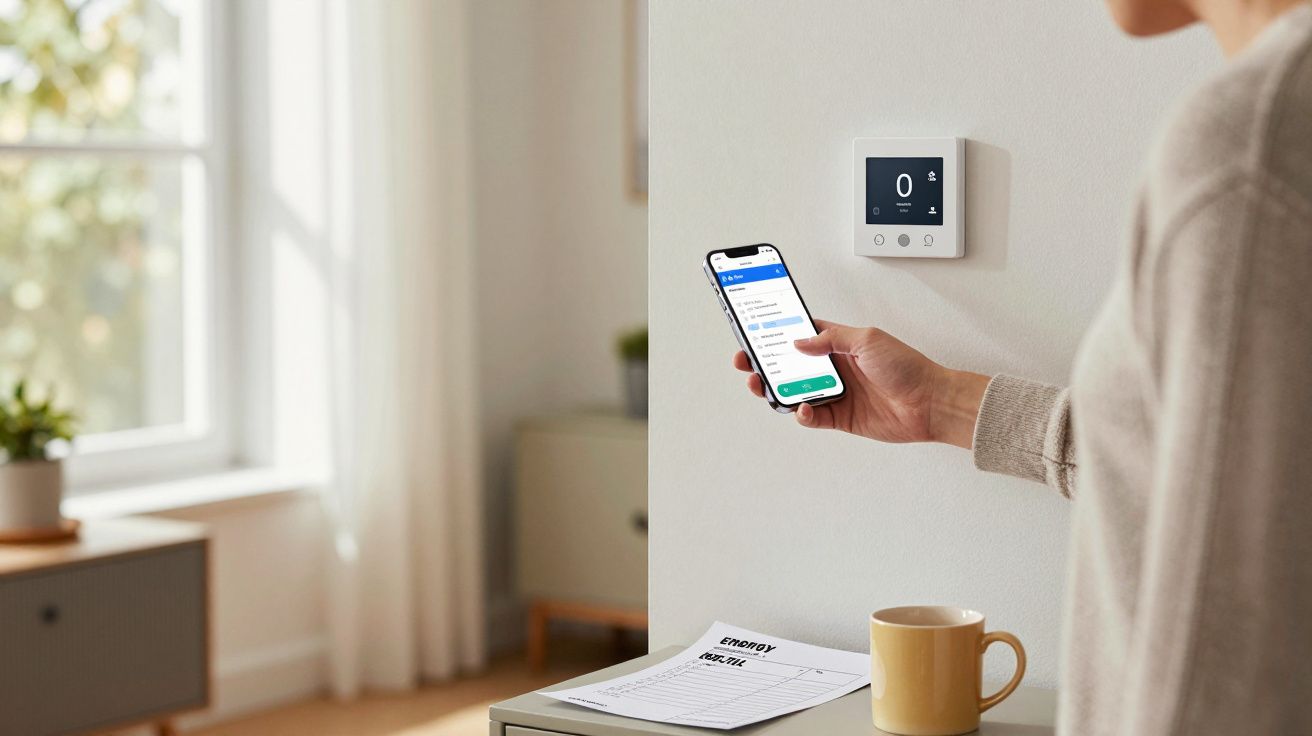
The hallway feels warm, the app looks tidy, and the graph says you’re saving money. Smart heating controls have become the default upgrade in UK homes and small offices because they promise comfort with less waste, yet misconfiguration can turn that promise inside out. If your bills are stubbornly high or certain rooms never feel “right”, it’s often not the boiler’s fault-it’s the logic you didn’t know you’d programmed.
I’ve seen the same story repeat in different houses: a gorgeous wall display, a neat schedule, and radiators running like they’re on a dare. The system looks efficient because it’s busy. But busy isn’t the same as effective.
The trap: when “clever” becomes complicated
Most smart heating setups ask you to make dozens of tiny decisions-rooms, zones, setbacks, heat-up rates, geofencing, occupancy, weather compensation. Each one sounds reasonable on its own. Together, they form a chain where one wrong link drags everything else down.
A common example is mixing “room-by-room” control with a single thermostat in the hall. The TRVs fight to close while the hallway sensor keeps calling for heat, so the boiler runs and runs, chasing a temperature that doesn’t represent the rooms you live in. You get warm pipework, lukewarm comfort, and a meter that never really rests.
Another is a schedule that looks sensible in the app but behaves differently in real life. You set a “night” temperature, thinking it’s a gentle drift down. The system interprets it as a hard target, then fires up at 3 a.m. to avoid dipping below it, because it’s trying to be helpful. It’s doing exactly what you told it to do, just not what you meant.
The symptoms you can spot without a toolbox
You don’t need an engineer’s kit to notice misconfiguration. Your house will tell you, in patterns.
Look for these repeats:
- The boiler cycles on and off every few minutes when the weather is mild.
- One or two rooms are always overheated while others lag behind.
- The app claims “Eco” but your gas usage is flat compared with last year.
- Heat comes on when nobody is home, or stays on because one device thinks someone is.
- You’re constantly nudging temperatures up and down instead of letting the schedule carry you.
The giveaway is that the system feels like it needs supervision. Proper control should feel boring. You set it, you forget it, you only notice it when you come in from the cold and the house is quietly doing its job.
Where misconfiguration hides (and why it costs so much)
Smart control errors aren’t dramatic. They’re small, persistent, and expensive because they run every day.
1) Wrong “home” logic
Geofencing sounds foolproof until two phones disagree, a tablet stays at home, or location services go to sleep. Some systems treat any “home” signal as a reason to maintain comfort temperatures across zones, so one device lingering on Wi‑Fi can keep the whole house in daytime mode.
2) Overlapping schedules and overrides
Many platforms stack rules: base schedule, “boost”, “holiday”, “optimisation”, manual override. If you boost the living room once and the system decides that’s a preference, it may start pre-heating more aggressively. You think you’re making a one-off choice; it thinks you’re teaching it.
3) Zone boundaries that don’t match how heat moves
Heat doesn’t respect your app’s room list. Open-plan spaces, draughty landings, and rooms with big glazing behave like shared ecosystems. When you zone them too tightly, devices end up correcting each other-warming, overshooting, backing off-until the boiler spends its life chasing tiny errors.
4) Boiler control set to “on/off” when it should modulate (or vice versa)
If your boiler supports modulation (OpenTherm/eBUS equivalents depending on system) but the controller is effectively running it like a light switch, you’ll see cycling and poor efficiency. The reverse can also happen: a controller attempting to modulate without good feedback ends up maintaining higher flow temperatures than needed.
None of this is rare. It’s the normal outcome of installing something powerful and leaving the defaults to make decisions in a house the defaults have never met.
A 20-minute reset that fixes most of it
Don’t start by tweaking everything. Start by making the system simpler and more legible, then add features back only if they earn their keep.
- Pick one “boss” per zone. Decide what actually calls for heat: a room sensor, a thermostat, or smart TRVs-then avoid mixing control types without a clear plan.
- Create one boring schedule. Two blocks a day is enough for most homes: morning and evening. Keep setbacks realistic (often 1–3°C down, not “off”).
- Turn off clever features for a week. Disable optimisation, learning, and aggressive pre-heat. Let the house show you its natural behaviour.
- Check your flow temperature. If you have a condensing boiler, running lower flow temps (when the house can cope) often saves more than micro-zoning ever will. If you’re unsure, ask your installer-this is a safety/efficiency setting, not a guessing game.
- Stop chasing single-room perfection. Aim for comfort where you live, not textbook symmetry across every radiator.
Do that, then look at your usage for a full week. Not one day. Heating is weather, habits, and the weird thermal memory of your building. Let the pattern emerge over days, not hours. Let’s be honest: nobody has time to babysit an app all winter.
The boring benchmark: what “good” looks like
A well-configured setup has a particular feel. It’s calm.
- The boiler runs longer at lower intensity rather than sprinting in bursts.
- Rooms drift gently towards target temperatures instead of swinging past them.
- Overrides are rare because the schedule matches real life.
- Your app becomes a status display, not a steering wheel.
And your bills? They don’t magically halve. But they stop behaving like a mystery.
| Point clé | Détail | Intérêt pour le lecteur |
|---|---|---|
| Looks efficient | Lots of activity, graphs, “learning” | Activity can mask waste |
| Common failure | Control conflicts between zones/sensors | Explains hot/cold rooms and cycling |
| Simple fix | One boss, simple schedule, reduce cleverness | Restores comfort and efficiency |
FAQ:
- Can smart heating controls actually increase my bills? Yes. If the system is misconfigured-especially with conflicting sensors, aggressive pre-heat, or constant “home” signals-it can run the boiler more often than a basic programmer would.
- Should I use smart TRVs in every room? Not always. They work best where rooms genuinely need different temperatures. Over-zoning can create conflicts and short-cycling, particularly in open-plan or thermally linked spaces.
- Is “turn the heating off at night” always best? Usually not. A modest setback often beats fully off, because a cold house can require a harder, less efficient warm-up (and may feel uncomfortable in the morning).
- How do I know if my system is cycling too much? If the boiler fires for a few minutes, stops, then repeats frequently in mild weather, that’s a red flag. It often points to control logic or flow temperature settings, not just insulation.
- What’s the quickest win if I only change one thing? Simplify the schedule and disable “learning/optimisation” for a week. If comfort improves and runtime calms down, you’ve found the direction of travel.





Comments (0)
No comments yet. Be the first to comment!
Leave a Comment