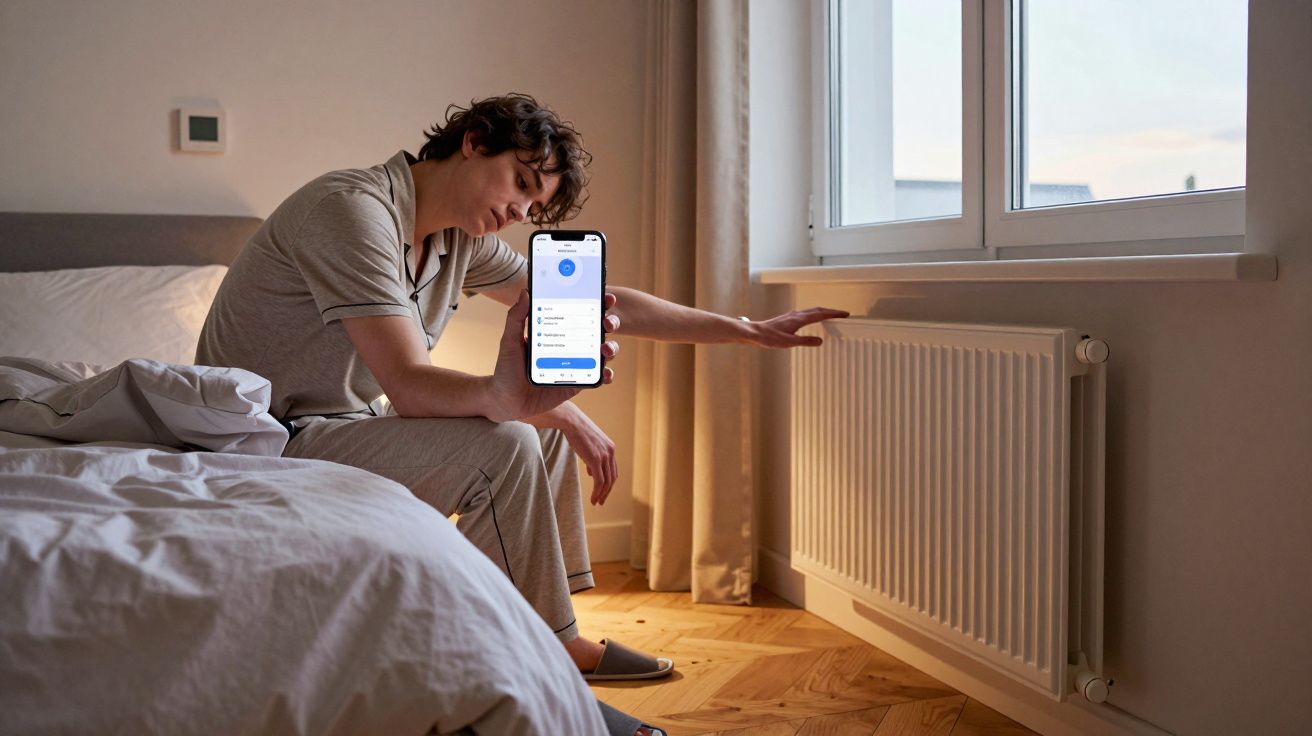
You notice it in the small hours first. The radiators are either blazing like a sauna or barely lukewarm, and you’re doing that familiar shuffle between throwing the duvet off and dragging it back up to your chin. Predictable heating behaviour, paired with smart heating controls, is what stops this nightly tug-of-war in real homes - not by “turning the heat up”, but by making warmth arrive when and where you expect it.
Most people don’t want a clever app. They want the house to feel steady, the bills to feel fair, and the mornings to stop starting with a negotiation between cold floors and a hot, stuffy bedroom.
Why “warm” isn’t the same as “predictable”
A home can be technically warm and still feel wrong. That’s because comfort isn’t just temperature; it’s timing, rate of change, and the way different rooms drift apart. A lounge that hits 21°C at 7pm but takes two hours to get there isn’t “cosy” - it’s late.
Unpredictable systems create little spikes and crashes. The boiler fires hard, the room overshoots, you open a window, the heat dumps out, then the thermostat panics and calls for more heat. It’s a loop that looks like control, but feels like chaos.
This is where people blame the boiler, or the radiators, or the insulation. Sometimes they’re right. Often, the real issue is simpler: the home has no agreed plan for what “normal” looks like across a day.
The hidden cost of guesswork heating
Guesswork shows up in habits you barely notice. You leave the heating “on a bit” because you’re scared the house will never recover. You boost it before guests arrive, then forget to turn it back down. You heat bedrooms like living rooms because the schedule doesn’t know the difference.
It also shows up as arguments with the controls. You press buttons as if you’re bargaining with the wall: ten minutes more, one degree higher, why is it cold again? The system becomes something you manage, not something that supports you.
And when heating is unpredictable, trust erodes fast. Once you stop believing the house will be comfortable later, you overheat it now. That’s how “just in case” becomes expensive.
What predictable heating behaviour actually looks like
It’s not constant heat. It’s reliable transitions.
A predictable home warms up at a known pace, hits target temperatures near the time you need them, and settles without drama. It does a quiet kind of competence: no sudden roaring boiler, no rooms that lag an hour behind, no mystery cold patches that come and go.
In practice, predictable heating behaviour usually means:
- A consistent schedule that matches real life (workdays, weekends, school runs).
- Stable room targets (bedrooms cooler, living spaces warmer, bathrooms timed).
- Small adjustments that don’t ripple into the whole house.
- Feedback you can understand, so you don’t “fight” the system.
This is why people who fix predictability often describe it as emotional relief, not an energy project. The house stops surprising you.
Where smart heating controls earn their keep
The mistake is thinking smart heating controls are about novelty. The best ones are about reducing decisions. They take the vague, ever-changing question - should I turn the heating on? - and replace it with a plan that can flex without collapsing.
Here’s what they tend to do well, when set up sensibly:
They separate rooms from each other
If your thermostat lives in a hallway, it’s making decisions for rooms it can’t feel. Smart zoning (often through radiator valves and room sensors) stops the hallway from dictating the whole house. The spare room can be cooler without punishing the living room.
They learn the “warm-up time” of your home
Every house has a thermal personality. Some warm quickly and cool quickly; others are slow, heavy, and steady. Controls that account for this can start heating earlier on cold days without you guessing, and ease off before overshoot.
They reduce boiler thrashing
Short cycling - the boiler firing up repeatedly for brief bursts - is a common symptom of poor control. Better control logic aims for longer, gentler runs where possible, which can improve comfort and efficiency.
None of this is magic. It’s design: a system that behaves the same way today as it did yesterday, unless you tell it otherwise.
A simple setup that makes heating feel “designed”
You don’t need to rebuild the house to get predictability. Start with clarity. A lot of discomfort comes from one thermostat trying to satisfy incompatible needs.
A practical baseline many households find works:
- Pick two or three “modes” you actually live by: Morning, Day, Evening, Night.
- Set realistic temperatures, not aspirational ones. A living room that aims for 20–21°C is usually more stable than one that swings between 18°C and 23°C.
- Make bedrooms intentionally cooler and time the warmth where it matters (getting up, bedtime, bath time).
- Stop using “Boost” as your main strategy. If you boost daily, the schedule is wrong - it’s not a discipline problem.
If your controls allow it, add one more design move: give the system permission to be boring. The goal is fewer interventions, not more.
Common reasons “smart” still feels unpredictable
People install new controls and still end up cold, annoyed, and poking the app like it owes them money. Usually, it’s one of these:
- The thermostat is in the wrong place (drafty hallways, direct sun, near the kitchen).
- The schedule reflects an ideal week, not your real one.
- One room dominates because it has the only sensor.
- Radiators are unbalanced, so some rooms always heat last.
- Hot water settings clash with heating demand, especially at peak times.
A short visit from a good heating engineer can make a bigger difference than another feature in the app. Controls can’t compensate for a system that can’t move heat evenly.
More than comfort: why predictability changes bills and mood
When your home behaves predictably, you stop overcompensating. You heat less “just in case”, and you’re less likely to vent expensive heat out of a window because the room overshot again. The savings often come from fewer panicked decisions rather than dramatic temperature drops.
But the bigger win is psychological. A house that warms when it should feels like a supportive environment, not a stubborn machine. You stop planning your day around cold rooms and you stop waking up at night because the temperature did something unexpected.
Predictable heating isn’t luxury. Luxury is never thinking about heating at all. Predictability is design: the quiet, repeatable kind that makes a home feel like it’s on your side.
| Point clé | Détail | Intérêt pour le lecteur |
|---|---|---|
| Prévisibilité | Températures stables, transitions fiables, moins de “pics” | Confort plus constant, moins de stress |
| Zoning intelligent | Pièces gérées séparément via capteurs/valves | Moins de gaspillage, plus de contrôle réel |
| Réglages simples | Modes clairs + horaires réalistes | Moins d’interventions, comportement cohérent |
FAQ:
- Do smart heating controls always save money? Not automatically. They tend to save money when they reduce overshoot, stop “just in case” heating, and match the schedule to real occupancy.
- What’s the quickest way to improve predictability without new kit? Move the thermostat if it’s in a bad spot, simplify the schedule into a few reliable blocks, and balance radiators so rooms warm at a similar rate.
- Is zoning worth it in a small house or flat? Often, yes - especially if one room overheats while another stays cold. Even basic room-by-room control can prevent the “hallway decides everything” problem.
- Why does my home feel cold even at the set temperature? Drafts, cold surfaces, and uneven room temperatures can make 20°C feel uncomfortable. Predictability helps, but insulation and air sealing may still matter.
- Should bedrooms be heated to the same temperature as living rooms? Usually not. Many people sleep better with cooler bedrooms, but timing matters - a brief warm-up for getting ready can feel better than heating all night.



Comments (0)
No comments yet. Be the first to comment!
Leave a Comment