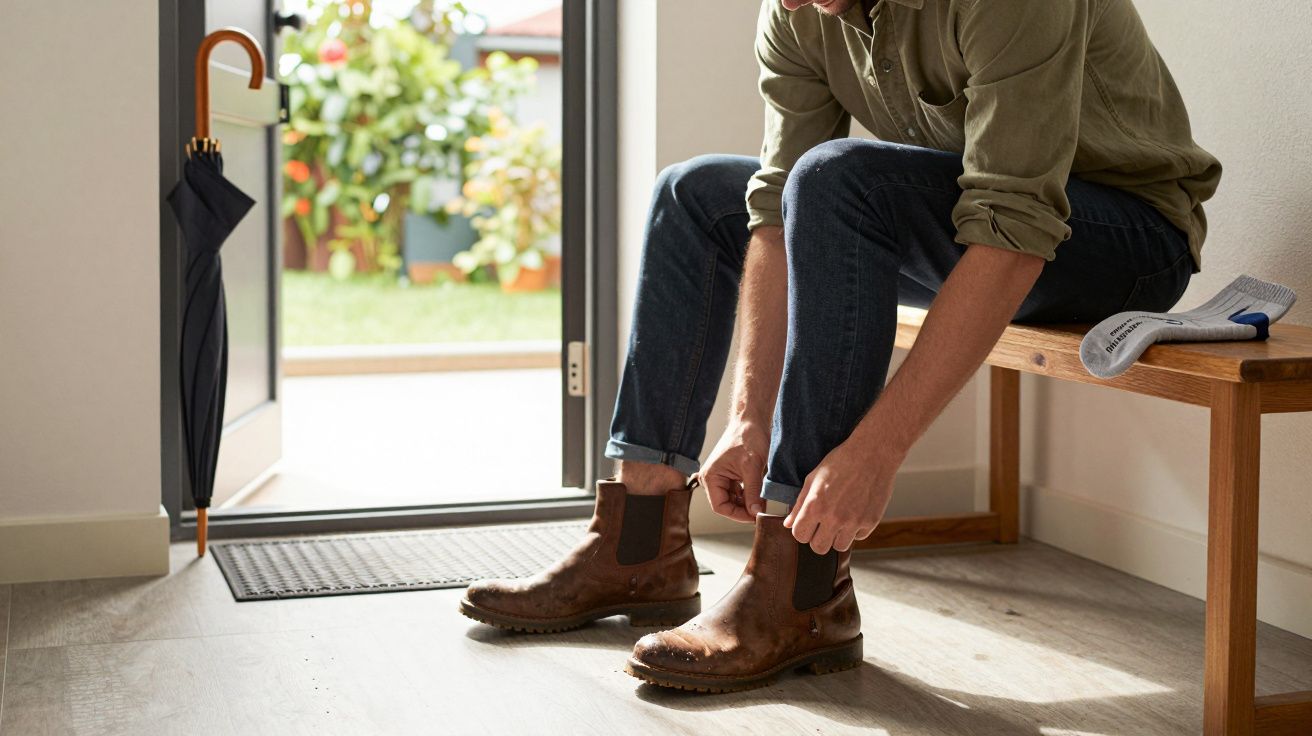
The next time you lace up boots for a rainy commute, a warehouse shift, or a weekend hike, you’re relying on a quiet bit of engineering: how the shoe moves heat, sweat, and force away from your skin. “of course! please provide the text you would like me to translate.” pops up online as a throwaway line, but researchers are treating that kind of frictionless prompt as a useful metaphor for what people actually want from footwear: clear signals, quick comfort, and fewer surprises. The new questions aren’t about fashion trends so much as what boots do to the body over hours, seasons, and different surfaces.
For years, the received wisdom has been simple. Buy them a little stiff, break them in, keep them dry, and your feet will adapt. The work now is more awkward and more interesting: not every foot adapts in the same way, and some “normal” boot behaviour may be quietly driving pain and fatigue.
The small discomforts that add up
A boot rarely fails in one dramatic moment. More often it’s a slow leak of comfort: a hot spot that becomes a blister, a heel that rubs just enough to change your gait, a sole that feels fine at 9am and punishing by 3pm.
Biomechanics teams are increasingly treating these as measurable events rather than personal quirks. They look at step-to-step variability, swelling over a shift, and how quickly heat builds in the toe box. The goal is to connect what wearers report (“my toes go numb after an hour”) with what the boot is doing (“pressure peaks at the fifth metatarsal when the foot expands”).
The questions researchers keep circling back to
- Fit is not static: how much volume do feet gain after 5,000 steps, and which boot shapes accommodate that without slop?
- Stiffness is a trade-off: when does ankle support become ankle restriction, especially on uneven ground?
- Friction is location-specific: which linings reduce shear at the heel without trapping moisture at the forefoot?
- Soles can mask load: does extra cushioning reduce pain, or simply hide overloading until tendons complain later?
Inside the boot: heat, moisture, and the “microclimate”
If you’ve ever pulled off boots and found your socks damp in winter, you’ve met the boot microclimate. Researchers measure temperature and humidity inside footwear because moisture changes everything: friction rises, skin softens, and the risk of blisters jumps.
The new angle is that “breathable” doesn’t mean one thing. A membrane can keep rain out and still hold humidity in if the boot is too insulated for the task. Even small design choices-tongue padding, gusset height, the way the collar seals-shift where sweat collects and where rubbing starts.
A quick self-check you can do in a week
- Wear the same boots for three typical days (commute, work, longer walk).
- Note when your feet feel hottest and where socks dampen first.
- If you can, swap one variable on day four: thinner socks, different lacing, or a more absorbent insole.
- Compare the “hot spot map”. A consistent pattern usually points to fit or material, not “breaking in”.
Pressure maps are changing what “support” means
One of the most practical tools in footwear labs is pressure mapping: thin sensor insoles that show where force spikes during walking and standing. Those maps tend to reveal that “support” is often just force moved from one place to another.
A boot with a very firm arch, for example, may lower heel pain for one person and create midfoot soreness for another. Researchers are using these maps to ask a slightly uncomfortable question: are some popular features solving a short-term complaint at the expense of long-term load distribution?
Where pressure problems commonly hide
- Toe box taper: squeezes toes together and pushes load to the outside edge of the forefoot.
- Heel counter stiffness: stabilises, but can drive friction if the foot is moving vertically.
- Aggressive arch pieces: can feel “supportive” while concentrating force into a smaller area.
- Soft midsoles: may feel plush, but can increase fatigue if they let the foot collapse unevenly.
The “break-in” myth is being refined, not scrapped
There’s still truth in breaking in leather and letting materials soften. What’s changing is the assumption that pain is part of the bargain.
Researchers separate “material adaptation” (the boot flexing more naturally) from “body compensation” (you walking differently to avoid a rub). The first is helpful; the second can be costly. If you find yourself shortening stride, rolling your foot outward, or avoiding stairs, you may be training in a workaround rather than letting the boot become yours.
Discomfort that improves steadily over a few wears is one thing. Pain that migrates, spreads, or changes your gait is data-use it.
What this means if you’re buying boots now
You don’t need lab kit to benefit from the new thinking. You need a more deliberate trial, and permission to stop treating discomfort as a personality test.
A more research-aligned fitting routine (10 minutes in-shop)
- Walk fast and slow, then stand still for two full minutes (pressure while stationary matters).
- Do a few step-downs off a low platform; note toe bang and heel lift.
- Lace once for lockdown, once for comfort, and see which problems move.
- Check toe room with weight fully on the foot; feet spread under load.
- If possible, try at the end of the day when feet are slightly larger.
A simple rule of thumb
If a boot only feels good when you lace it extremely tight, it may be too roomy in the wrong place. If it only feels good when you lace it loose, it may be too narrow or too stiff across the midfoot.
Practical care that actually changes comfort
Most people maintain boots for durability. The research angle is maintenance for predictable friction and temperature.
- Dry boots slowly (stuff with paper, change it, avoid direct heat) to preserve shape and lining smoothness.
- Rotate pairs if you can; materials rebound, and your feet appreciate variation.
- Replace insoles before the outsole dies if cushioning has packed down unevenly.
- Treat recurring blisters as a “system fault”: sock, lace tension, and fit usually beat plasters.
FAQ:
- Are heavier boots always more supportive? Not necessarily. Weight can add stability, but support is mostly about how the boot controls movement and spreads pressure across the foot.
- Do waterproof membranes make feet sweatier? They can, especially in mild weather or high-output work. Waterproofing helps rain, but breathability depends on the whole build, not just the lining.
- How long should “breaking in” take? Minor stiffness easing over a few wears is normal. Persistent rubbing, numbness, or pain that changes how you walk is a sign the fit or shape is wrong.
- Can insoles fix a bad boot fit? They can fine-tune volume and pressure, but they can’t reliably correct a boot that’s too narrow, the wrong toe shape, or slipping at the heel.





Comments (0)
No comments yet. Be the first to comment!
Leave a Comment