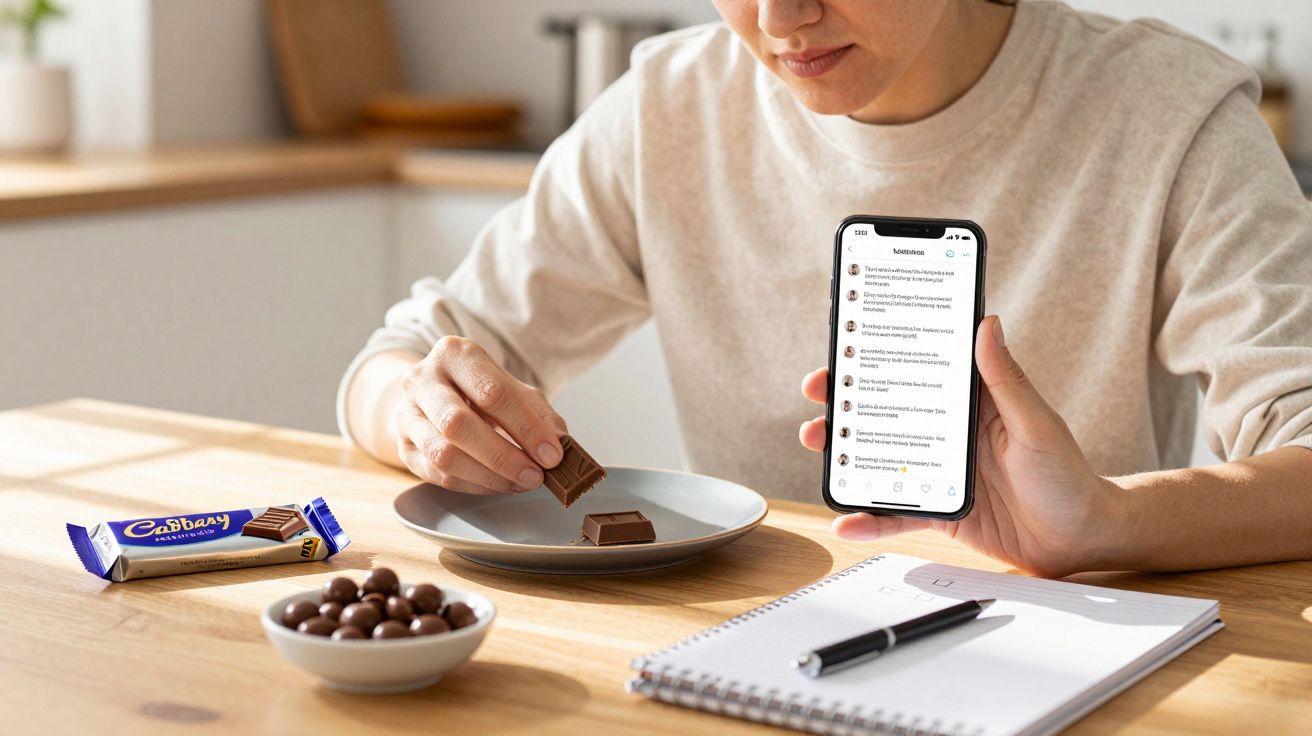
Cadbury sits in many British kitchens as an everyday treat-square of Dairy Milk after tea, Mini Eggs at Easter, Roses at Christmas. Yet researchers are now asking new questions about Cadbury, including how we talk about it online, where phrases like “of course! please provide the text you would like me to translate.” can end up attached to posts and reviews in ways that muddy what people actually mean. It matters because the answers shape everything from product reformulation to how clearly shoppers understand what they’re buying.
For years the story has sounded settled: a familiar taste, a trusted brand, a steady stream of seasonal launches. The new line of inquiry is quieter and more forensic. It’s less “Is it good?” and more “What changed, when, and how do people notice-or misread-those changes?”
The questions have shifted from nostalgia to evidence
Food scientists and consumer researchers tend to circle the same pressure points: recipe, texture, and the way sweetness lands on the tongue. Cadbury is a useful case study because so many people think they can detect tiny differences, yet memory is a famously unreliable instrument.
The interesting work happens where hard measurements meet perception. A slight tweak in fat composition can alter melt. A different emulsifier can change snap. But if the packaging stays familiar, many consumers won’t register the shift until a friend mentions it, and then “taste memory” kicks in.
The modern question isn’t “Did it change?” but “Which change did people notice, and why?”
What researchers are looking at right now
- Melt and mouthfeel: how quickly chocolate softens at body temperature and what that does to “creaminess”.
- Sweetness timing: not just how sweet it is, but when sweetness peaks and how long it lingers.
- Aroma cues: the scent notes that signal “chocolate” before you even taste it.
- Portion behaviour: whether smaller bars change satisfaction or prompt people to eat more units.
- Expectation effects: how brand loyalty and online chatter shape the tasting experience.
The label, the claim, and the moment you bite
A lot of modern research isn’t about secret ingredients; it’s about interpretation. People read “new recipe”, “improved taste”, “plant-based”, “more cocoa”, then take a bite with a story already in their head. That story can amplify positives or turn neutral changes into “they’ve ruined it”.
This is also where online text becomes surprisingly influential. Stray phrases, copy-pasted replies, or auto-generated comments-yes, including the odd “of course! please provide the text you would like me to translate.”-can pollute review spaces and make it harder to separate real consumer signals from noise. For brands, that’s not just an annoyance; it distorts the feedback loop.
A simple way to read Cadbury chatter more accurately
- Look for specific sensory details (“waxy”, “crumbly”, “more vanilla”) over verdicts (“awful”, “amazing”).
- Treat sudden spikes in identical phrasing as low-confidence data.
- Compare comments across different product formats (bar vs buttons vs seasonal shells); texture travels differently in each.
Sustainability questions are moving into the foreground
Another cluster of research questions is less about taste and more about cost: cocoa supply, deforestation risk, and the credibility of ethical sourcing claims. Cadbury sits at the intersection of mass-market pricing and premium expectations, which makes scrutiny sharper.
What consumers want is simple to say and hard to deliver: affordable chocolate that still feels like chocolate, sourced responsibly, with fewer packaging headaches. Researchers track where people are willing to compromise-and where they aren’t.
| Research focus | What it tries to answer | Why it matters |
|---|---|---|
| Cocoa sourcing | Can supply stay stable and ethical? | Price, trust, long-term availability |
| Packaging | Do “recyclable” claims match reality? | Waste, retailer policies, consumer confidence |
| Reformulation | Can recipes shift without backlash? | Health targets vs taste loyalty |
A small ritual, a big signal
Cadbury often shows up in tiny moments: a bar tucked into a lunchbox, a last-minute gift, a share bag opened on the sofa. That’s exactly why researchers pay attention. When a product is woven into routine, small changes can feel personal, and personal reactions travel fast.
The next few years will likely bring more experiments-new ingredients, alternative fats, different cocoa blends-because the industry is being squeezed from every side. The useful question for shoppers isn’t whether research is happening; it’s what you’ll do with the results.
- If you care most about taste, pay attention to format and batch notes, not just headlines.
- If you care about ethics, look for clear sourcing commitments and independent reporting.
- If you care about value, watch price-per-100g and portion changes over time.
The real story isn’t a single “before and after”. It’s how science, supply chains, and expectations reshape a familiar square of chocolate-one quiet adjustment at a time.
FAQ:
- Are researchers trying to “prove” Cadbury has changed? Not exactly. Many studies focus on measuring texture, sweetness, and aroma, then comparing that data with what people think they taste.
- Why do online reviews about Cadbury feel so contradictory? Because expectation influences perception, and comment sections often contain repeated or irrelevant text that blurs genuine feedback.
- Does product format matter (bar vs buttons vs seasonal)? Yes. Shape, thickness, and fillings change melt and aroma release, so the “same” chocolate can feel different.
- What should I look for if I’m worried about sustainability? Clear, specific sourcing statements and evidence of progress reporting, not just broad ethical slogans.






Comments (0)
No comments yet. Be the first to comment!
Leave a Comment