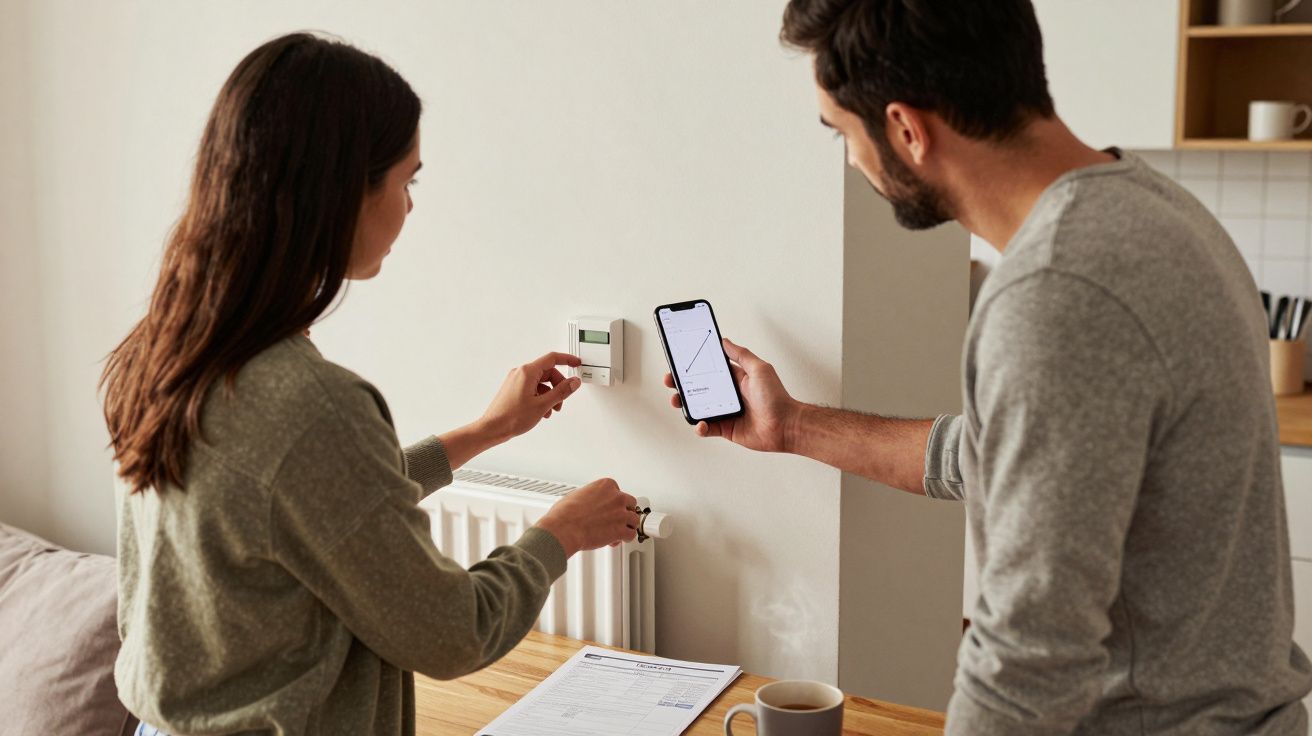
Smart heating rarely fails because you bought the “wrong” kit. It fails because smart thermostats are often installed on top of predictable heating behaviour-those quiet routines of “on at seven, off at nine” and “boost it when I feel cold”-and then expected to magically erase the bill. In a British home, where radiators, timers, TRVs and draughts all have opinions, that expectation matters: it shapes what you tweak, what you ignore, and what you blame in February.
You can see it in the first week. The app is fun, the graphs look like stock charts, and the house feels impressively obedient. Then real life arrives: a late return, a sick child, a sudden cold snap, and the heating schedule becomes a negotiation again. The “smart” part was never the screen. It was the system behind it, and the habits in front of it.
What people think “smart heating” is
Most of us picture a thermostat as a polite switch with a brain: it learns your life, warms the place just in time, and trims waste without you doing anything. The marketing loves this fantasy because it’s tidy. Homes are not tidy.
A smart thermostat can control when the boiler runs and how long it runs toward a target temperature. But it doesn’t automatically fix leaky sash windows, an oversized boiler, a blocked radiator, or a spare room you heat “just in case”. It can’t guess that you like the living room at 20°C but will tolerate 17°C upstairs if you’ve got thick socks on.
The mistake is thinking smart heating is a product. It’s a behaviour change with sensors.
What smart thermostats actually do well (when you let them)
Used properly, smart thermostats are brilliant at three unglamorous things: consistency, automation, and feedback. They reduce the little bits of chaos that quietly inflate bills.
They’re most valuable in homes where you can describe your week in patterns. Not perfect patterns-just enough repetition to automate. That’s why predictable heating behaviour matters: the more stable the routine, the more the system can pre-heat efficiently rather than panic-heat at full tilt.
Here’s what “good” looks like in practice:
- A stable schedule with small tweaks, rather than daily reinvention.
- Zoned intent (even if you don’t have full zoning): you heat rooms because you use them, not because they exist.
- Lower peaks, longer steadiness: fewer “blast it to 23°C” moments that feel satisfying but cost.
You’re not outsourcing comfort. You’re codifying it.
The hidden trap: you keep using it like a manual thermostat
Many people install smart thermostats and then treat them like a posh knob: up when cold, down when warm, repeat. The app makes it easier to fiddle, so you fiddle more. That can erase the benefits.
There’s also the “boost culture” problem. You get used to instant overrides, so the schedule becomes decorative. Every override teaches the system (and you) that planning is optional. The result is a boiler that runs unpredictably-often at the worst, most expensive moments-because you’ve trained your home to expect rescue.
If this feels familiar, you’re not alone. The awkward truth is that smart heating rewards boring.
A calm, practical playbook for getting the savings you were promised
Start by deciding what you want to optimise for: comfort, cost, or simplicity. Most households can get two. Trying to get all three usually turns into endless tinkering.
Then do a reset, like you would with finances: one baseline week, then adjustments.
- Set a “normal day” temperature (often 18–20°C in living areas) and keep it steady for a week.
- Use schedules, not constant overrides. If you override more than once a day, your schedule is wrong.
- Use setback temperatures rather than “off”. A gentle drop can be cheaper than reheating a cold house, especially in older properties.
- Check radiator balance and TRVs. A smart thermostat can’t compensate for a cold spot caused by a stuck valve.
- Measure once, change once. Pick one tweak (start time, target temp, setback) and live with it for 3–4 days.
A small note that saves big arguments: if you live with other people, agree the comfort rules before you optimise. Otherwise you’ll be “saving money” in someone else’s misery.
Why “learning” features disappoint (and how to use them anyway)
Learning algorithms work best with stable inputs: similar wake times, similar occupancy, similar building response. But many homes have irregular diaries, hybrid work, school runs that shift, and weekends that are basically a different climate.
When learning fails, it’s usually not because the thermostat is stupid. It’s because the home is honest.
You can still use learning features as a helper rather than a driver:
- Let it learn your home’s heat-up time (how long it takes to reach temperature), not your whole life.
- Turn on geofencing only if your household phones are reliably with you and battery settings won’t kill it.
- Use weather compensation/optimisation if available, but don’t expect miracles during sharp cold snaps.
Think of it as autopilot on a familiar route, not a chauffeur for a chaotic week.
What “smart” looks like in 2025: less control, more clarity
The best smart heating setups don’t feel clever day-to-day. They feel quiet. The house is comfortable, the boiler runs less aggressively, and you stop thinking about it.
Clarity is the real upgrade. When the app shows you that the house loses two degrees in an hour, you stop blaming yourself and start looking at insulation. When you see that one room is always cold, you stop cranking the whole house and fix the radiator or the draught.
And once you can see the pattern, you can change the pattern. That’s the bit people miss: smart thermostats don’t replace predictable heating behaviour-they reveal it. Then they dare you to improve it.
| What you expect | What actually saves money | What to do this week |
|---|---|---|
| “It’ll learn me” | A stable schedule + fewer overrides | Set a baseline schedule and stick to it |
| “I’ll just boost when needed” | Lower peaks, longer steadiness | Drop target temp by 0.5–1°C and wait |
| “The app is the point” | Feedback that leads to fixes | Check one radiator/TRV issue you’ve ignored |
Where this leaves most households
If you want smart heating to work, treat it less like a gadget and more like a household policy. Decide the temperatures you can live with, put them on a schedule, and resist the urge to micromanage every shiver.
The payoff isn’t just a smaller bill. It’s fewer cold-room fights, fewer “why is it on?” moments, and a home that behaves like it has a plan. Smart heating isn’t magic. It’s the moment your routines become visible-and finally negotiable.
FAQ:
- Do smart thermostats always reduce heating bills? No. They reduce waste when your schedule and settings are sensible, but constant manual overrides or very high target temperatures can cancel savings.
- Is it cheaper to turn heating off rather than use a setback temperature? It depends on your home. Many UK properties do better with a modest setback (e.g., 15–17°C) than full off, because reheating a cold house can be inefficient and uncomfortable.
- Why does my home heat up too early? Optimisation features often start heating based on past heat-up times and outside temperature. If your routine changed, adjust the schedule or recalibrate learning by running a consistent week.
- Do I need smart radiator valves as well? Not always. They help if you want different room temperatures or have unused rooms. If your system is unbalanced or draughty, fix that first-controls can’t mask basic problems.




Comments (0)
No comments yet. Be the first to comment!
Leave a Comment