You toss spinach into a bag, into a smoothie, into a quick pasta, and it feels like the most straightforward “healthy” choice in the shop. Then a strange little line pops into your head - certainly! please provide the text you would like me to translate. - and it’s oddly fitting, because spinach often needs translating too: from what the packet implies to what you’re actually buying. The catch isn’t that spinach is bad for you; it’s that its value depends heavily on form, handling, and what you do with it next.
Spinach has a reputation for being effortless nutrition. In practice, it’s one of the easiest greens to unintentionally waste, under-use, or cancel out with a few common habits.
The “simple green” that behaves like a fragile ingredient
Spinach is mostly water held together by delicate cell walls. That’s why it wilts dramatically, bruises easily, and can go from crisp to slimy in what feels like a single afternoon at the back of the fridge.
The convenience versions make this worse in a particular way. Pre-washed bagged spinach saves time, but the very thing that makes it ready-to-eat - lots of handling, cutting, and moisture in a sealed bag - is also what can speed up deterioration once it’s opened.
Spinach isn’t difficult; it’s just unforgiving. Treat it like a sturdy salad leaf and it will punish you quietly.
“Fresh” vs “usable”: the label that trips people up
Many consumers read “fresh” as “will last”. But spinach freshness is more about how recently it was harvested and how cold it’s been kept, not how long it will survive in your fridge after you break the seal.
A bag can look perfectly fine through the plastic, then collapse into damp clumps within a day because:
- condensation builds up inside the bag
- damaged leaves leak moisture
- bacteria and yeasts thrive in wet, low-airflow environments
If you only use a handful at a time, the maths starts to look silly: you’re paying for convenience and then binning half of it.
The nutrition catch: spinach is rich - and oddly easy to “miss”
Spinach earns its halo honestly. It’s packed with folate, vitamin K, carotenoids, and a decent hit of fibre for something that disappears in a pan.
But two consumer misunderstandings show up again and again: how cooking changes volume, and how the body accesses certain nutrients.
The shrinking-pan illusion
Raw spinach looks like a lot. Cook it and it becomes a polite spoonful.
That’s not a scam; it’s physics. But it changes how you portion it. People add “a bit of spinach” to a curry or pasta, watch it vanish, and assume they’ve eaten a meaningful serving when they’ve barely made a dent.
If you want spinach to count, plan for it to collapse. As a rough guide:
- for a side portion, think in handfuls, not leaves
- for a main meal, treat a standard bag as “one ingredient”, not “one garnish”
The oxalate reality (and why it matters without being dramatic)
Spinach is high in oxalates, natural compounds that can bind to minerals like calcium and iron in the gut. For most people, in normal amounts, it’s not a problem. The catch is that “normal amounts” can quietly become “daily mega amounts” if you live on green smoothies or stack spinach into every meal because it feels like the safest choice.
This matters most for:
- people prone to calcium oxalate kidney stones (ask your GP or dietitian if you’re unsure)
- anyone relying on spinach as their main iron strategy, especially if they’re already low
Spinach contains iron, but it’s non-haem iron, and oxalates (plus other factors) can reduce absorption. It’s still a useful food - just not the single solution it’s sometimes sold as.
Bagged, frozen, or bunched: the choice that changes everything
The simplest way to “win” with spinach is to match the type to the job, rather than buying the same bag out of habit.
When bagged spinach makes sense
Bagged spinach is at its best when you’ll use it quickly and you want it raw:
- salads, sandwiches, wraps
- a last-minute handful stirred into hot food right at the end
- quick omelettes when you can use most of the bag
The trick is to treat the opened bag like a perishable ingredient with a clock on it, not like a cupboard staple.
When frozen spinach is the smarter buy
Frozen spinach is the boring option that often performs better. It’s cheap, consistent, and you can use exactly what you need without racing a slime deadline.
It shines in:
- curries, soups, dhal, lasagne, pasta sauces
- smoothies (especially if you like them cold and thick)
- batch cooking, because you can measure it and forget it
The only downside is texture: it won’t give you crisp leaves. But if you’re cooking it anyway, frozen is usually the more practical choice.
| Type of spinach | Best for | Common pitfall |
|---|---|---|
| Bagged, “ready to eat” | Raw meals and speed | Goes wet fast once opened |
| Bunched (loose) | Cooking, sautéing, better texture | Needs washing; can hide grit |
| Frozen | Cooking and smoothies | Not great for salads |
The handling catch: one small habit that keeps it alive longer
Spinach hates trapped moisture. Most fridges create exactly that.
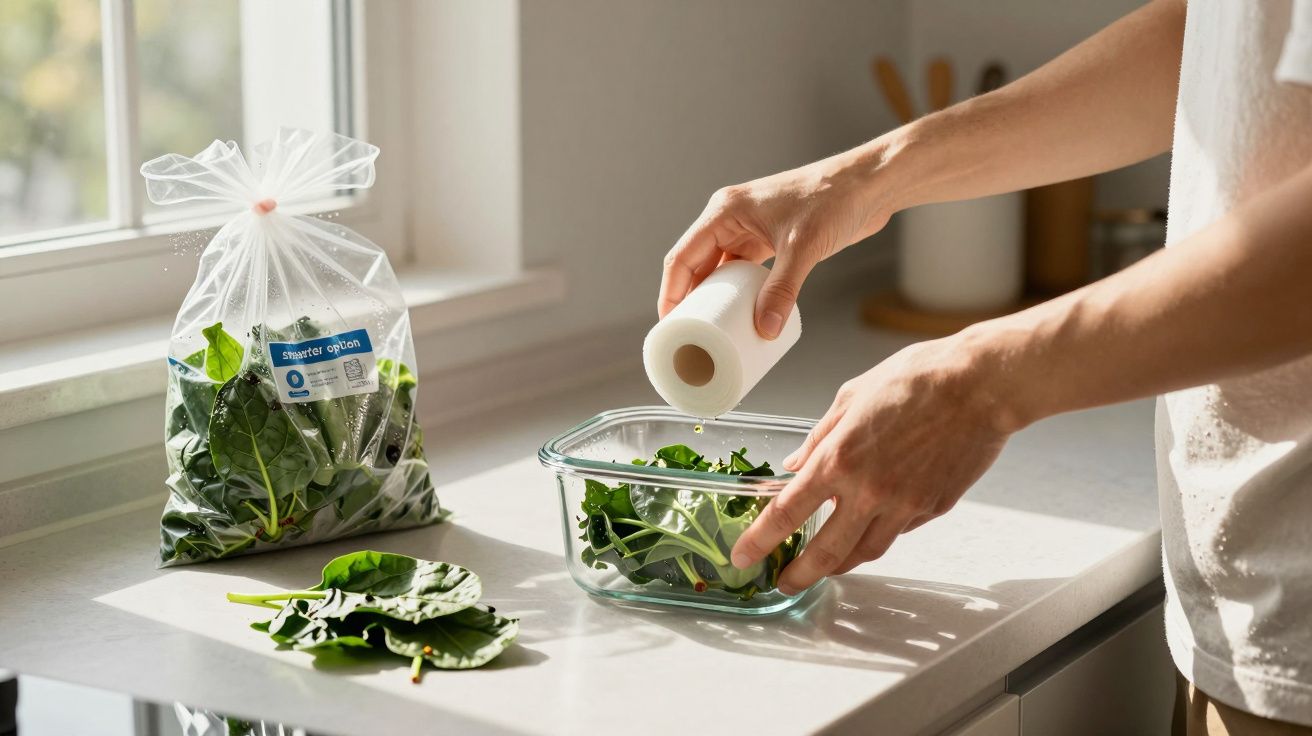
If you buy bagged spinach and want it to last beyond the first use, do a tiny reset when you get home:
- open the bag and check for damp clumps; remove any crushed leaves
- tuck a piece of kitchen roll inside to absorb condensation
- loosely re-seal (or move to a container with a bit of airflow)
Keep it cold, but not pressed against the back wall where it can partially freeze and then weep water as it thaws.
Most spinach “goes off” because it gets wet and bruised, not because it reaches some mystical sell-by moment.
Making spinach actually count in your week
Spinach works best when you stop treating it like a virtuous extra and start treating it like a planned ingredient.
A few low-effort ways to do that:
- Double it in cooked meals. Add once, let it wilt, then add again.
- Pair it with something that helps iron absorption. A squeeze of lemon, tomatoes, peppers, or a citrus dressing.
- Rotate your greens. Mix in kale, spring greens, rocket, cabbage - not because spinach is “bad”, but because variety covers gaps.
If you love spinach daily, keep it. Just vary the form: frozen for cooked meals, fresh for raw ones, and don’t assume one handful equals one serving.
The real “catch” most people miss
Spinach looks simple because it’s familiar. But familiarity makes us sloppy: we buy it aspirationally, we store it casually, and we use it symbolically - a handful to feel healthy - rather than intentionally.
Handle it like the fragile leaf it is, choose the right format for the right job, and spinach becomes what it’s meant to be: an easy, reliable upgrade. Ignore the catch, and it becomes the most well-intentioned food waste in your fridge.




Comments (0)
No comments yet. Be the first to comment!
Leave a Comment