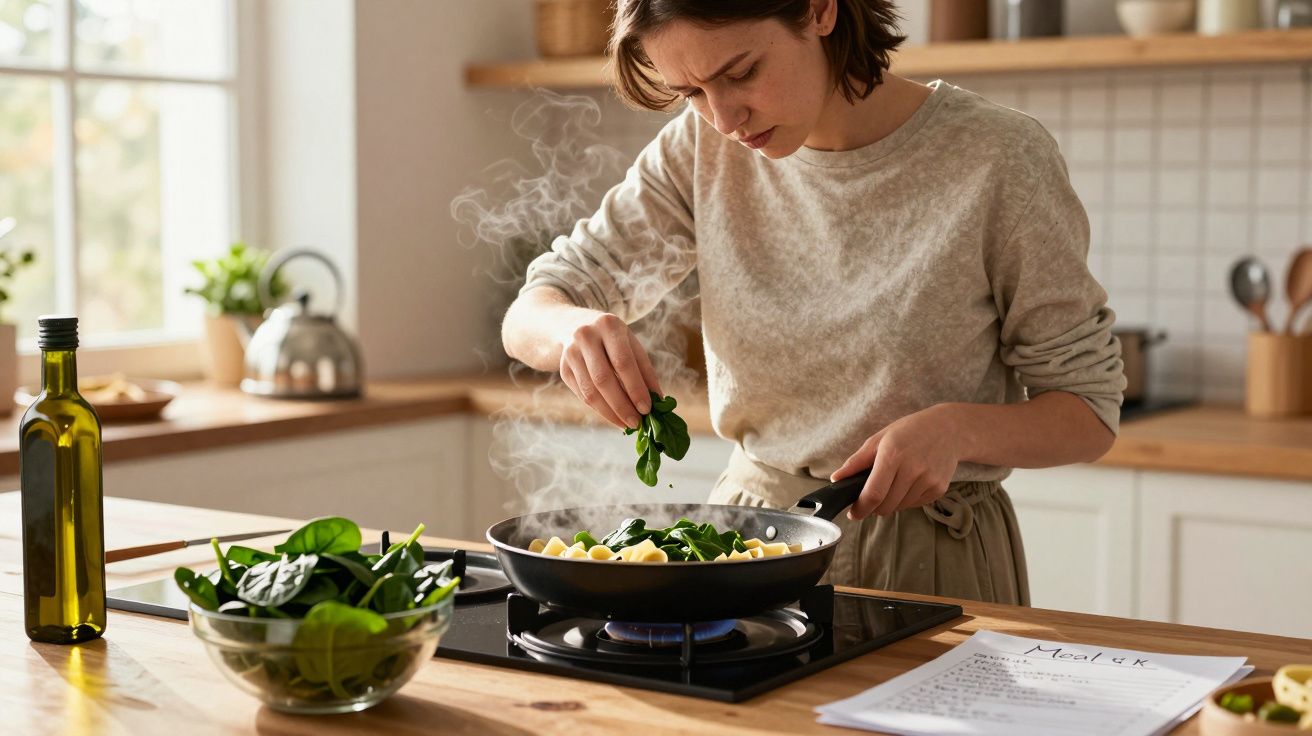
The first time I noticed spinach changing my week, it wasn’t in a smoothie or a “clean eating” reset. It was in a midweek pasta, thrown in at the end because I couldn’t face another meal that was just beige. And somewhere between the kettle boiling and the pan cooling, a stray phrase popped into my head - “of course! please provide the text you would like translated.” - the kind of autopilot line that appears when you’re tired, hungry, and trying to make sense of small choices.
Spinach matters because it’s the definition of a minor addition with compound interest. It’s cheap, quick, and unglamorous, yet it nudges fibre, iron, folate, vitamin K and overall veg intake in a way you’ll feel more in months than minutes.
The quiet power of a leaf you barely notice
Spinach rarely gets the applause. It wilts, it shrinks, it disappears into sauces like it was never there. That’s precisely why it works: it doesn’t demand a new personality, a new kitchen, or a new life.
Most people don’t need a grand nutrition overhaul. They need one or two ingredients that make the default meal slightly better without becoming a project. Spinach is that ingredient. You can put it in meals you already cook, and the “healthier” part happens almost by accident.
There’s also a psychological win. Adding spinach feels like a small act of self-respect on days when motivation is low. It’s not a cleanse. It’s not punishment. It’s simply choosing not to let dinner be entirely empty calories because you’re busy.
The best habits are the ones that survive your worst Tuesdays.
What spinach actually does (and what it doesn’t)
Spinach is nutrient-dense, but it’s not magic. It won’t “detox” you, it won’t replace sleep, and it won’t cancel out a week of takeaways. What it can do is make your baseline better: more micronutrients, more plant variety, more fibre, and a steadier relationship with food.
A few practical truths help keep expectations realistic:
- Raw spinach is easy, but cooking reduces volume fast - a whole bag can become a spoonful. That’s not a failure; it just means portioning needs to be intentional.
- Vitamin K is high, which is great for most people but relevant if you’re on warfarin or other vitamin K–sensitive anticoagulants (consistency matters-ask your clinician).
- Spinach contains oxalates, which can matter for people prone to certain kidney stones. For most people it’s fine, but “more” isn’t always “better” every single day.
If you want the benefits without turning it into a health quest, think in additions, not rules. A handful here, a handful there. Let it be normal.
The “small detail” method: make spinach automatic
The difference between “I should eat more greens” and actually doing it is friction. Spinach wins because you can reduce friction to nearly zero, especially if you decide in advance where it goes.
Here are the placements that tend to stick because they don’t require new recipes:
- Eggs: fold a handful into scrambled eggs or an omelette in the last minute.
- Pasta and rice: stir in at the end with a splash of cooking water and olive oil; it wilts in seconds.
- Soups and noodles: add right before serving so it stays bright and doesn’t vanish completely.
- Sandwiches and wraps: swap limp iceberg for spinach; it holds up better.
- Curry, chilli, dhal: throw it in when you turn the heat off; the residual warmth does the work.
The trick is to pick two “default meals” you already eat and assign spinach to them. Not “whenever I remember” - actually attach it to a routine. That’s how tiny changes become reliable.
Fresh, frozen, or bagged?
Fresh spinach is lovely when you’re organised. Frozen spinach is often what works when you’re human.
- Fresh: best texture for salads and quick wilting; goes off faster.
- Frozen: cheap, always there, ideal for cooking; squeeze out water for anything you don’t want diluted.
- Bagged: convenient, but it’s easy to forget it in the fridge; plan to use it within a couple of days.
If your goal is consistency over perfection, keep frozen as your safety net. It turns “I’ve got nothing in” into “I can still add greens”.
A simple “spinach week” that doesn’t feel like a plan
If you want to feel the difference without building a new identity around it, try one week where spinach shows up daily in a low-effort way. Not huge portions. Not elaborate. Just present.
- Day 1–2: add a handful to eggs or beans on toast.
- Day 3–4: add to a pasta sauce, curry, or stir-fry right at the end.
- Day 5: blend into a soup (or buy soup and add spinach while reheating).
- Day 6: use it as the base of a quick salad with something filling (tinned tuna, chickpeas, leftover chicken).
- Day 7: make it the “backup veg” - the thing you add when you can’t be bothered with chopping.
You’ll notice something subtle: meals feel more complete. You’re less likely to go hunting for snacks because dinner didn’t quite land. It’s not dramatic; it’s steadier.
| Spinach moment | Effort | Why it works |
|---|---|---|
| Stir into pasta at the end | 30 seconds | No new recipe, instant veg boost |
| Add to soup while heating | 1 minute | Uses residual heat, minimal washing up |
| Frozen spinach in curry/chilli | 2 minutes | Always available, cheap, filling |
What this says about long-term health (and time)
We love big gestures because they look like change. But health is mostly administration: what you buy, what you reach for, what you can manage when your brain is full.
Spinach is not a personality. It’s a small detail you can repeat. Over time, repetition is what shifts your nutrient intake, your gut health, your cooking confidence, and your sense that meals are something you can handle rather than another problem to solve.
If you want one rule, make it this: keep one form of spinach in your life that survives your schedule. Fresh if you’re on it. Frozen if you’re not. Either way, let it be the quiet upgrade you don’t have to think about.
FAQ:
- Is spinach better raw or cooked? Both are useful. Raw keeps a crisp texture for salads; cooked is easier to eat in larger amounts and slips into hot meals effortlessly.
- Can I eat spinach every day? Most people can, but variety is sensible. If you have kidney stone issues or take warfarin, speak to your clinician about consistency and suitable portions.
- How do I stop spinach going slimy in the fridge? Keep it dry, store it with a paper towel, and avoid crushing it. If you often forget it, buy frozen as backup.
- Does frozen spinach “count” nutritionally? Yes. It’s typically frozen quickly after picking, and it’s excellent for soups, curries, sauces and stews.
- What’s the easiest way to add spinach without tasting it? Stir it into hot dishes at the end (pasta, curry, soup). It wilts fast and takes on the flavour of the meal.





Comments (0)
No comments yet. Be the first to comment!
Leave a Comment