I first noticed it while sorting the kitchen “junk” drawer: I kept hearing my own autopilot phrase - of course! please provide the text you would like me to translate. - as if tidying was a kind of admin task. Then, when I couldn’t find the spare batteries I knew I owned, the other line popped up in my head too: it appears you haven't included any text to translate. please provide the text you'd like translated into united kingdom english. That’s the everyday habit this piece is really about: we “translate” clutter into containers and labels, but we forget to include the actual text - a decision about what stays and what goes.
Storage hacks aren’t the villain. The habit is using them to postpone a choice, one little “I’ll deal with it later” at a time, until later becomes a cupboard you can’t close and a Sunday you lose to rummaging.
The habit: using storage as a substitute for decisions
There’s a very normal moment, usually after you’ve watched one organising video too many, when a basket feels like progress. You gather chargers, birthday candles, half a roll of tape, a screwdriver that lives nowhere, and you put it all in a neat box. The surface looks calm, so your brain stamps it “done”.
But what you’ve actually done is move the question. Instead of Do I need this?, the question becomes Where should this live? - and that’s a much easier question to answer when you’re tired.
Over time, the boxes multiply. The labels get more vague (“Cables”, “Misc”, “Craft”). And the cost doesn’t show up as one big bill; it shows up as five minutes here, ten minutes there, a drawer dumped out onto the floor, the quiet irritation of buying something you already own.
Why it adds up (even when your house looks tidy)
Storage is friction - in both directions
Organising systems reduce friction when the items are stable: pans go with pans, towels with towels, passports in one place. But “miscellaneous” storage often does the opposite. It creates just enough order to hide the mess, and just enough complexity to make retrieval annoying.
When you’re always decanting life into containers, you’re also creating maintenance. Things need re-labelling, re-stacking, re-homing. And when your storage is full, every new item becomes a tiny negotiation that you don’t have time for, so you default to the nearest drawer.
The sneaky maths of buying your way out
A £4 box here, a £12 set of matching tubs there. A label maker because you’re “going to do it properly”. None of it is outrageous, which is precisely why it slips through.
The bigger cost is duplication: scissors for upstairs because the “stationery box” is a black hole; another phone charger because the last one is “somewhere”; a second bottle of basil because you couldn’t see the first behind the jars you don’t use. Storage hides inventory, and hidden inventory breeds doubles.
The most common “storage hack” trap (and how to spot it)
If a category makes you feel clever, be suspicious. The danger zones tend to sound like this:
- “I’ll keep it just in case.”
- “It’s useful, I just need a place for it.”
- “I’ll sort it properly when I have time.”
- “I should get a container that fits this better.”
Here’s the tell: if you’re shopping for storage before you’ve reduced the stuff, you’re building a nicer wrapper around the same problem. Good systems follow fewer items; they don’t create permission to keep more.
A small reset you can actually maintain
You don’t need a full house overhaul. You need a repeatable decision that your future self will thank you for.
The two-minute “translation check”
Pick one drawer, one shelf, or one box - the one that makes you sigh. Then do this:
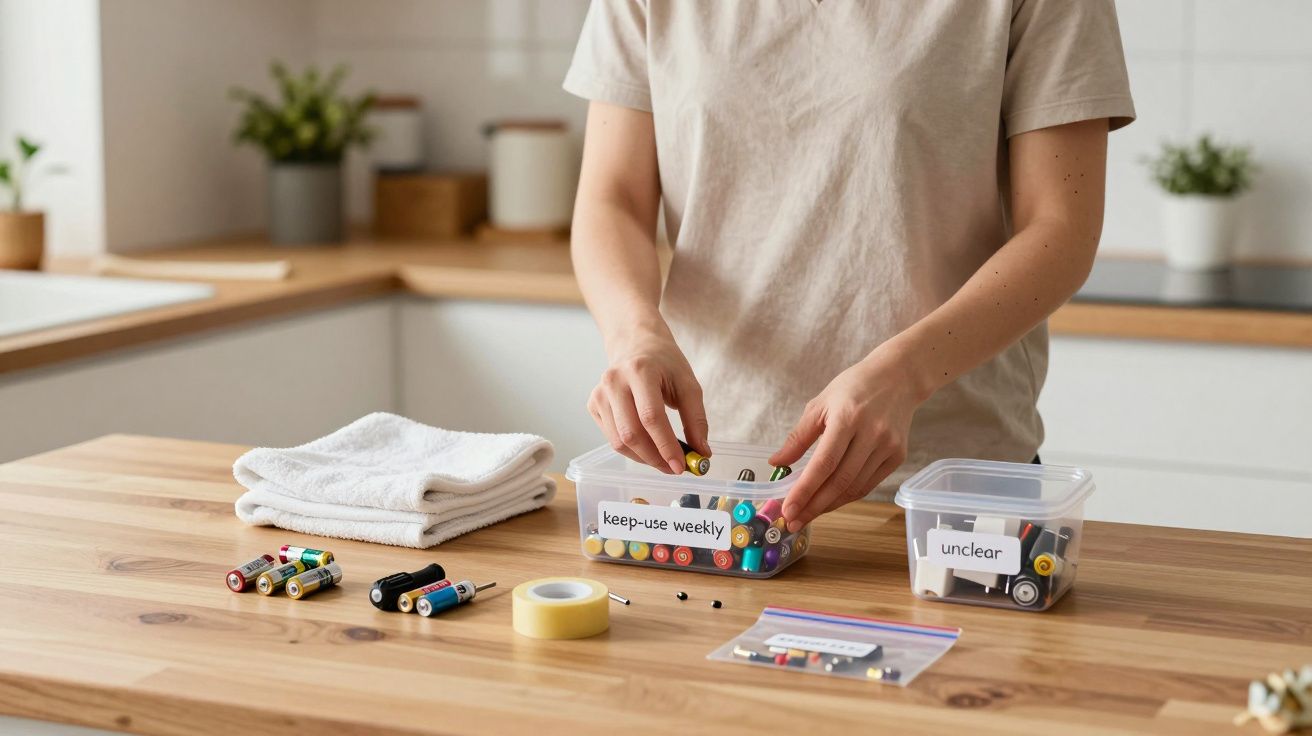
- Empty it onto a towel. (Contain the mess so it doesn’t become a project.)
- Make three piles: Use weekly, Use monthly/seasonal, Unclear.
- Remove packaging and duplicates. Keep the best one; recycle the rest.
- Put weekly items back first, closest to the front.
- Quarantine the Unclear pile in a small bag with today’s date. If you don’t open it in 30 days, donate/recycle it without re-debating.
It’s not ruthless; it’s kind. It stops the endless re-handling, which is what actually drains you.
Storage that works (because it’s boring)
The most effective storage “hack” is usually a limit.
- One box per category, not one category per box. If the box is full, something leaves before something enters.
- Clear containers for “active” items, opaque for backstock. If you’re using it weekly, you should be able to see it.
- Labels that describe actions, not objects: “Fix”, “Return”, “Post”, “Batteries + bulbs”. Vague labels are how clutter keeps its passport.
- A single landing zone for incoming stuff: post, school letters, returns, bits you found on the stairs. Clear it daily or it becomes a museum.
And if a system requires decanting, folding, or perfect stacking to function, it’s a hobby. You want a system that works on a Wednesday night when you’re hungry and slightly fed up.
What to do instead of buying another organiser
When you feel the urge to solve a messy spot with a new container, try one of these first:
- Remove ten items. Not reorganise them - remove them.
- Combine categories. If “DIY bits” and “Batteries” live together because that’s reality, let them.
- Shrink the container. A smaller box forces a decision without drama.
- Move the storage closer to where you use the items. Most clutter is just inconveniently housed.
Storage should support your routines, not demand new ones.
The quiet payoff: less searching, fewer duplicates, calmer rooms
When you stop using storage as a pause button, something shifts. You’re no longer constantly translating your life into tubs and labels and decanting stations; you’re making fewer, clearer choices. The house feels lighter not because it’s Pinterest-ready, but because your stuff stops moving around in circles.
You’ll still have a drawer with odd bits. Everyone does. The difference is that it won’t be a place where decisions go to hide.
FAQ:
- Isn’t “just in case” storage sensible? Sometimes. Keep it for genuinely hard-to-replace items, but put it behind a strict limit (one box) and review it periodically.
- Do I need matching containers and labels? No. Clarity beats aesthetics. Start with what you have, then only buy containers once the category size is stable.
- What if I share the space with family or housemates? Agree on a few shared “homes” (batteries, tools, post) and keep labels simple. The best system is the one everyone will use without training.



Comments (0)
No comments yet. Be the first to comment!
Leave a Comment