
In most British homes, central heating systems are the invisible background to everything: getting a child dressed before school, drying laundry, sitting still long enough to read a book. Yet when you ask the question that actually matters - what should my system design be, for this house and this life? - the answers go foggy fast. People talk about boilers like brands of washing powder, and you’re left guessing why some rooms never quite catch up.
It usually starts the same way. A cold corner. A radiator that hisses like it’s annoyed. A bill that rises even though your habits haven’t changed. You turn the thermostat up by one degree, then down again, as if it’s a negotiation.
Somewhere in the middle is the question nobody answers clearly: am I trying to make my home warm, or am I trying to make my heating system behave? Those are not the same job.
The real question: what are you optimising for?
Most advice assumes you want “heat, cheaply”. Fair enough. But in real houses, you’re also optimising for quiet, for predictability, for not having to think about it at 7am when the kitchen tiles feel hostile.
So ask it properly. Not “Should I get a new boiler?” but:
- Do I need the house to warm up quickly, or just stay steady?
- Do I use all rooms equally, or do I live in three rooms and pay for seven?
- Do I want simple controls, or detailed control that I’ll actually use?
Because the system that feels brilliant in a two-bed flat can feel infuriating in a draughty Victorian terrace. The building is part of the system, whether anyone says it out loud or not.
Why “turn it up” fails (and what’s really going on)
When a room won’t heat properly, people blame the radiator first, then the boiler, then the weather, then themselves. Often it’s none of those. It’s that the system isn’t moving heat where you think it is.
A few common culprits hide in plain sight:
Flow, not just temperature
Hot water has to circulate. If the flow rate is wrong, or parts of the system are throttled by old valves, or there’s sludge, you can have a boiler working hard while one end of the house stays stubbornly cool. The thermostat reads “20°C” in the hallway and the back bedroom feels like a fridge.
Balance (the boring word that changes everything)
Radiators closest to the boiler often steal the show. They heat fast, they feel “fine”, and the far rooms starve quietly. Balancing is simply the unglamorous act of making each radiator take its fair share, so the system behaves like a whole rather than a series of arguments.
Control strategy: on/off versus steady
Some homes are run like a light switch: blast heat, coast, blast again. Others do better with a steadier approach, especially if the building leaks heat quickly or you’re in and out all day. Neither is morally superior. One is just less stressful in your specific house.
The three types of comfort (and the system design that matches)
People describe “warm” as if it’s one feeling. It isn’t. Most of us are chasing one of these:
Fast warm-up comfort
You want the chill gone quickly, especially mornings and after work. This leans on responsiveness: decent emitter output (radiators sized properly), good circulation, and controls that anticipate your routine rather than lag behind it.Steady background comfort
You want the house to stay okay, not swing between too cold and too hot. This is where zoning, weather compensation (where fitted), and avoiding constant stop-start can matter more than cranking flow temperatures.Room-by-room comfort
You live differently in different spaces. You want the spare room cool, the bathroom warm, the office stable. This pushes you towards better zoning and smarter control - but only if it’s set up cleanly and you’ll maintain it.
The trap is buying a “smart” solution for a house that really needs basic hydraulic sanity first. Tech can’t fix a system that can’t share heat properly.
A simple 30-minute audit you can do before you call anyone
You don’t need to become a heating engineer. You just need to stop being blind.
Pick a cold day. Put the heating on as you normally would. Then:
- Walk the radiators in order: which heat first, which lag? If the same ones always win, that’s a balancing clue.
- Check radiator temperature pattern: hot at the top and cooler at the bottom can indicate sludge; cold at the top can mean air.
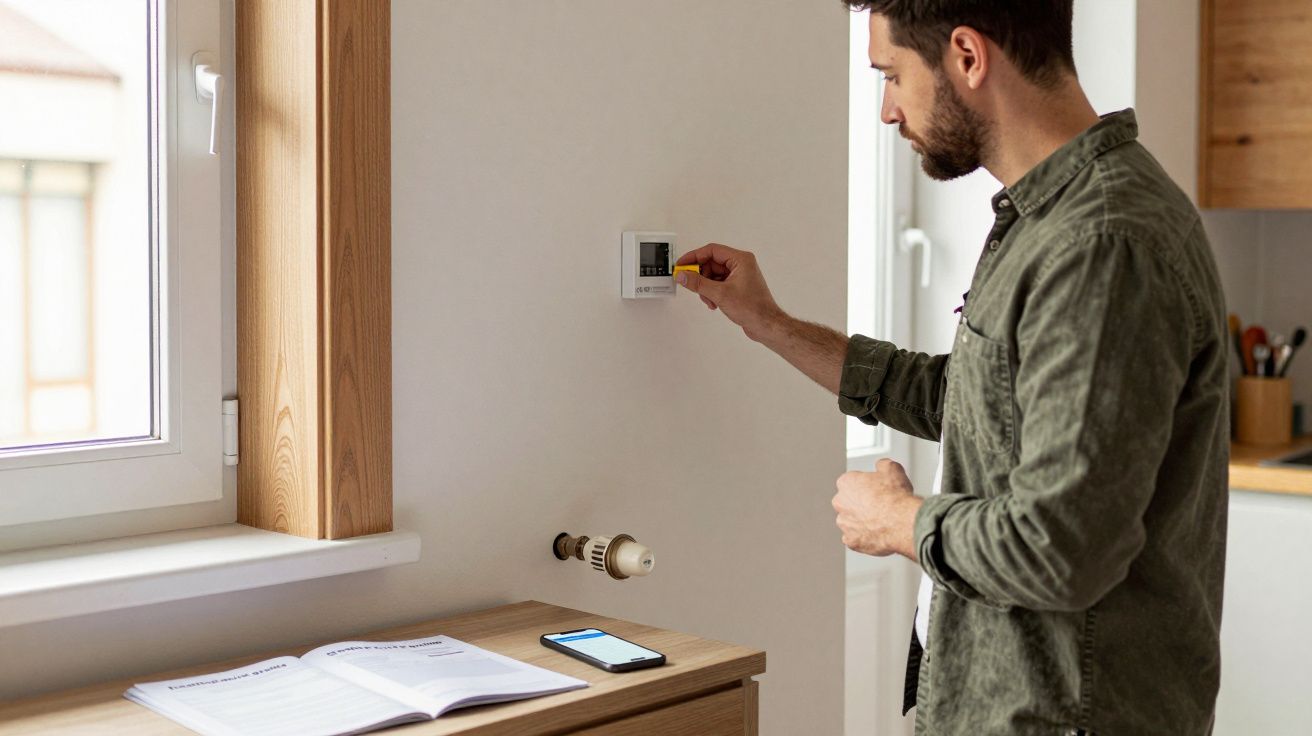
- Notice where the thermostat is: if it’s in a naturally warm spot (hallway near the kitchen, sunny wall, near a radiator), it may be lying on the system’s behalf.
- Listen for noise: rushing water, clicking, banging. Quiet systems tend to be well-set systems.
Write it down like you’re describing a friend’s house, not your own. It helps you stay honest.
Then when you speak to an installer, you’re not pleading for warmth. You’re presenting symptoms.
What good installers ask (and what you should ask back)
A decent conversation sounds less like “What boiler do you want?” and more like “How do you live in the space?”
Questions worth hearing:
- Which rooms are hardest to heat, and when?
- Have you had balancing or a powerflush, and when?
- What’s your typical schedule - steady background, or peaks?
Questions worth asking back, calmly:
- How will you size radiators for heat loss, not just “like for like”?
- Will you check and balance the system after installation?
- What flow temperature are you designing around, and why?
- What controls strategy are you setting up for this household?
If the answers are vague, you’re about to buy shiny kit on top of the same old problem.
The quiet truth: most “heating problems” are system problems
We love a single culprit. A broken boiler is a satisfying story. But many homes aren’t suffering from a single failure; they’re suffering from a system that was added to, patched, extended, and never truly designed for the current shape of the house.
That’s why the question matters. Not “What’s the best boiler?” but “What’s the best behaviour for my home?”
When the design is right, you stop thinking about heating. The hallway isn’t a sauna. The back bedroom doesn’t punish you. The thermostat stops feeling like a roulette wheel. You get your mornings back.
The short cheat-sheet I’d tape inside the airing cupboard
- Warmth is distribution: check balance and flow before chasing gadgets.
- Comfort has types: decide if you want fast, steady, or zoned.
- Controls should match the way you live, not the way a manual assumes you live.
- A good quote explains design choices, not just products and price.
FAQ:
- Do I need a new boiler if some rooms are cold? Not necessarily. Cold rooms are often caused by poor balancing, circulation issues, undersized radiators, or control placement rather than boiler failure.
- Is “smart heating” worth it? It can be, but it won’t fix fundamentals. If your system is unbalanced or emitters are poorly sized, smart controls may just automate the same uneven results.
- Should I run heating low and constant or in bursts? It depends on your home’s heat loss and your routine. Leaky homes and households at home more often can prefer steadier background heat; others want fast warm-up at set times.
- What’s the one thing I should insist on with an installer? A design-led approach: heat-loss thinking (not just swapping like-for-like), a plan for controls, and commissioning that includes balancing.




Comments (0)
No comments yet. Be the first to comment!
Leave a Comment