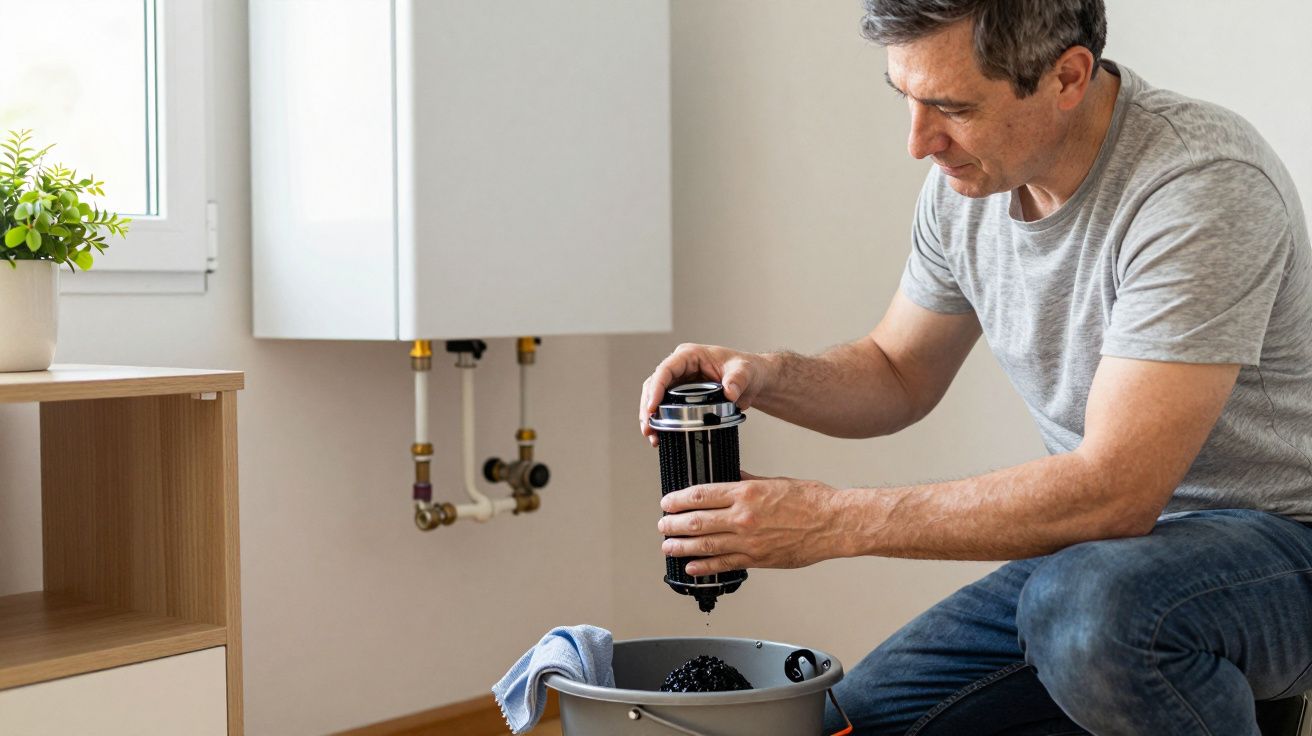
You don’t notice failure building up; you notice the day the pump screams, the boiler locks out, or a valve starts sticking for “no reason”. In most sealed heating and cooling circuits, a magnetic system filter sits quietly in the return line, catching the black sludge and metallic debris that would otherwise keep circulating. That is system protection in its least dramatic form: not a shiny upgrade, but the difference between a system that stays stable and one that slowly grinds itself rough.
If you’ve ever bled a radiator and seen the water run like ink, you’ve met the enemy. It isn’t just mess. It’s wear, drag, and tiny particles doing long-term damage one pass at a time.
The debris you can’t see is the one that bills you later
Hydronic systems are meant to be closed loops, but they’re not perfectly clean loops. Oxygen gets in through top-ups, micro-leaks, and sometimes through non-barrier pipework. Add heat, mixed metals, and time, and you create corrosion products-most notably magnetite, a fine black iron oxide that behaves like silt.
The trick is that it doesn’t need to form a blockage to cause trouble. It can coat heat exchangers, lodge in narrow waterways, and sand away at pump bearings. A system can still “work” while losing efficiency and adding stress, which is why the decline feels like bad luck rather than a predictable chain of events.
Why a magnetic system filter punches above its weight
A magnetic system filter is basically a controlled ambush. Instead of letting debris roam the circuit until it finds somewhere expensive to settle, you give it a place to stop: a chamber that slows flow, plus a strong magnet that grabs ferrous particles.
That last part matters because magnetite is small enough to stay suspended and persistent enough to keep recirculating. The magnet doesn’t care if the particles are too fine for a basic strainer; it simply holds them. You get less abrasion, less build-up in hot spots, and fewer of those “it was fine yesterday” failures that are really years in the making.
Think of it like the torque wrench’s click: not glamorous, but repeatable prevention. The payoff is usually silence-no cavitating pump, no kettling noises, no constant topping up and re-bleeding.
The slow-motion failures it prevents (and how they look in real life)
Most reliability problems in wet systems are not cinematic. They’re boring symptoms that people live with until the day they can’t.
Common patterns include:
- Cold spots on radiators that return after bleeding, because sludge is settling and re-suspending.
- Noisy circulation pumps as debris and micro-bubbles increase turbulence and wear.
- Sticky or chattering zone valves where fine particles work their way into moving parts.
- Boiler or heat pump errors triggered by restricted flow through a heat exchanger designed with tight passages.
- Rising running costs because a thin film of sludge on heat-transfer surfaces acts like insulation.
None of these scream “fit a filter” in the moment. They just whisper “this system is aging faster than it should”.
Filters aren’t magic. Placement and maintenance decide whether they actually protect anything.
There’s a myth that once a filter is installed, the job is done forever. In reality, a filter is only as useful as its ability to keep capturing without becoming its own restriction.
In most domestic installs, the sweet spot is typically on the return to the heat source, where cooler water reduces the risk of disturbing deposits and where captured debris is intercepted before it hits the boiler’s or heat pump’s most sensitive internals. You also want access: if it’s tucked behind cabinetry like a guilty secret, it won’t be cleaned often enough.
A basic routine tends to look like this:
- Clean the filter after the first few weeks of operation post-install or post-flush (systems shed a lot early on).
- Check it at annual service as a minimum, more often if the system is older or was visibly dirty.
- Keep inhibitor levels correct, because a filter catches particles but doesn’t stop corrosion chemistry by itself.
That’s when system protection becomes a habit rather than a box-tick.
The hidden benefit: reliability isn’t just fewer breakdowns, it’s stable performance
The underrated win of cleaner water is not only avoiding catastrophic faults. It’s keeping the system predictable.
When sludge is controlled, flow rates stay closer to design. Thermostatic radiator valves behave better. Balancing stays balanced. Condensing boilers condense properly because heat exchange stays efficient. Heat pumps, which can be fussier about flow and delta-T, are less likely to trip on protections or drift into inefficient operation.
You end up with a system that feels “unchanged” year to year. That’s the real luxury: not noticing it.
A quick “is this worth it?” checklist
If you’re deciding whether a magnetic system filter is genuinely relevant, these questions tend to cut through the noise:
- Is the system older than a few years, or does it have a history of topping up and bleeding?
- Are there mixed metals in the circuit (steel radiators, copper pipe, aluminium heat exchangers)?
- Do you hear pump noise, kettling, or frequent valve issues?
- Has the system ever been flushed properly, or has it just been “kept going”?
- Are you installing a new boiler or heat pump and want it to stay reliable for the long haul?
If you answered yes to more than one, filtration stops being an optional extra and starts looking like basic care.
| What the filter tackles | What you notice at home | Why it matters long-term |
|---|---|---|
| Magnetite and ferrous debris | Less noise, fewer cold spots | Protects pumps, valves, heat exchangers |
| Circulating sludge build-up | More stable heat output | Maintains efficiency and flow rates |
| Post-install shedding | Fewer early teething issues | Prevents damage during “dirty” bedding-in |
FAQ:
- Do magnetic system filters work with heat pumps as well as boilers? Yes. They’re often valuable on heat pumps because stable flow and clean heat exchangers are critical to efficient, fault-free operation.
- If I have a filter, do I still need inhibitor? Yes. The filter captures particles that exist; inhibitor helps reduce new corrosion forming in the first place.
- How often should a magnetic system filter be cleaned? Commonly after the first few weeks post-install, then at least annually. Older or dirtier systems may need more frequent checks initially.
- Will a filter fix a badly sludged system on its own? It helps, but it isn’t a reset button. Heavy sludge usually calls for a proper cleanse/flush and re-dosing, with the filter then keeping the system clean afterwards.
- What’s the most common mistake with these filters? Installing one and never servicing it. A neglected filter can become a restriction, which undermines the very system protection it was meant to provide.






Comments (0)
No comments yet. Be the first to comment!
Leave a Comment