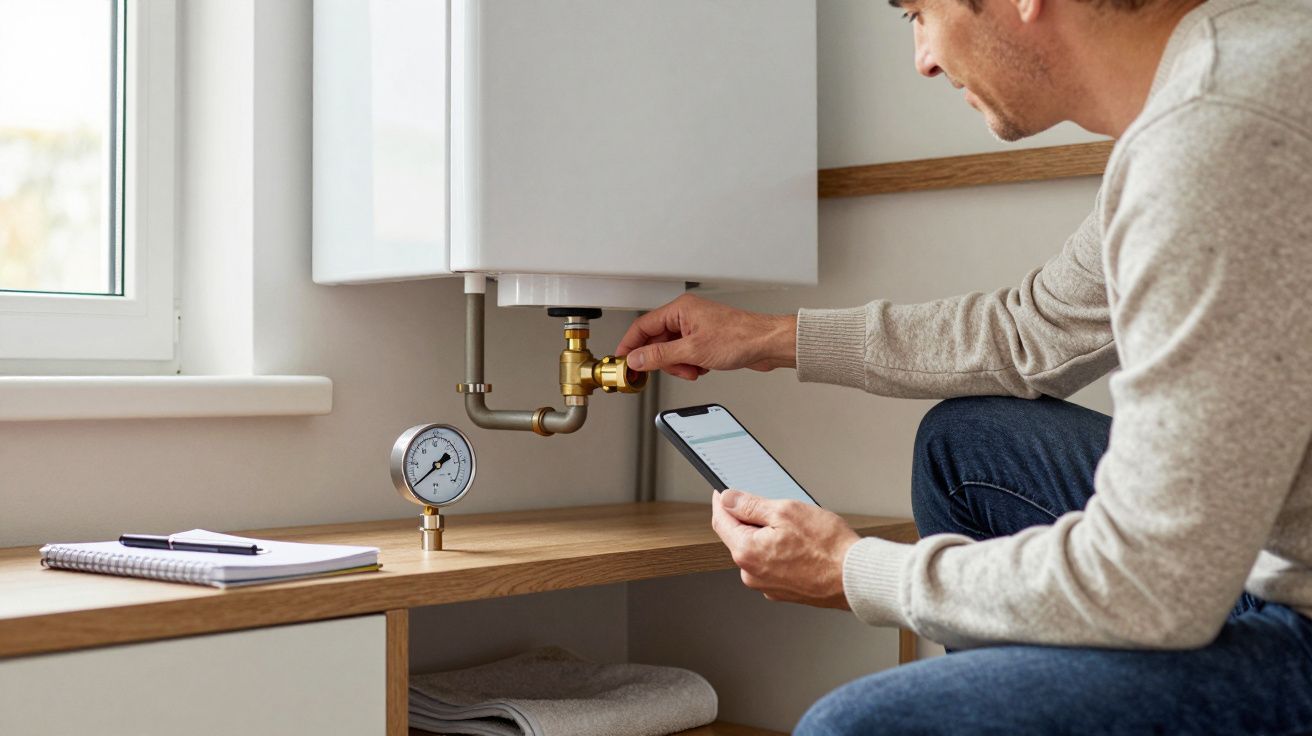
You notice it on a cold morning, usually when you least need drama: the radiators feel lukewarm, the boiler looks “fine”, and then you spot the gauge sitting low. A boiler pressure drop can be completely ordinary, but it’s also one of the easiest ways to stumble into misdiagnosis - topping up again and again without asking why the system keeps losing water. The difference matters because the right fix is often small, while the wrong one can mask a leak, stress components, and turn a minor niggle into a call-out.
Most people learn one ritual: find the filling loop, open the valves, watch the needle climb, close everything, and hope it behaves. It usually does… until it doesn’t. And that’s where the pressure myth starts: the belief that pressure is the problem, rather than the clue.
The myth: “Low pressure means the boiler is faulty”
Boiler pressure isn’t like a phone battery. It doesn’t “run down” because the appliance is old, and it doesn’t get used up by heating your home. In a sealed central-heating system, the water should stay put, circulating around radiators and pipework while the boiler heats it.
So when pressure drops, something has changed in the sealed loop: water has escaped, air has been introduced, or a safety route has been triggered. The boiler may be reacting correctly, not failing.
The common misstep is treating the top-up as a cure rather than a temporary reset. It’s a bit like mopping a floor without looking up at the dripping ceiling.
What pressure actually tells you (and what it doesn’t)
Think of the gauge as a calm little reporter. It doesn’t explain the story, but it tells you when to start asking questions. Most homes run happily around 1.0–1.5 bar when cold (your manual may specify slightly different figures), rising as the system heats.
A quick top-up after bleeding radiators is normal. A repeat top-up every few days isn’t. And a pressure drop that happens only when the heating is on often points to a different cause than one that happens overnight.
Here’s the simple truth: pressure doesn’t “go”; water does. The pressure just follows it.
The usual suspects behind a boiler pressure drop
You don’t need to be an engineer to narrow this down. You just need to notice patterns and do one or two safe checks.
1) You bled radiators (and forgot the system needs replacing water)
Bleeding releases trapped air, which is good. But it also lets out a small amount of water, so the pressure can dip afterwards. If the pressure drop happens once, right after bleeding, and then stabilises, that’s often the end of it.
Top up to the recommended cold pressure, close the filling loop properly, and keep an eye on it for a week. Stable is the goal, not “as high as possible”.
2) A tiny leak somewhere in the system
Small leaks are famously rude because they’re not always dramatic. They can evaporate on a warm pipe, soak into floorboards, or show up as a faint greeny crust around a radiator valve.
A quick, non-invasive scan: - Look under radiators for damp patches or rusty staining. - Check radiator valves and the joints at either end. - Peek at visible pipework near the boiler for drips or limescale-like residue. - Notice if you’re topping up more often in colder months (leaks can worsen with expansion/contraction).
If you keep topping up without finding the leak, you’re essentially feeding it.
3) The pressure relief valve has been discharging
If the system pressure gets too high, the boiler protects itself by dumping water outside through a copper pipe (often near an external wall). People don’t always notice because it may only discharge when the heating is running.
A clue is a wet patch outside under that pipe, or a pipe that drips only during heat-up. If that’s happening, the pressure drop is the aftermath - and the real question becomes: why did it over-pressurise?
4) Expansion vessel issues (the quiet cause people miss)
When water heats, it expands. The expansion vessel provides a cushion (air on one side, system water on the other) so the pressure doesn’t spike. If the vessel has lost its charge or failed, pressure can swing high when hot and then fall low when cold - which looks like “mysterious” pressure behaviour.
This is where misdiagnosis thrives. People keep topping up, which can make the hot pressure even higher, which can trigger the relief valve, which loses more water, which drops pressure again. A loop of bother.
5) The filling loop isn’t fully shut
It sounds too simple, but it happens. If the filling loop valves aren’t fully closed, the system can creep up in pressure and then discharge via the safety valve, leaving you with a drop later and no obvious “leak” indoors.
If you top up, make it a proper finish: - Close both valves firmly (don’t overtighten). - Remove the flexible hose if your setup is designed for that. - Check the pressure later the same day and the next morning.
How to avoid misdiagnosis: a calmer way to “read” the system
If you want one practical habit that saves time, it’s this: stop treating the gauge as a panic button and start treating it like a diary.
Try a simple two-day check: 1. Note the pressure when the system is cold (first thing in the morning). 2. Note the pressure when the heating has been on for 30–60 minutes. 3. Note whether it drops overnight with the heating off.
Patterns can point you in the right direction: - Drops only after bleeding: likely normal, top up once. - Drops steadily whether heating is on or off: likely a leak. - Rises high when hot, then ends up low later: possible expansion vessel/relief valve involvement.
Don’t chase a “perfect number” every hour. Watch for stability.
What you can do safely, and when to call someone
You can usually top up pressure safely if you follow your boiler manual and you’re confident identifying the correct valves. If you’re unsure, pause - guessing around gas appliances and pipework isn’t a hobby.
Call a Gas Safe registered engineer if: - You’re topping up more than once a month. - The external discharge pipe is dripping or leaving a wet patch. - Pressure shoots up high when heating runs (then crashes later). - You can’t find any sign of leaks but the drop continues.
A good visit isn’t just “repressurise and leave”. It’s identifying why the pressure is moving in the first place.
The quiet point of all this
A boiler pressure drop isn’t automatically a catastrophe, but it is a message. The myth is thinking the number is the fault, when it’s usually the symptom - and that’s how misdiagnosis turns a simple top-up into months of repeat problems.
Top up when it’s appropriate, yes. But if it keeps happening, let the system tell you its story instead of silencing it with the filling loop.
| What you notice | Likely meaning | Best next step |
|---|---|---|
| Pressure dipped after bleeding | Normal water loss from bleeding | Top up once, monitor for a week |
| Pressure rises high when heating is on | Expansion/relief valve scenario | Check for discharge pipe dripping; get it checked |
| Pressure drops repeatedly with no recent bleeding | Water escaping somewhere | Look for leaks; book an engineer if it persists |
FAQ:
- Is it safe to top up boiler pressure myself? Often yes, if your manual shows the correct procedure and you’re confident using the filling loop. If you’re unsure what you’re looking at, stop and get advice.
- Why does the pressure drop again after I’ve topped it up? Usually because water is leaving the sealed system (a leak or discharge), or because pressure is spiking when hot and then dumping water via the safety route.
- What pressure should my boiler be on? Many systems sit around 1.0–1.5 bar when cold, but always follow your boiler’s manual as designs vary.
- Can bleeding radiators cause low pressure? Yes. Bleeding releases air and a little water, so a one-off top-up afterwards is common.
- What’s the biggest mistake people make with low pressure? Repeatedly topping up without investigating the cause, which can hide leaks or worsen overpressure-related discharge.




Comments (0)
No comments yet. Be the first to comment!
Leave a Comment