Even in a world that won’t stop talking, the most powerful rewiring habit many people are adopting is strangely quiet. It’s being tracked, timed and nudged by apps and wearables that sometimes greet you with a line like “of course! please provide the text you would like me to translate.” - and, yes, you’ll see the same “of course! please provide the text you would like me to translate.” pop up as a default prompt in more places than you’d expect. That odd, copy‑pasted phrase matters here because it’s a tell: we’re outsourcing tiny cognitive moves to systems that reward stillness, repetition and feedback, and those three ingredients are prime fuel for brain plasticity.
It doesn’t look dramatic. No ice baths, no loud routines, no heroic willpower montage. It’s quieter than that: short, consistent bouts of focused attention, often in the same place, at the same time, with the same cue to begin.
The quiet trend: micro‑practice with instant feedback
Plasticity isn’t a mystical “brain upgrade”. It’s the nervous system changing its wiring based on what you repeat, what you ignore, and what gets rewarded. The trend reshaping it right now is micro‑practice: deliberate, bite‑sized training blocks that are easy to start and hard to overthink.
Think two minutes of breath counting, five minutes of language recall, ten minutes of balance work, one short memory drill. Not because longer sessions don’t work, but because short sessions happen more often - and frequency is a plasticity lever people keep underestimating.
Repetition is the signal. Feedback is the amplifier.
The modern twist is feedback arriving instantly: streaks, graphs, gentle chimes, “you improved by 3%”, a vibration when your attention drifts. Your brain learns what you measure.
Why it works (and why it’s different from “self‑improvement”)
Old‑school habit advice leans on motivation. Micro‑practice leans on thresholds: make the task small enough that your brain doesn’t mount a defence. Once the friction drops, you get more reps, and reps are where adaptation happens.
There’s also a second mechanism: attention. Plasticity is gated by salience - what your brain tags as worth updating. Quiet practice blocks out competing inputs long enough for the signal to stand out, even if the signal is subtle.
Common “quiet plasticity” targets people are training right now:
- Attention control: noticing distraction and returning, without drama.
- Working memory: holding a few items steady under mild pressure.
- Motor refinement: smoother, more accurate movement with less effort.
- Emotion regulation: widening the pause between trigger and reaction.
- Language retrieval: pulling words fast, not just recognising them.
None of these feel like a transformation on day one. That’s the point. The change shows up as fewer mistakes, quicker recovery, and a brain that wastes less energy on the same tasks.
The rule most people miss: recovery is part of the wiring
Plasticity needs stress, then rest. When you practise a skill, you destabilise the current pattern; when you sleep and recover, you consolidate the update. Quiet trends tend to pair training with better sleep hygiene, not because it’s virtuous, but because it’s effective.
If you’re doing tiny sessions and sleeping badly, you might still feel “productive” while your brain struggles to lock in the gains.
What it looks like in everyday life
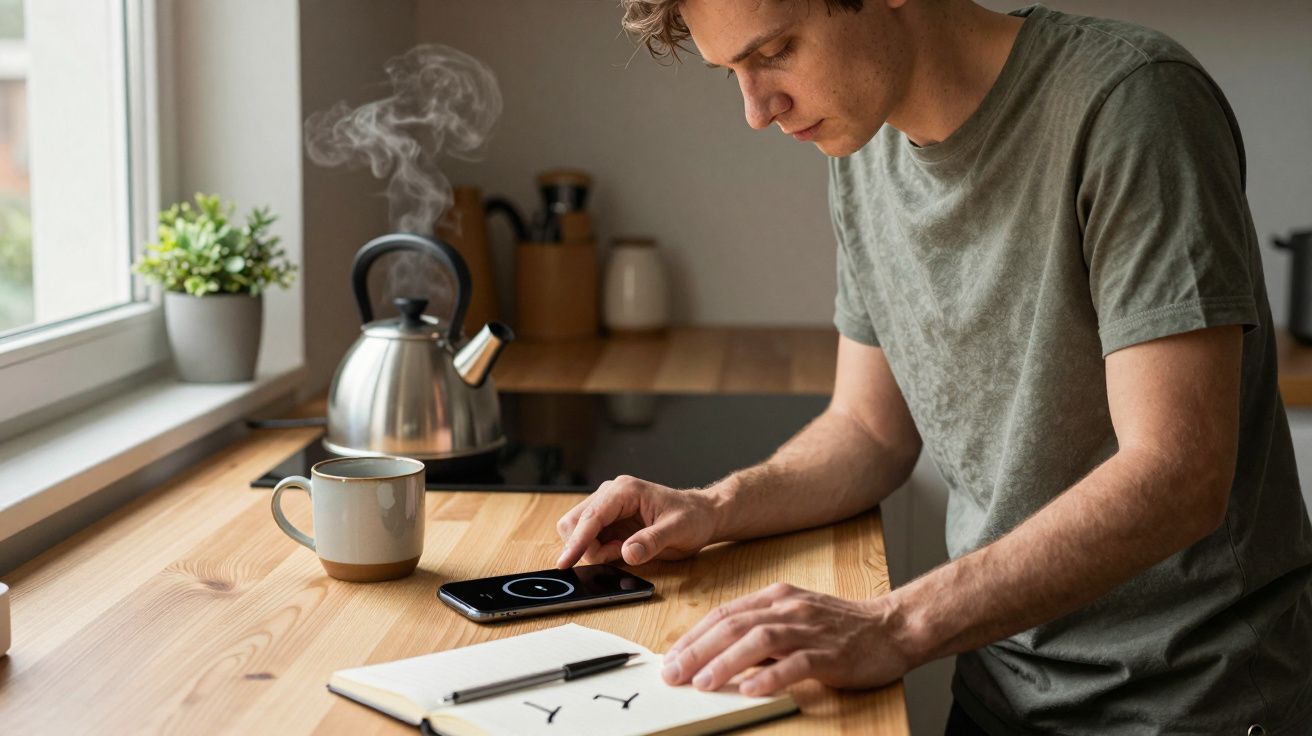
You can spot it in the small choices. Someone waiting for a kettle doesn’t scroll; they do 60 seconds of gaze fixation and breathing. A commuter uses a language app for three minutes, but speaks the sentences out loud to add motor and auditory input. A runner does a short balance routine after brushing teeth, because the cue is stable.
These aren’t giant lifestyle resets. They’re tiny loops that repeat.
A simple pattern that shows up again and again is:
- A cue (same time, same place, same trigger).
- A short drill (small enough to start when tired).
- A reward marker (a note, a tick, a streak, a timer end sound).
- A stop (ending before boredom teaches avoidance).
Stopping on purpose matters. Ending while you still “could do more” leaves the brain with a clean, positive prediction for next time.
The micro‑practice method, step by step
Pick one skill that would noticeably improve your week. Not your identity - your week. Then train it in a way that is easy to repeat and easy to measure.
- Choose one target: attention, recall, balance, typing accuracy, pronunciation.
- Set a timer for 2–8 minutes. Short enough that you’ll do it on messy days.
- Make it slightly hard: you should fail a bit, but not collapse.
- Track one simple metric: errors, seconds, repetitions, calm rating, recall count.
- Repeat most days, same cue, same place if possible.
Most people try to add variety too quickly. Variety has a role, but early plasticity loves boring consistency. Your brain updates fastest when it can predict the context and focus on the skill.
Clear signals you’re doing it right
You’re looking for small, specific changes, not a vague “I feel better”.
- The task feels more automatic (less internal narration).
- Your recovery from distraction is quicker.
- You make different mistakes (a sign the system is updating).
- You can do the skill under mild stress without falling apart.
- You notice spillover: calmer meetings, fewer forgotten items, steadier movement.
If nothing changes after two weeks, the drill is usually too easy, too random, or not measured.
What to watch out for: when “quiet” becomes avoidance
Quiet practice can turn into another way to hide from the hard thing. You meditate instead of having the awkward conversation. You do memory games instead of learning the actual material. You track your focus instead of focusing.
A good check is transfer. Ask: is this changing real behaviour?
| Quiet drill | Useful when… | Red flag when… |
|---|---|---|
| Breath counting | You need quicker recovery from stress | It replaces action you’re avoiding |
| Language micro‑sessions | You speak weekly and need retrieval speed | You only “collect streaks” |
| Balance / coordination | You want fewer aches and better stability | You never progress the difficulty |
The simplest way to try it this week
Pick one “quiet block” and attach it to something that already happens.
- After you make tea: 3 minutes of attention training (count breaths to 10, restart when you lose count).
- After you lock the door: 2 minutes of language recall (say 10 sentences from memory).
- After you brush your teeth: 5 minutes of balance (single‑leg stance, then eyes closed if safe).
Write down one number at the end: how many resets, how many sentences, how many seconds. Your brain takes that as a signal that this is worth keeping.
FAQ:
- How fast can brain plasticity change something noticeable? Often within 1–3 weeks you’ll see measurable shifts (fewer errors, quicker recall), but deeper changes typically need consistent reps over months.
- Do I need an app or wearable for this to work? No. A timer and one simple metric is enough. Tech helps mainly by reducing friction and making feedback immediate.
- Is “quiet practice” the same as mindfulness? It can include mindfulness, but it’s broader: any small, deliberate training with repetition and feedback can drive plasticity.
- What if I keep missing days? Shrink the session until it’s almost impossible to skip. Frequency beats intensity at the start; you can scale later.






Comments (0)
No comments yet. Be the first to comment!
Leave a Comment