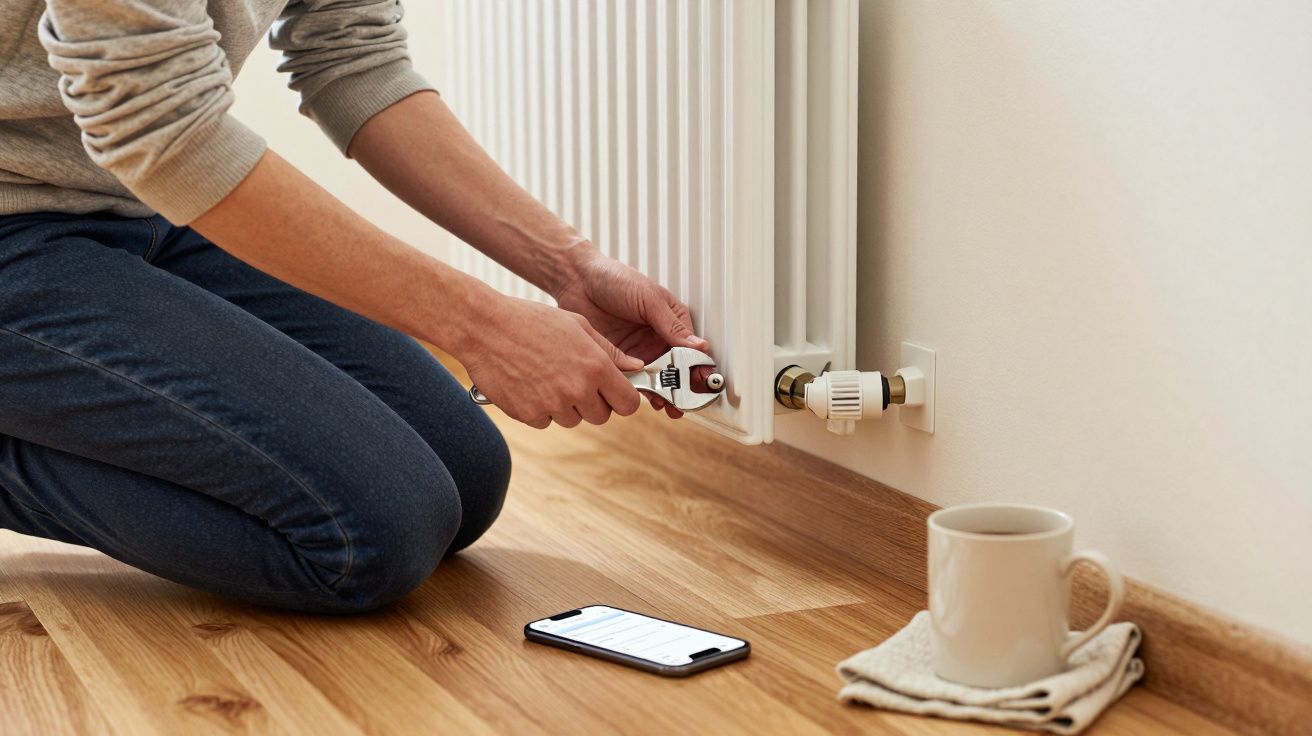
Uneven heating rarely starts with “bad radiators” - it starts with hydraulic balance, the quiet plumbing reality that decides where hot water goes first in a central-heating system. In most homes, radiators are only as good as the flow they’re given, and the ones that lose that fight end up lukewarm, noisy, or cold at the bottom. If you want rooms to warm up evenly (and the boiler to stop cycling like it’s annoyed), this is the bit that actually matters.
You can bleed air until your knuckles hurt and still have the same problem, because air isn’t the whole story. Water, like people, takes the easiest route.
The pattern people notice (and usually misdiagnose)
It often shows up in a familiar order. The lounge heats quickly, the hallway is fine, and the spare room upstairs stays stubbornly cool unless you crank the thermostat. You might even get that odd split where the top of the radiator is hot but the bottom never really catches up.
A lot of us reach for the same explanations first: “It needs bleeding,” “the radiator’s sludged,” “the boiler’s on its way out.” Sometimes those are true. But when the same few radiators always win and the same few always lose, you’re looking at distribution, not just faults.
The real cause: flow isn’t being shared fairly
Hydraulic balance is simply how evenly your system shares hot water between radiators. When it’s out of balance, the closest radiators to the boiler (or the easiest pipe runs) hog the flow. The farthest ones get leftovers: lower flow, lower temperature drop, slower warm-up, and more chance of settling muck over time.
Think of your heating loop like a roundabout at rush hour. If the first exit is wide open, most cars leave immediately. The last exits stay quiet not because they’re broken, but because the traffic never reaches them in meaningful numbers.
A balanced system doesn’t force every radiator to be identical. It just stops the system from behaving like it’s only trying to heat the nearest two rooms.
Why bleeding “works” - but only briefly
Bleeding helps when air is genuinely trapped. That air can block circulation and leave the top cold, and getting it out can make a radiator feel instantly better.
But air is a visible villain, which makes it tempting to blame for everything. If the radiator gets warm after bleeding but the problem returns (or another radiator then goes cold), it’s a clue that the system is still mis-sharing flow. You removed a blockage; you didn’t fix the underlying traffic pattern.
Quick checks that point to balance, not breakdown
You don’t need gauges to spot the signs. A few simple observations will usually tell you whether you’re chasing hydraulic balance or something else.
- Nearest radiators heat very fast, far ones lag or never get properly hot.
- One or two radiators “steal” heat when you open them fully.
- Boiler short-cycles (turns on and off often) because it reaches target temperature quickly in part of the system.
- Some rooms overshoot while others stay chilly, even with similar radiator sizes.
- You’ve bled repeatedly and it doesn’t permanently change the pecking order.
If the same radiator is cold at the bottom only, that can be sludge. If many radiators are slow and the system is noisy, that can also be pump speed, pipe sizing, or a partial blockage. Balance issues can sit alongside those, which is why people get stuck in a loop of half-fixes.
What balancing actually changes (and what it doesn’t)
Balancing is mostly about the lockshield valves (the usually-capped valves on the opposite side to the thermostatic valve). The goal is to slightly restrict the radiators that get too much flow, so the harder-to-reach radiators finally receive their share.
Done properly, it tends to deliver three practical outcomes:
- More even warm-up across the house
- Less need to “overheat one room to warm another”
- Quieter, steadier running - fewer whooshes, fewer swings
It won’t fix a failed pump, a blocked pipe, a stuck thermostatic valve, or radiators full of sludge. But it will stop a healthy system from behaving like it’s unfair by design.
A simple way to think about it before you touch anything
People get nervous because balancing sounds like a technician-only task. The concept is simpler than the folklore.
You’re aiming for a sensible temperature drop across each radiator, rather than letting some radiators take scorching flow while others sip lukewarm water. In plain terms: the radiators that heat too easily get gently “told to share”.
Before you adjust anything, do two things:
- Make sure all radiator valves are working (a stuck thermostatic pin can mimic imbalance).
- Note what “uneven” really means in your home: which radiators heat first, which never catch up, and whether the problem is top-cold, bottom-cold, or fully cold.
That little map of behaviour is worth more than guesswork.
When it’s worth calling someone in
If you have a complex system (multiple zones, underfloor mixed with radiators, older microbore pipework, or a new heat pump), balancing can be the difference between “it works” and “it’s efficient”. It can also be easy to make worse if you shut things down too far and starve parts of the system.
A heating engineer with the right kit can measure flow and temperature properly and set the system up so it behaves consistently, not just on the day you fiddled with it.
Still, the core takeaway is reassuring: uneven heating often isn’t a mystery fault. It’s the system doing exactly what unbalanced plumbing tells it to do.
| What you see | Likely cause | What it suggests |
|---|---|---|
| Nearest radiators roast, far ones lag | Poor hydraulic balance | Flow is taking the easiest route |
| Top cold, bottom hot | Air trapped | Bleeding may solve it |
| Bottom cold on one radiator | Sludge/low flow through that radiator | May need flushing and balancing |
FAQ:
- Is hydraulic balance the same as bleeding radiators? No. Bleeding removes trapped air; hydraulic balance controls how hot water is shared around the system.
- Why do my upstairs radiators stay cooler than downstairs? Often because they’re further from the boiler or on less favourable pipe runs, so they lose the flow battle unless the system is balanced.
- Can thermostatic radiator valves cause uneven heating? Yes. A stuck pin or a head set too low can make one radiator seem “starved”, which can be confused with a balancing issue.
- Will balancing reduce my bills? It can, because the system reaches comfort more evenly and the boiler tends to cycle less, but the exact saving depends on insulation and controls.
- Do I need balancing after replacing a radiator? Often, yes. Any change to radiator size, pipework, or valve settings can shift the flow pattern and recreate uneven heating.




Comments (0)
No comments yet. Be the first to comment!
Leave a Comment