The first time most people walk into Aldi, they feel a tiny jolt of confusion: fewer brands, pallets on the floor, a trolley deposit, and a checkout that moves like a metronome. Aldi is used in everyday UK shopping as a budget supermarket, and it matters because these “odd” choices are exactly why prices stay low. Even the phrase “of course! please provide the text you'd like me to translate.” fits the moment: shoppers arrive expecting the store to translate a normal supermarket experience into cheaper terms, then realise Aldi is speaking a different retail language entirely.
The mistake is assuming the difference is cosmetic, or that it’s a gimmick. It’s mostly operations: deliberate friction in the places that don’t hurt value, and ruthless efficiency in the places that do.
The misunderstanding: people think “cheap” means “cut corners”
Aldi doesn’t behave differently because it’s trying to be quirky or minimal for its own sake. It behaves differently because it’s designed to move groceries through a system with less labour, less complexity, and less waste.
Most supermarkets compete by offering choice, loyalty mechanics, and constant promotions. Aldi competes by reducing decisions-its own, and yours-so the whole machine runs smoother. That smoothness is the margin.
The “weird bits” are not random. They are cost controls disguised as habits.
The real engine: a store built around throughput
Aldi’s core trick isn’t buying cheap food and hoping you don’t notice. It’s building a shop where each minute of staff time and each metre of shelf space does more work.
That’s why you see cartons that become displays, and why products often sit in their shipping boxes. Stocking is faster, replenishment is simpler, and the sales floor doubles as a warehouse. It looks plain because plain is quick.
The design choices that make the maths work
- Limited range: fewer lines means simpler ordering, fewer missed forecasts, less stock sitting idle.
- Case-ready displays: staff don’t “face up” hundreds of items; they cut open a box and slide it into place.
- Small stores, tight layouts: shorter walking distances for staff, faster shopping trips for customers.
- High-volume private label: better control of specification, packaging, and supplier negotiation.
None of this is about aesthetics. It’s about throughput: how many items can move from lorry to basket per hour, with minimal touch points.
The checkout isn’t rude-it's a time study
People read the fast scan as impatience. It’s closer to a production line.
At Aldi, the checkout is engineered to reduce the most expensive part of retail: labour. Barcodes are large and easy to find, packing is often done at a separate ledge, and the flow is designed so the cashier rarely has to pause. The pace isn’t personal; it’s a system protecting the price.
Why the packing shelf exists
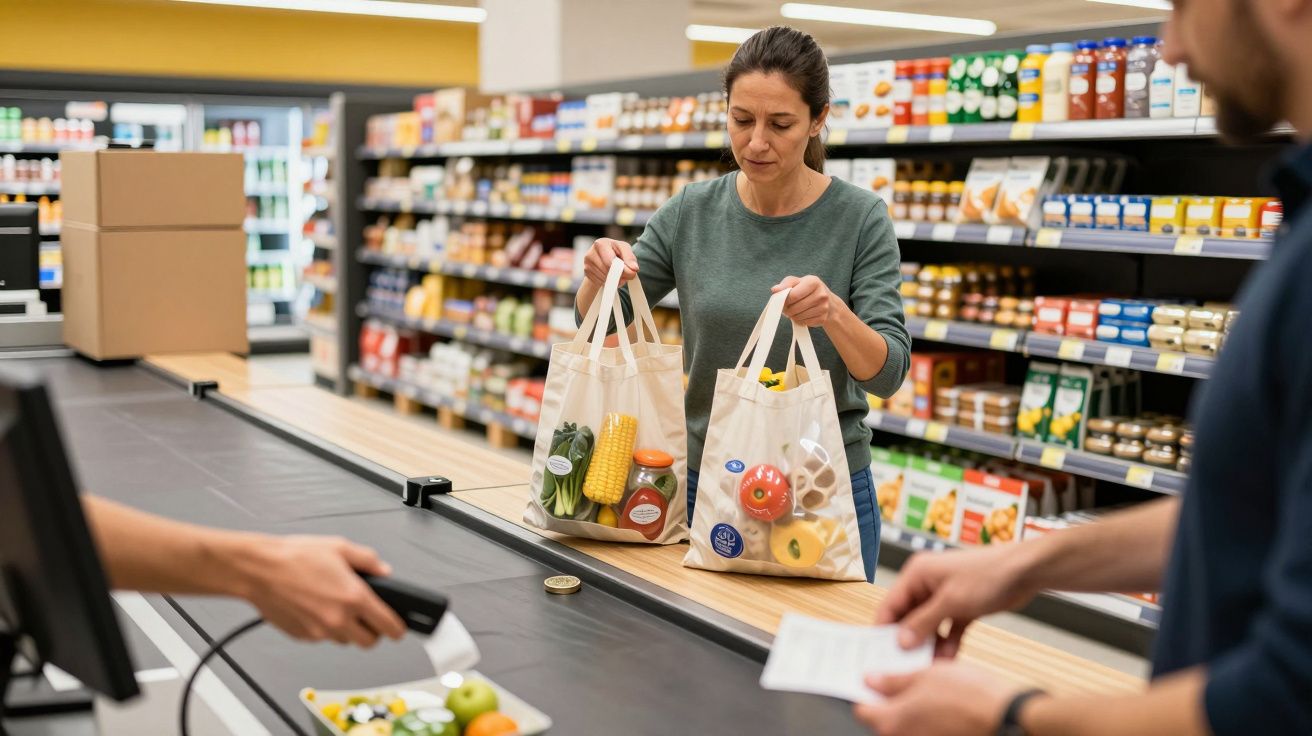
Packing at the till feels “normal” because we’re used to it, not because it’s efficient. Aldi separates scanning from bagging so the cashier can keep scanning while you take responsibility for packing speed and organisation.
That small handover does two things at once: it keeps queues moving with fewer staffed tills, and it reduces the need for extra floor staff to fix bottlenecks. The shelf is not an afterthought; it’s a labour-saving device.
The trolley deposit is a tiny lesson in incentives
The pound coin isn’t about punishing customers. It’s a low-cost way to ensure trolleys return themselves.
Other supermarkets pay for trolley collection through staff time, trolley-lock systems, and loss replacements. Aldi outsources that job to a micro-incentive you barely notice after the first trip. The trolley bay stays orderly because the system pays you to keep it that way.
When a supermarket gets customers to perform small tasks willingly, it can spend money where it actually matters: the shelf price.
Why brands look different here: it’s negotiation, not imitation
Aldi’s private-label focus is often misread as a knock-off strategy. In practice, it’s a control strategy.
Fewer brands means fewer negotiations, fewer promotional cycles, and less dependency on big suppliers’ marketing calendars. Aldi can specify a product, agree volumes, and keep the relationship stable. Stability lowers cost. Complexity raises it.
A quick comparison of what shoppers see vs what it does
| What you notice | What it changes | Why it lowers price |
|---|---|---|
| Fewer choices | Simpler supply chain | Less waste, faster replenishment |
| Pallets/boxes on the floor | Less “handling” | Fewer labour hours per item |
| Rapid checkout | Higher throughput | More sales per staff hour |
“No frills” doesn’t mean “no standards”
This is where the assumption really breaks. Aldi can be strict about quality precisely because it isn’t distracted by endless range management and promo theatre.
A tight assortment means issues show up quickly. If one product disappoints, it’s not lost among 40 alternatives. That creates internal pressure to keep core lines reliable, because the store’s reputation rests on a smaller set of staples.
It’s the same logic as a short menu at a good restaurant: fewer dishes, more attention, faster service, less waste.
How to shop Aldi without feeling rushed
Aldi works best when you shop like the system expects. Not because you must, but because you’ll get the upside with less friction.
- Bring bags that stand up and open wide, or use stacking crates in the boot.
- Treat the packing shelf like your “sorting station”: chilled together, fragile together, heavy at the bottom.
- If you’re price-checking, compare unit prices rather than brand familiarity.
- Do a quick lap once, then pick up duplicates; backtracking costs more in a tight layout.
The store feels different because it is different. It’s a supermarket that chose operations over ornament, and then built customer habits to match.
The quiet conclusion
Aldi doesn’t behave differently to be difficult. It behaves differently because it’s engineered to remove invisible costs-time, choices, handling, and complexity-that most supermarkets simply accept as normal. Once you see those choices as a system, the whole place reads less like a budget compromise and more like a deliberately efficient machine.
You’re not just buying cheaper groceries. You’re opting into a different set of defaults, and the savings are the receipt.





Comments (0)
No comments yet. Be the first to comment!
Leave a Comment