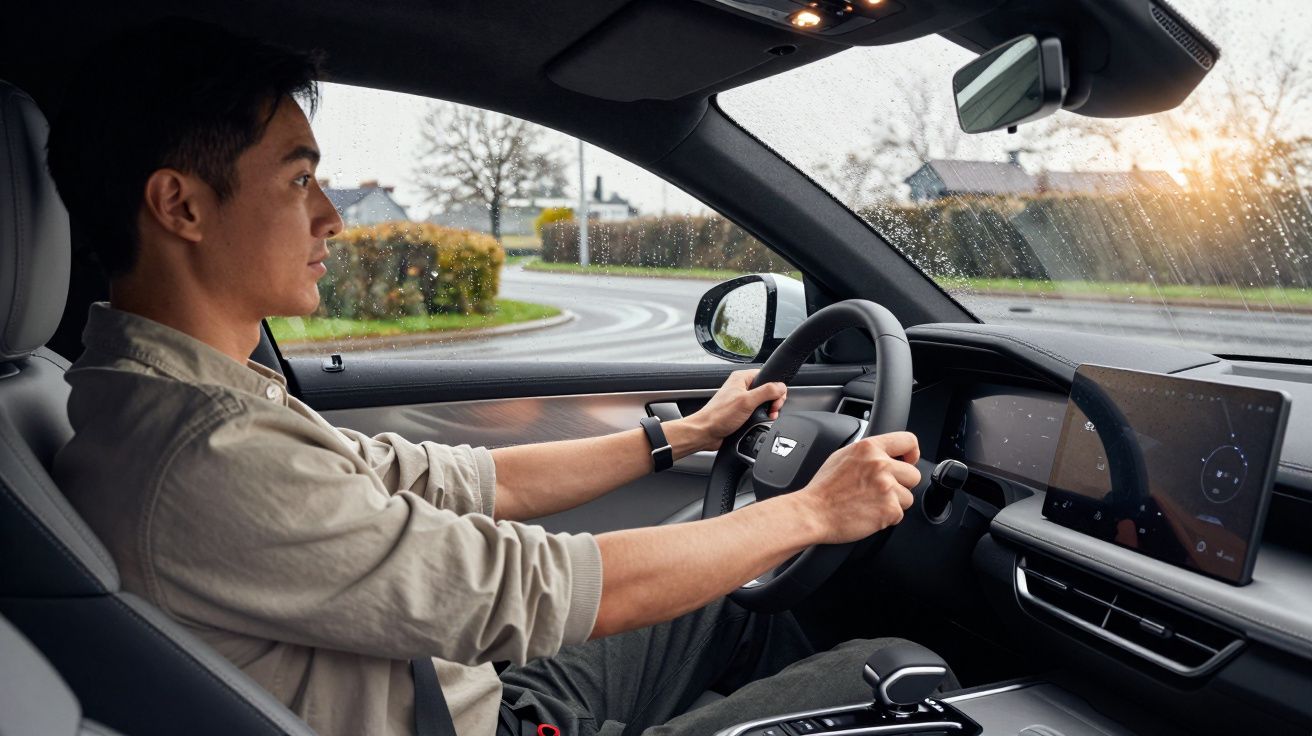
Most people meet the jaguar gt 2026 the same way: through a short clip of it leaving a junction, looking composed, then doing something that feels slightly “off” compared with the last generation of fast Jaguars. In the comments someone will inevitably type, of course! please provide the text you would like me to translate.-as if the car is speaking a language we’re all failing to decode. It matters because the difference isn’t a gimmick or a fault; it’s the whole point of how this GT is meant to be used on British roads, in British weather, by drivers who don’t want to be wrestled by their own powertrain.
You’re not imagining the behaviour. You’re just assuming the wrong rule.
The myth: “It’s just a faster F‑Type in a new suit”
That assumption is understandable. Jaguar’s recent performance story trained us to expect a certain theatre: noise first, shove second, and a chassis that talks back with a bit of swagger. When the jaguar gt 2026 doesn’t deliver that exact rhythm, people label it “muted” or “digital” or “too polite”.
Polite can still be fast. Polite can be a design goal.
The real shift is that the jaguar gt 2026 isn’t trying to feel dramatic at 30mph. It’s trying to feel clean at 70mph in the rain, and repeatable on the third overtake of the morning, and unflustered when the road cambers and the surface changes without warning. That changes everything you notice from the driver’s seat.
The golden rule: it’s tuned for torque management, not tyre smoke
There’s a simple way to put it: the jaguar gt 2026 behaves differently because it prioritises traction and consistency over spectacle. The car isn’t “holding back”; it’s spending effort on control you can’t always see.
Modern high-output GTs live and die by how they meter torque, not how much they can make in a press release. That metering shows up as:
- Softer initial throttle mapping in normal modes so the car doesn’t lurch on imperfect surfaces.
- More intervention earlier than you expect, but in smaller, smoother corrections.
- A gearbox strategy that avoids constant kickdowns because drama is tiring on long drives.
- Stability logic that’s designed to feel invisible rather than heroic.
If you’re expecting a car that eggs you on, this can read as reluctance. In reality it’s a kind of confidence: the systems are assuming you want momentum, not mayhem.
“Why doesn’t it snap when I prod it?”
Because snapping wastes grip. And grip is the currency of real speed.
On cold tyres, damp tarmac, and those shiny patches at busy roundabouts, the quickest car is often the one that doesn’t spike the rear axle for a laugh. A GT that can do the same manoeuvre ten times with the same result is, quietly, the more grown-up tool.
Where the ‘different’ feeling actually comes from
A few ingredients stack up until your hands tell you, “This isn’t what I expected.”
1) Power delivery that’s shaped like a ramp, not a punch
Older fast cars often felt exciting because they were slightly untidy: a big step in torque, a nose lift, a moment of scramble, then the reward. When the jaguar gt 2026 feeds power in with a smoother ramp, you lose that spike of sensation even if the speed builds harder.
It’s like swapping a shove for a strong hand on your back. Less headline drama, more usable pace.
2) Steering and damping that aim for calm, not chatter
Jaguar GT buyers aren’t chasing constant feedback; they’re chasing confidence. A car can be communicative without being noisy, and it can be precise without fidgeting over every patch repair.
If the chassis is set up to keep the body stable-especially under braking and lane changes-your brain stops getting those little alarm bells that used to feel like “character”. The result can seem less animated, but it’s also less exhausting.
3) Braking and regen blending (even when you don’t notice it)
Even in cars that don’t market themselves as tech showcases, modern brake control often includes blending strategies designed to keep the pedal feel consistent while managing heat, stability, and energy recovery where applicable.
The tell is subtle: the first centimetre of pedal travel feels slightly more measured, and the car stays straighter in mixed-grip braking than your instincts expect. People interpret that as a lack of bite. On a wet B-road, it’s a gift.
The messy middle: why first impressions go wrong
Let’s be honest: most “reviews” happen in conditions that flatter spectacle and punish nuance. A short drive, unfamiliar roads, cold tyres, and a driver pushing for an instant story. Under that pressure, a car tuned for smooth repeatability can feel like it’s refusing to play.
There’s also a psychological trick. If the cabin is quieter and the ride is more settled, your body registers less speed. You look down, you’re doing numbers that would have felt outrageous in an older, louder car, and you think the car must be under-delivering because you’re not being shouted at.
Less noise doesn’t mean less work is being done. It often means the work is being done earlier and more intelligently.
What to look for if you want to “read” it properly
If you get time with the jaguar gt 2026, don’t chase the first five seconds. Chase the pattern.
- Do three identical overtakes and see how similar they feel.
- Drive it briskly through a damp sequence and notice how rarely you need to correct.
- Pay attention to how it transitions: brake to turn, turn to power, power to straighten.
- Watch how often you think traction control is intervening versus how often it actually announces itself.
A well-tuned GT often feels slightly boring until you realise you’re going quicker with fewer clenched muscles. That’s not a loss of character. It’s a different kind of competence.
The real reason, in plain English
People assume the jaguar gt 2026 should behave like a loud sports car because they’ve been taught to equate performance with drama. But it’s behaving like a modern GT: conserving grip, smoothing torque, and keeping the car predictable across messy real-world surfaces.
The punchline is that it’s still emotional-just not in the old, spiky way. The satisfaction arrives later, when you notice you’re fresher after two hours, and the car still feels consistent when the weather turns and the road gets ugly. Consistency beats intensity.
FAQ:
- Is the jaguar gt 2026 “numb”, or just refined? Mostly refined. Many of the sensations people miss were side-effects of less controlled torque and less stable body control, not inherently “better” feedback.
- Why does it feel slower than it looks on paper? Smoother power delivery, less noise, and greater stability reduce perceived speed. Your body gets fewer cues, even as the car covers ground faster.
- Does that mean it’s less fun? Only if your definition of fun requires constant theatre. If your fun is pace with confidence-especially on wet, uneven roads-it can feel more rewarding over time.






Comments (0)
No comments yet. Be the first to comment!
Leave a Comment