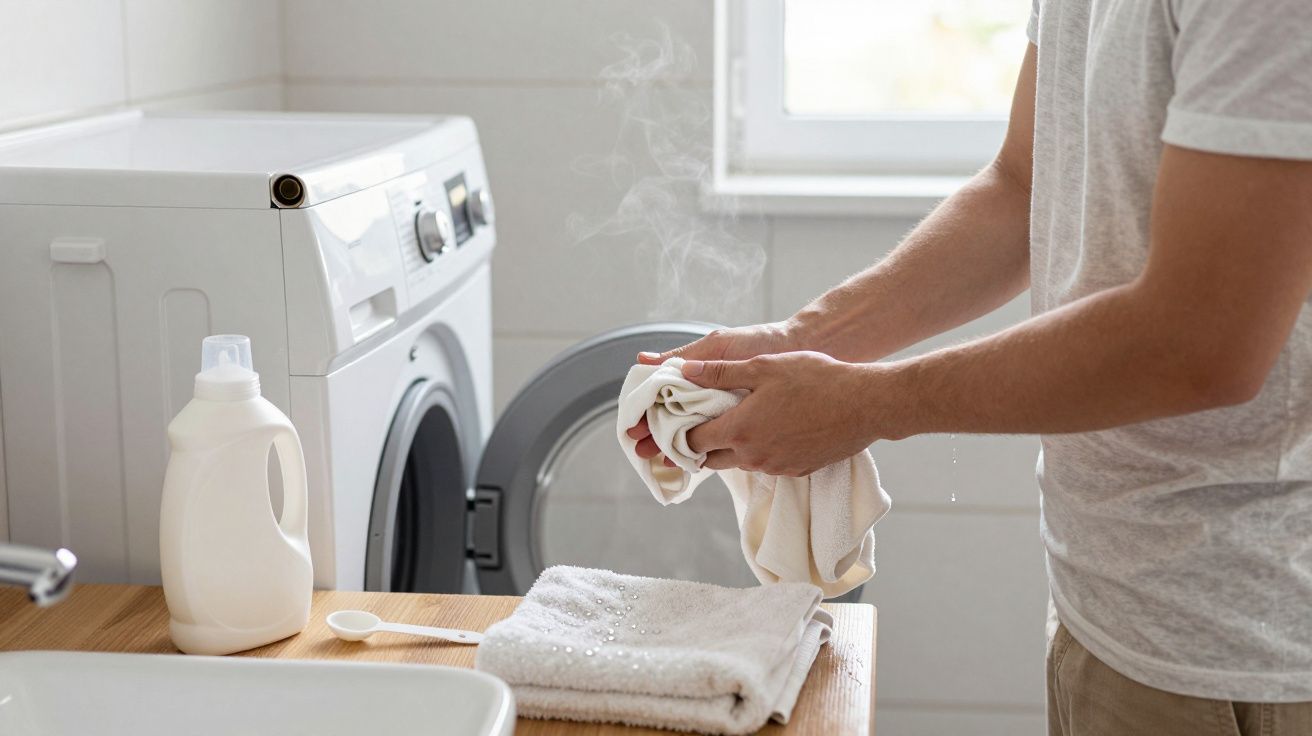
The phrase “of course! please provide the text you’d like me to translate.” pops up in odd places - chat windows, help prompts, those moments you’re half-distracted while doing something else. I’ve even seen its near-twin, “of course! please provide the text you would like me to translate.”, sitting in the background while someone sorts a wash basket. It matters because laundry is full of autopilot decisions, and the smallest “prompt” you ignore can turn into the kind of damage you only notice when it’s expensive or irreversible.
It isn’t the dramatic mistakes people warn you about - the red sock, the shrunken jumper, the bleach splash. It’s a quieter signal, easy to miss, that your routine is slowly undoing your clothes.
The warning sign nobody clocks: “clean” that doesn’t feel clean
Most laundry errors announce themselves with a bang: colour run, stretched collars, crunchy towels. The subtle one is the opposite. Your clothes come out looking fine, but they feel slightly off - a waxy film, a stiffness at the seams, an odd “not quite fresh” smell that returns the moment the fabric warms up on your body.
That’s not your imagination, and it’s not just “hard water”. It’s usually residue: too much detergent, too cool a wash for what you’re asking it to remove, or a machine that’s quietly gunking up. It’s the laundry equivalent of low-level noise - tolerable until you notice it, and then you can’t un-notice it.
Why residue happens (even when you’re being sensible)
Detergent is designed to cling: to oils, to particles, to odours. When there’s more detergent than dirt to bind to, or not enough water/heat/agitation to rinse it away, it clings to the fabric instead. Fabric softener makes this worse by adding another coating, especially on towels and sportswear.
The machine plays a part, too. Modern eco cycles use less water, which is great for bills and the planet, but it’s less forgiving of overdosing. Combine that with low temperatures and liquid detergent, and you can build a thin layer inside the drum and pipes that slowly re-perfumes everything in the worst way.
A quick self-test: if your “clean” clothes smell fine in the basket but turn sour after an hour of wear, you’re likely dealing with build-up, not poor hygiene.
The two-minute check that tells you what’s going on
You don’t need to dismantle the washer or become a chemistry person. You need one tiny investigation that most people never do because it feels too boring to matter.
- Rub-test a damp item: Take a freshly washed cotton T-shirt, dampen a small patch with warm water, and rub it between your fingers. If it feels slippery or soapy, that’s residue.
- Towel test: Towels should feel absorbent, not water-repellent. If water beads on the surface for a moment before soaking in, there’s a coating.
- Smell the drawer and the seal: Pull out the detergent drawer and sniff the underside. Check the rubber door seal. A sweet/chemical “clean” smell there is often old detergent, not cleanliness.
None of this is dramatic. That’s the point. It’s a slow drift that shortens the life of fabric and makes you wash things more often, which creates more residue, which makes you wash things more often.
Fix it without buying a new machine (or “laundry stripping” everything)
Start small. One reset wash, one dosing change, one habit you can keep.
- Run a hot maintenance wash (60–90°C, empty drum) with either a proprietary machine cleaner or plain white vinegar in the drum (check your manufacturer guidance; don’t mix with bleach).
- Halve your detergent for two weeks. Seriously. Most people overdose. If you’re in a soft-water area, you can often use far less than the cap suggests.
- Skip fabric softener on towels, gym kit, and anything “technical”. If you want softness, use dryer balls or shake towels out before drying.
- Add an extra rinse if you’re washing heavy loads or using an eco cycle that’s stingy with water.
If you want one “anchor” habit: dose detergent for the actual load size, not the basket size in your head. Laundry lies. A half-full drum looks full when you’re late.
The quiet damage residue causes (and why it’s worth catching early)
Residue doesn’t just make things smell weird. It changes how fabric behaves. Towels lose absorbency, sportswear traps bacteria, darks look dull, and whites go grey because the fibres are essentially holding onto a thin layer of old product.
It also encourages the kind of damp, biofilm-friendly environment that makes machines smell “musty” even when you’re doing everything “right”. You end up fighting the problem with more fragrance, more detergent, more softener - which is like turning up the brightness on a screen that’s already giving you a headache.
Catch it early and the fix is gentle. Leave it for months and you’re into repeated hot washes, deeper cleans, and clothes that never quite recover their original feel.
A simple “better wash” template you can actually stick to
You don’t need a ten-step routine. You need a default that keeps residue from becoming your normal.
- Every wash: Use less detergent than you think, and don’t cram the drum (a hand’s width of space at the top is a decent guide).
- Weekly: One warmer wash (40–60°C) for items that can take it, especially bedding and towels.
- Monthly: One empty hot maintenance wash, and rinse the detergent drawer under a tap.
- Always: Leave the door ajar for an hour after washing so the seal dries.
Your clothes should come out smelling of… almost nothing. Clean has a texture and a neutrality. If “clean” smells loudly perfumed, it can be a cover version.
| Subtle sign | What it usually means | Quick fix |
|---|---|---|
| “Clean” smell turns sour when worn | Residue + trapped bacteria | Extra rinse + reduce detergent |
| Towels feel soft but don’t dry you | Softener coating | Stop softener + hot wash reset |
| Washer smells “fresh” in a chemical way | Detergent build-up in drawer/seal | Clean drawer + maintenance wash |
FAQ:
- Isn’t more detergent always better for sweaty clothes? No. Too much can trap odour by leaving residue behind. Use the right dose and add an extra rinse or a warmer cycle instead.
- Can I fix this just by using scent beads or stronger softener? That usually masks the issue and adds more coating. The goal is better rinsing and less build-up.
- Do I need to wash everything at 60°C to solve it? Not usually. One periodic hotter wash plus correct dosing and ventilation is enough for most households.
- What if I have hard water? You may need a little more detergent than soft-water areas, but overdosing still causes residue. Consider a detergent formulated for hard water and keep the monthly maintenance wash.






Comments (0)
No comments yet. Be the first to comment!
Leave a Comment