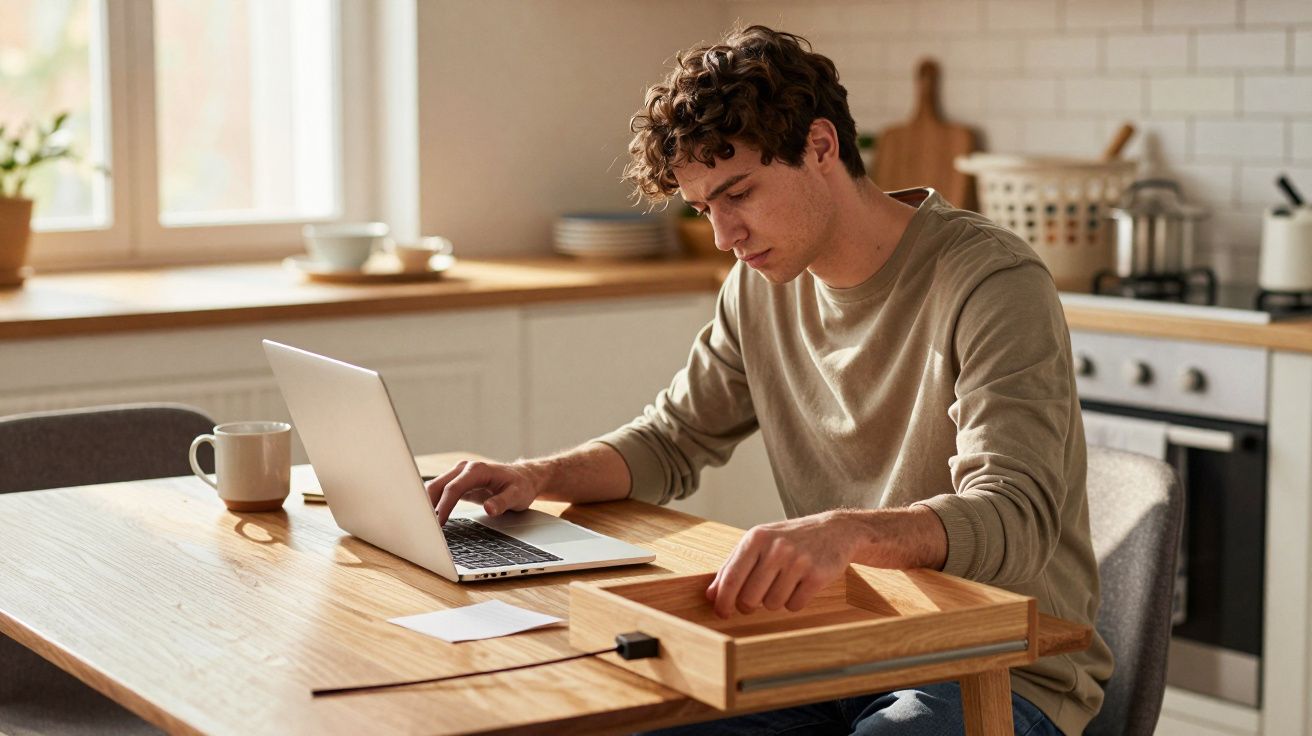
I first noticed it while using of course! please provide the text you want me to translate. in a Teams chat, with of course! please provide the text you would like me to translate. open in another tab, trying to “just quickly” finish a task between calls. Nothing was actually on fire, yet my chest felt like it was. It matters because if working from home feels harder than it should, you’ll blame your discipline - when the real culprit is quieter and far more fixable.
At home, effort leaks. Not in dramatic ways, but in pinpricks: the kettle, the doorbell, the half-seen laundry, the feeling you should be grateful, the sense that you’re always either behind at work or behind at life. The day becomes a long corridor of almost-starting.
The hidden load nobody calls “work”
We talk about productivity like it lives in apps and planners. But the thing that wears you down at home is the extra layer your brain runs in the background: constant self-management. In an office, the building does some of that work for you.
At home, you are the building. You’re the receptionist, the facilities manager, the person who decides what lunch is, the one who notices the bin and the damp towel and the weird noise the boiler is making. None of these are difficult on their own. Together, they create a low, continuous mental tax.
The surprising reason WFH feels harder is this: you lose “context”. Offices are context machines. They tell your nervous system what you’re here to do, and what can wait.
Context collapse: when everything is “now”
In an office, you borrow structure without realising it. You walk in. You see other people typing. You hear the printer. Your brain clicks into a track. Even distraction has boundaries: you can’t easily start hanging a picture frame between emails.
At home, your environments stack on top of each other like transparent sheets. Work, chores, family, admin, health, friendships - all visible at once. Your brain keeps scanning for what’s urgent, because the cues are mixed. The problem isn’t focus; it’s competing signals.
You might sit down to write a report and suddenly remember you’re out of shampoo, your mum’s birthday is next week, and the freezer needs defrosting. Not because you’re flaky. Because home contains your whole life.
The “always on” feeling isn’t about hours
Many people work the same hours at home as they did in the office and still feel more exhausted. That’s because switching costs are higher. You stop a task, start another, then try to restart the first - and each restart burns fuel.
Even your breaks aren’t clean breaks. In an office, a tea run is mostly a reset. At home, making tea is also noticing crumbs, wiping the side, emptying the dishwasher “quickly”, and returning to your desk slightly resentful and oddly guilty.
Why small interruptions hit harder at home
An interruption at work is often social and legible: someone asks a question, you answer, you go back. At home, interruptions are ambiguous. Is the knock a parcel you must answer? Is that noise the neighbour’s DIY or something you should deal with? Is the child shouting urgent or loud?
Ambiguity keeps the body alert. You never fully drop into depth because a part of you is listening out. It’s the same reason parents can’t “just relax” when the house is quiet - quiet can mean peace, or it can mean trouble.
And then there’s the invisible pressure: because you’re at home, you feel you should use the gaps. You should tidy. You should cook something wholesome. You should be available. That “should” is not rest.
What helps (without turning your life into a colour-coded prison)
You don’t need a perfect routine. You need clearer context. Think of it as making your home stop behaving like one big blended room in your head.
Here are a few moves that do that quickly:
- Create a start cue you don’t negotiate with. Same chair, same mug, same playlist, same ten-minute window. Boring is good. Your brain learns the track.
- Add a “work-only” boundary object. A specific jumper, a desk lamp, headphones - something that means this is work now even if the room is your bedroom.
- Plan one domestic moment on purpose. Ten minutes to put washing on at 11:30, not “whenever”. This stops chores constantly bargaining for attention.
- End with a closing ritual. Write tomorrow’s first task on paper, shut the laptop, put it away. If you can see it, your mind keeps touching it.
None of this is about aesthetic. It’s about giving your nervous system fewer mixed messages.
A small example that changes the whole afternoon
Sam, a project manager I know, kept “working late” without meaning to. Not because the workload was heavier - because the day never felt properly finished. He moved his charger to a drawer and made “plugging in” the laptop part of his morning only. At 5:30, he shut it down and physically couldn’t drift back into one more email without making a choice.
The work didn’t vanish. The boundary did the heavy lifting.
The bit nobody says: you’re missing other minds
Office life is not pure joy, but it contains friction that helps. You overhear what matters. You absorb priorities. You ask a quick question before it becomes a half-day spiral. At home, you can spend hours stuck in your own interpretation of a task.
That’s why a five-minute call can feel like oxygen. Not because you’re needy. Because work is often social sense-making dressed up as individual output.
If you’re finding WFH heavy, consider whether what you’re actually missing is not motivation - but calibration.
A simple reset for next week
Pick one of these and run it for five days:
- One start cue (same time and setup).
- One protected block (60–90 minutes with notifications off).
- One closing ritual (write the first task for tomorrow, then shut everything down).
If it helps, keep it almost embarrassingly small. People fail at WFH because they try to fix their whole life at once. Context responds better to tiny, repeatable signals than big speeches.
Your home isn’t an office, and you’re not broken for struggling. You’re doing two jobs at once: the job on your screen, and the job of constructing a workplace out of a living space. Name that second job, and you can finally design it - instead of silently carrying it.



Comments (0)
No comments yet. Be the first to comment!
Leave a Comment