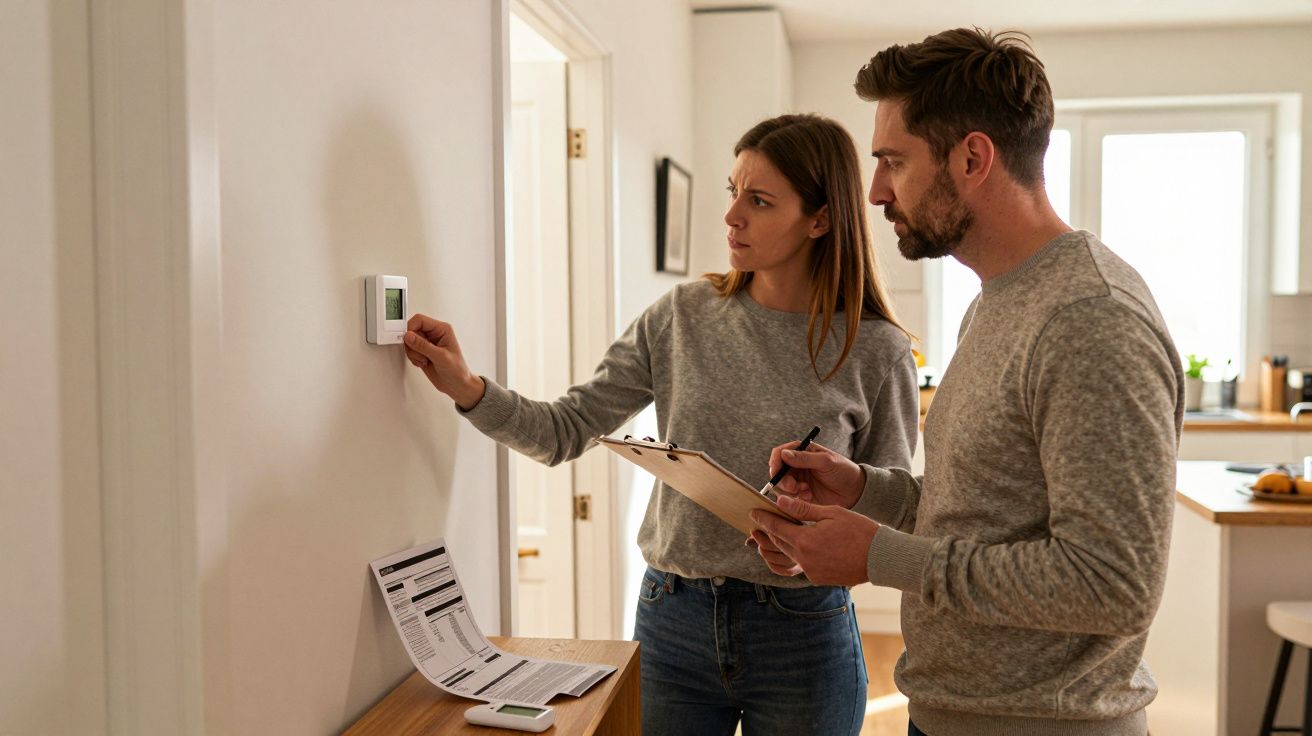
Brochures make it sound simple: install energy efficient heating, watch the bills fall, and feel smug about carbon. Then the first winter lands and real-world performance turns out to be the thing you actually live with-cold bedrooms, longer warm-up times, and a system that only sings when you run your home like a lab. It matters because you’re not buying a concept; you’re buying comfort, reliability, and costs you can predict.
The uncomfortable truth is that “efficient” often describes a set of conditions, not your Tuesday night. The gap between the lab and the lounge is where savings go to die.
The headline problem: efficiency is not the same as outcomes
In a datasheet, efficiency is a ratio under controlled inputs: specific flow temperatures, steady demand, clean filters, ideal weather. In a home, demand is messy: doors open, showers run, teenagers refuse to close windows, and the outside temperature drops faster than forecasts. Your system isn’t rewarded for being clever; it’s punished for every mismatch between assumptions and reality.
A good installer knows this, but the market doesn’t always price it in. Many sales journeys skip straight from “high seasonal efficiency” to “lower bills” without asking what you want the house to feel like at 7 a.m., or how you actually use rooms.
Where the gap shows up in energy efficient heating
Heat pumps: brilliant physics, fussy context
Heat pumps can be outstanding, particularly in well-insulated homes with emitters sized for low temperatures. But their best numbers often assume low flow temperatures and long run times. If your house loses heat quickly, the system may need higher flow temperatures to keep up, and the efficiency drops right where you notice it most.
The common failure mode isn’t that the heat pump “doesn’t work”. It’s that it works, but not in the way your habits demand-so you override it, boost it, or add electric top-ups that quietly rewrite the maths.
Condensing boilers: efficient until you ask for too much heat too fast
Condensing boilers earn their efficiency when return water temperatures stay low enough for condensation. Run high radiator temperatures for quick heat, or keep short on/off cycles, and you drift away from that sweet spot. You still get heat, but you don’t get the promised efficiency.
This is why two identical boilers can have wildly different bills. It’s not just the appliance; it’s how it’s set up and how it’s driven.
Controls: the system’s “brain” that people fight with
Modern controls can reduce waste, but only if the household understands them and trusts them. The moment a system feels slow, residents start manual overrides: constant schedule changes, high set-points, or repeated boosts. That turns a carefully tuned strategy into chaos, and the system becomes “inefficient” largely because it’s being treated like a stubborn old heater.
The real-world performance checklist nobody wants to do
You can call this boring, but it’s the difference between a smooth winter and a long argument with your hallway thermostat.
- Measure heat loss, don’t guess. Room-by-room heat loss and emitter sizing decide whether low-temperature heating is realistic.
- Check flow temperatures and curves. A heat pump’s weather compensation curve is often where savings are won or lost.
- Look at cycling. Short cycles waste energy and wear components; they usually signal control issues, oversizing, or poor distribution.
- Prioritise insulation and draught-proofing. Efficiency upgrades perform best when the building stops leaking heat.
- Plan hot water honestly. Bath-heavy households, high hot-water set-points, or oversized cylinders can shift outcomes more than you expect.
Efficient kit can’t out-run a leaky envelope or a control strategy the household hates.
A small table that explains most disappointments
| What you optimise for | What you usually change | What you might sacrifice |
|---|---|---|
| Lowest bills | Lower flow temps, longer run times, smart schedules | Fast “blast” heating, instant recovery |
| Maximum comfort | Larger emitters, better insulation, stable set-points | Upfront cost, disruption |
| Minimal hassle | Simple controls, conservative settings | Peak efficiency, some savings |
The trap is trying to get all three without paying for the building work or the commissioning time. Physics doesn’t negotiate, it invoices.
Three moments that predict whether your “efficient” system will feel efficient
- The first cold snap. If the home can’t hold heat, you’ll crank settings and never come back down.
- The first bill that doesn’t match the promise. This is where people abandon optimisation and settle into “whatever works”.
- The first service visit. Filters, balancing, firmware updates, and sensor placement sound minor-until they’re the reason your system behaves oddly.
Most systems don’t fail dramatically. They just drift into a mediocre mode that feels safe: higher temperatures, more boosts, less trust. That’s the quiet death of projected savings.
What “good” looks like: boring, measured, and slightly obsessive
A genuinely good installation reads like process, not magic. It includes commissioning, documentation, and a bit of education for the household. It assumes you’ll forget the manual and still tries to protect you from your own overrides.
If you want a practical test, ask for two things after install: a clear explanation of target flow temperatures (by outside temperature), and evidence that the system has been balanced and checked for cycling. If the answer is vague, your real-world performance will probably be vague too.
The uncomfortable conclusion
“Efficient systems” are often efficient in the same way a race car is efficient: under the right conditions, with the right setup, and with a driver who understands the controls. Energy efficient heating can be a real upgrade, but only when the building, the design, and the daily habits stop fighting the equipment.
The good news is that this is solvable. The bad news is that it’s rarely solved by the box alone.




Comments (0)
No comments yet. Be the first to comment!
Leave a Comment