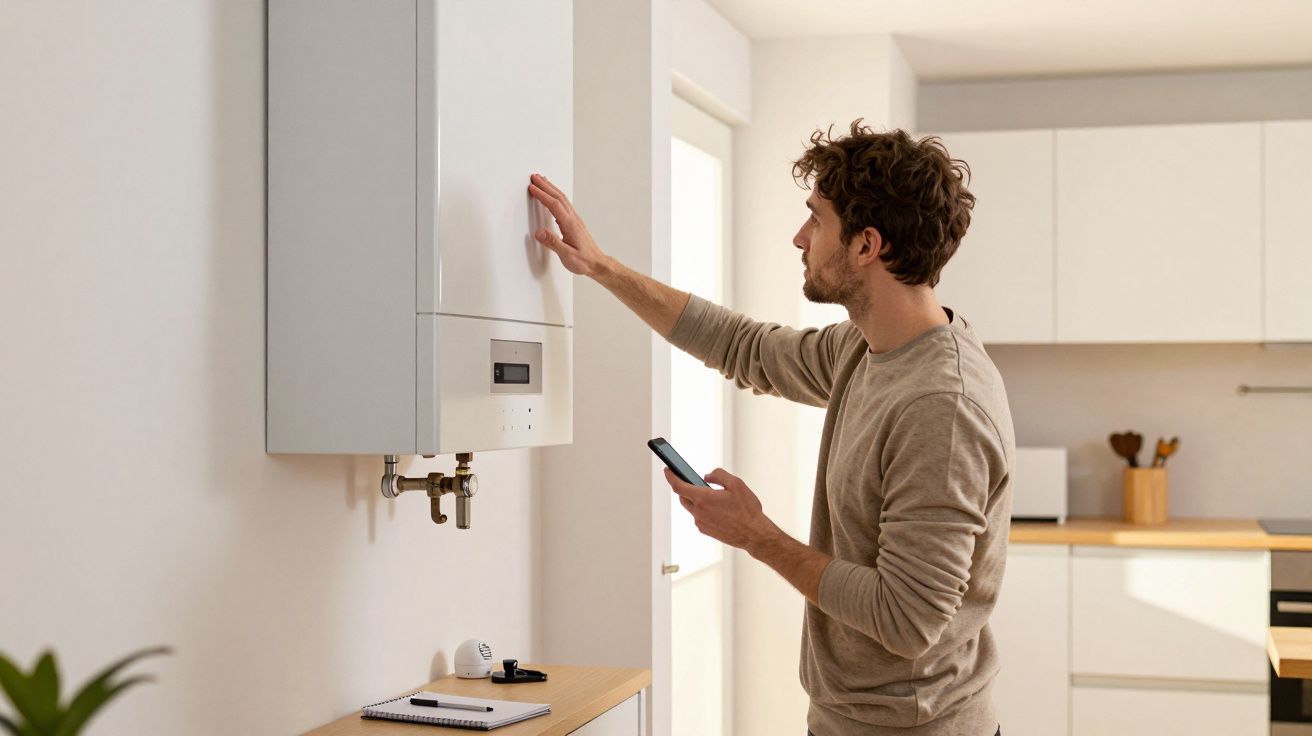
I first noticed the gas boiler from the hallway, not the kitchen: a new edge to the sound, like something small trying to escape. Boiler making noise is easy to dismiss because it still heats, the hot water still runs, and life is loud anyway. But one particular noise is less “keep an eye on it” and more “turn it off and act”, because it can signal unsafe combustion or a failure that will get worse in minutes, not weeks.
The trap is familiarity. We live next to these boxes for years, so we normalise the clicks, the whoosh, the gentle tick of metal warming. Then one day the soundtrack changes, and the house tries to tell you something in a language you’re not used to listening to.
The sound that means stop: a deep vibrating hum (or “booming”) at ignition
There’s a difference between a boiler that’s chatty and a boiler that’s angry. A brief whirr as the fan starts, a single click, then a steady burn-fine. A deep vibrating hum, a “whoomph”, or a booming thud as it lights is not fine, even if it settles after.
That noise can be delayed ignition: gas building in the chamber for a moment, then lighting all at once. It can also be a burner or ignition problem causing unstable combustion. Either way, it’s telling you flame control isn’t behaving normally, and that’s not the part you want improvising inside a sealed box connected to your gas supply.
If you only take one thing from this: a booming start-up or rumbling combustion noise is a stop-and-call scenario.
What to do in the next 60 seconds (no heroics)
People hesitate because they don’t want to “overreact”. The better frame is this: you’re not diagnosing, you’re reducing risk while you wait for someone qualified to diagnose.
- Turn your heating off at the programmer/thermostat so it stops calling for heat.
- If the noise continues or repeats, turn the boiler off using the boiler’s power switch.
- If you smell gas, don’t touch electrics or switches. Open windows and doors, and call the National Gas Emergency Service on 0800 111 999 (UK) from outside or a neighbour’s phone.
- If anyone feels unwell (headache, dizziness, nausea), get outside for fresh air and consider 999 if severe-carbon monoxide exposure can look like “a bit of flu” until it doesn’t.
Then wait. Let the system go quiet. The point is to stop repeated ignition attempts while you arrange help.
Why that noise is different from “kettling” and other common racket
Most boiler noise advice online lumps everything together: gurgling, banging, whistling, humming. But your ear can sort them into two buckets: water-side sounds and fire-side sounds.
Water-side problems are often urgent for the boiler’s health, but not usually immediate safety emergencies. Fire-side problems can be.
Here’s the quick mental split:
- Kettling (water-side): a sharp, kettle-like hiss/roar, often when the boiler is working hard. Common causes include limescale on the heat exchanger, poor flow, sludge, or a partially closed valve. It’s bad for efficiency and components, and it can tip a boiler into overheating cut-outs-but it’s not the same as a combustion “boom”.
- Booming/rumbling at ignition (fire-side): a thud, bang, or bassy vibration right as the burner lights. That’s the one that can indicate ignition or burner faults and needs a Gas Safe engineer.
If you’re unsure which you’re hearing, treat it as the more serious category. People rarely regret being cautious with gas; they often regret waiting for “one more cycle”.
The simple checks you can do (and the ones you can’t)
There’s a kind of false competence that comes from YouTube. With a gas boiler, you want the boring kind: check what you can observe safely, leave sealed combustion and gas parts alone.
Safe, useful checks:
- Look at the boiler pressure gauge (if you have one). Many systems want roughly 1.0–1.5 bar when cold. Very low pressure can cause strange behaviour and lockouts; very high pressure can trigger discharge outside.
- Listen for where the noise comes from. Is it at ignition only, or during the whole run? Does it correlate with hot water demand, heating, or both?
- Check radiator valves are open in the rooms you use. Starving a system of flow can make it noisy and stressed.
- Find the condensate pipe outside in winter. If it’s frozen, some boilers will try to start, fail, and cycle. (That often presents as repeated attempts rather than a single boom.)
Do not do:
- Don’t remove the boiler case.
- Don’t adjust gas valves, burners, or ignition components.
- Don’t keep resetting the boiler to “see if it clears”. Repeated ignition attempts are exactly what you’re trying to avoid if combustion is unstable.
What a Gas Safe engineer is likely to check (so you can describe it well)
When you ring, the most helpful thing you can give isn’t a guess at the fault. It’s a clean description of the moment.
An engineer will typically look at:
- ignition electrode and lead condition
- burner condition (debris, alignment, corrosion)
- fan performance and air supply
- gas pressure and valve operation (measured properly)
- flue integrity and combustion readings (analyser), because sound is often the first clue that combustion isn’t clean
Write down what you hear: “single bang at ignition”, “vibrating hum during burn”, “starts fine on hot water, bangs on heating”, “worse first thing in the morning”. It saves time and nudges the visit towards the right kit and parts.
“A boiler that lights with a thud is telling you it didn’t light when it should,” a service engineer once told me. “That’s not a ‘monitor it’ noise. That’s a ‘stop making it try’ noise.”
The two sounds people panic about unnecessarily
Not every noise deserves a shutdown, and knowing that stops you ignoring the one that does.
- Ticking and pinging as radiators and pipework warm up: metal expanding. Annoying, usually harmless.
- A brief whirr/click/soft whoosh at start-up: normal sequencing on many modern boilers.
The problem isn’t that these sounds exist. It’s that they train you to think all noise is “just the boiler being the boiler”, until you miss the change in tone that matters.
A quick “sound-to-action” cheat sheet
| Sound | When it happens | What to do |
|---|---|---|
| Deep boom/thud or rumbling at ignition | Right as the burner lights | Turn off, call Gas Safe; if gas smell, call 0800 111 999 |
| Kettle-like roar/hiss (“kettling”) | Under load, often heating on | Turn down demand, book service/flush check soon |
| Gurgling/sloshing | Often after bleeding or pressure issues | Check pressure, bleed radiators if confident, book if persists |
What this changes for you at home
Boilers fail in ways that are noisy but not urgent, and in ways that are urgent but easy to rationalise away. The skill isn’t becoming a heating engineer in your head. It’s learning which sound belongs to which category, and acting without bargaining.
If your boiler making noise includes that bassy boom at ignition, don’t wait for a convenient day off. You’re not being dramatic-you’re being precise. The house is giving you a warning in the only language it has.
FAQ:
- Is any banging from a gas boiler an emergency? Banging or booming at ignition should be treated as urgent: switch off and arrange a Gas Safe check. Occasional pipe “knocks” as heating expands can be normal, but if you can’t clearly separate the sounds, err on the safe side.
- Can low boiler pressure cause loud ignition noises? Low pressure can cause lockouts and poor circulation, but a true “boom” at ignition points more towards ignition/combustion issues than simple pressure. Check pressure, but don’t keep restarting to test.
- What if the boiler only makes the noise on hot water, not heating? Tell the engineer exactly that. It can help narrow whether it’s related to diverter operation, demand patterns, or ignition behaviour under a specific load.
- Should I turn off the gas at the meter? If you smell gas or suspect a leak, yes-only if it’s safe and you know how. Otherwise, turning the boiler off and calling a Gas Safe engineer is the right first step.
- Could it be carbon monoxide? A noise alone can’t confirm CO, but unstable combustion can increase risk. If you have a CO alarm sounding or anyone feels unwell, get fresh air immediately and seek urgent help.



Comments (0)
No comments yet. Be the first to comment!
Leave a Comment