The house can feel perfectly normal until a boiler making noise cuts through it - and if that noise is kettling, it isn’t just “one of those things”. It’s your heating system telling you something is wrong inside the heat exchanger, often with scale, sludge, or restricted flow. Ignore it for long enough and you can end up with no hot water, repeated lockouts, or a repair that costs far more than it needed to.
Most people describe it as a low rumble, a popping, or a sound like a kettle boiling that seems to come from the boiler casing. It often shows up when the heating first fires, or when you demand lots of hot water at once, and it can fade as the system settles. That pattern is a clue - and it’s why this particular noise deserves immediate action, not a “wait and see”.
What “kettling” actually means (and why it sounds so alarming)
Kettling is the noise made when water inside the boiler starts to boil in tiny pockets rather than circulating smoothly. That localised boiling creates steam bubbles that collapse and bang against metal surfaces, which is why the sound can be sharp, rattly, or like a kettle on the hob.
The most common trigger is limescale on the heat exchanger (especially in hard-water areas), because scale acts like an insulating blanket. Heat builds up under it, water flashes into steam, and the boiler protests loudly. Sludge, magnetite, a partially closed valve, or a struggling pump can produce the same “hot spot” effect by slowing the flow.
This is not about panic. It’s about recognising that a boiler shouldn’t routinely sound like it’s boiling.
This noise means immediate action: what to do today
Start with the actions that reduce risk and prevent damage, without dismantling anything or guessing.
- Turn the heating off and let the boiler cool if the noise is loud, persistent, or getting worse. You can usually leave electrics on, but stop demanding heat until you’ve checked the basics.
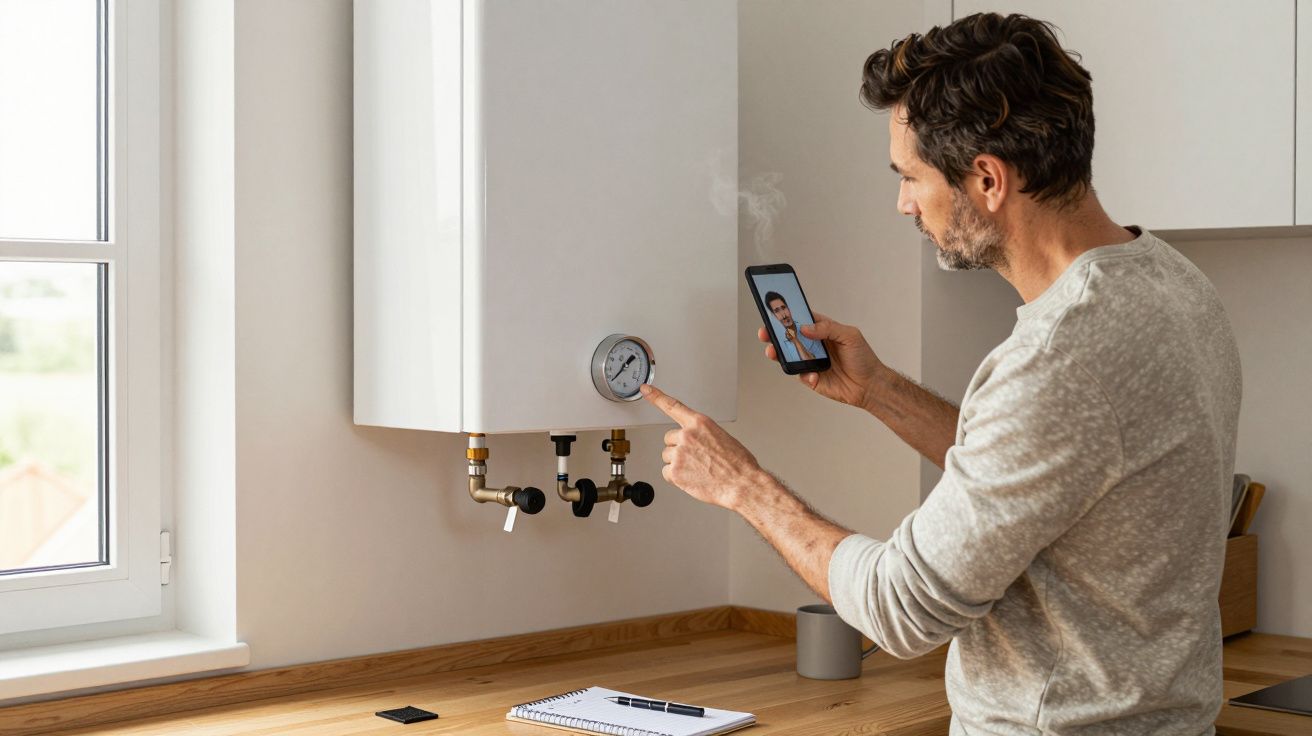
- Check the boiler pressure (for most combi systems). If it’s very low or very high, follow your manual to correct it, but don’t keep topping up a system that’s losing pressure repeatedly.
- Bleed radiators only if needed, and re-check pressure afterwards. Trapped air can create gurgling, but it’s usually a different sound from kettling; still, it’s an easy elimination step.
- Look for simple flow restrictions: thermostatic radiator valves stuck shut, isolation valves accidentally knocked, or a seized radiator valve pin. Don’t force anything.
- If the boiler is still kettling, book an engineer. Kettling is often fixable, but it’s rarely solved by “running it until it clears”.
If you smell gas, feel unwell, or suspect a carbon monoxide issue, stop and treat it as an emergency: ventilate, leave the property, and contact the relevant emergency services and your gas network operator.
How to tell kettling from other boiler noises
Boilers do make some normal sounds - fans spinning up, gentle ignition, and water moving. The trick is listening for the pattern and the “quality” of the noise.
- Kettling: harsh rumbling, popping, or banging that tends to appear when the boiler heats hard.
- Air in the system: gurgling or trickling, often more noticeable at radiators than at the boiler.
- Pump issues: whining, grinding, or a high-pitched buzz, sometimes followed by overheating lockouts.
- Expansion noises: ticking as pipes warm up and expand (often from floors or boxed-in pipework).
If the sound is new, sudden, or escalating, treat it as a fault until proven otherwise.
What usually causes it (and what the fix looks like)
An engineer will typically work through the likely culprits in a logical order, because “kettling” is a symptom, not a diagnosis.
- Limescale in the heat exchanger: common in hard-water regions; often addressed with a chemical descale, a powerflush (in some cases), and fitting or checking a scale reducer.
- Sludge/magnetite restricting flow: may need a system clean and a magnetic filter fitted or serviced.
- Restricted circulation: stuck valves, blocked plate heat exchanger (combi boilers), or a partially failed pump.
- Incorrect boiler settings: sometimes flow temperature is set unnecessarily high, amplifying the problem.
A quick “turn the temperature down” can reduce the noise, but it doesn’t remove scale or sludge. Think of it as earplugs, not treatment.
Why waiting can make it worse
Kettling is often the sound of heat stress. Running a boiler with poor heat transfer can lead to higher internal temperatures, more frequent cycling, and strain on components that aren’t cheap: pumps, heat exchangers, sensors, and diverter valves.
There’s also the household reality: the boiler might limp along until the coldest week, then fail when you need it most. The earlier you act, the more likely the fix is targeted rather than a cascade of parts.
A simple “next step” checklist before you call
Have these details ready. It speeds up diagnosis and stops you paying for time spent guessing.
- Boiler make/model and approximate age
- Whether the noise happens on heating, hot water, or both
- Boiler pressure reading (cold and when running, if safe to check)
- Any recent work: new radiators, drained system, refills, inhibitor added
- Your water hardness area (if you know it) and whether you have a scale reducer/softener
- Photos of any error codes or flashing lights
Quick guide: noise → likely issue → urgency
| Noise pattern | Likely cause | Action |
|---|---|---|
| Kettle-like rumble/popping when firing | Kettling from scale/flow restriction | Book engineer soon; reduce use until checked |
| Loud banging + repeated lockouts | Overheating/poor circulation | Stop using and arrange urgent visit |
| Gentle ticking in pipes/walls | Thermal expansion | Monitor; check pipe clips/boxing if needed |
Preventing it after the repair
Once kettling is fixed, prevention is mostly about water quality and flow.
- Add and maintain inhibitor (and don’t assume it’s still effective years later).
- Service the boiler annually and ask specifically about signs of scaling or restricted flow.
- Clean/fit a magnetic filter if your system is prone to sludge.
- In hard-water areas, consider a scale reducer/softener solution appropriate to your property.
- Keep flow temperature sensible; many systems run comfortably without maxing it out.
You’re not trying to make the boiler silent. You’re trying to keep it from boiling where it shouldn’t.
FAQ:
- Is kettling dangerous? It’s usually not immediately dangerous like a gas leak, but it is a warning sign of overheating or restricted circulation that can lead to breakdowns and component damage. If you suspect carbon monoxide or smell gas, treat that as an emergency.
- Can I fix kettling myself by topping up pressure? Correcting pressure can help if low pressure is the underlying issue, but kettling is most often caused by scale or poor flow. Repeatedly topping up without fixing the cause can worsen corrosion and sludge.
- Does turning the boiler temperature down solve it? It can reduce the noise by lowering heat stress, but it rarely removes the cause. Use it as a short-term measure while you arrange a proper inspection.
- Will a boiler service stop kettling? A good service can catch early signs and improve performance, but if scale/sludge is already significant, you may need descaling, cleaning, or system flushing in addition to routine servicing.






Comments (0)
No comments yet. Be the first to comment!
Leave a Comment