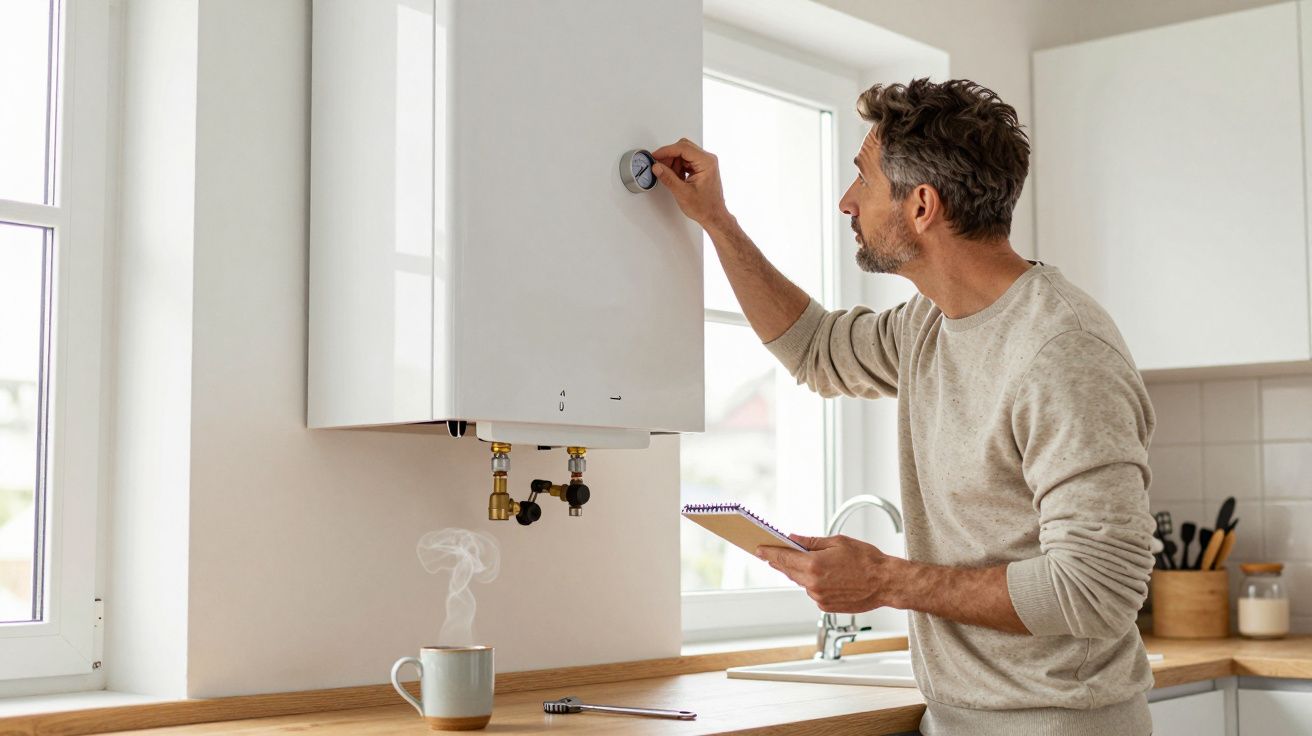
Boilers tend to fail in the least dramatic way possible: a small part gets tired, the system becomes temperamental, and you only notice when the hot water turns lukewarm halfway through a shower. Knowing which boiler components typically go first makes component replacement feel less like guesswork and more like a simple plan. The aim isn’t to turn you into an engineer; it’s to help you spot early warning signs before a cheap part becomes an expensive call-out.
Most breakdowns are wear-and-tear, not mystery. Heat, water, scale, vibration and thousands of on/off cycles do their quiet work, and the same few parts end up carrying the blame.
What “fails first” usually means in a real home
In practice, the first component to fail is often the one that moves, senses, or seals. Anything with a diaphragm, a small motor, a microswitch, or a delicate circuit board is living a harder life than the steel case suggests.
There’s also a location factor. Areas with hard water ask more of heat exchangers, diverter valves and sensors, while older systems with sludge punish pumps and pressure components. A boiler can be “serviced regularly” and still suffer if the water quality is brutal.
Think of it as a queue, not a lottery: a few parts are simply nearer the front.
The top boiler components most likely to fail first
1) Pressure relief valve (PRV) and small seals
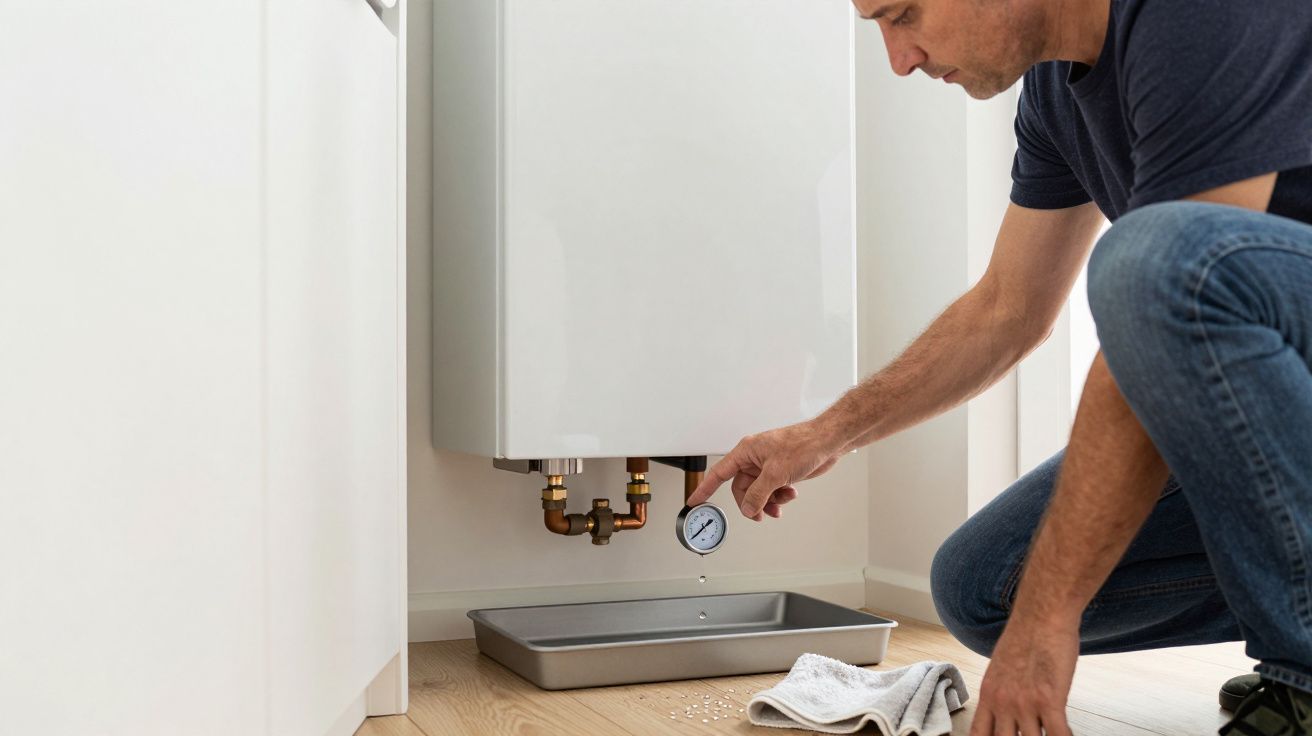
The PRV is designed to protect the boiler by releasing water if pressure gets too high, but it can start to weep as the internal seal ages or debris catches it slightly open. The symptom is often a slow, annoying pressure drop that returns even after topping up.
Component replacement here is usually straightforward, but the key is not to ignore it. A constant top-up introduces fresh oxygen, which can accelerate corrosion elsewhere in the system.
Common clues
- Pressure falls over days, not minutes
- Damp staining or drips from the discharge pipe outside
- You keep “just topping it up” more and more often
2) Diverter valve (combi boilers)
If you have a combi, the diverter valve is the traffic controller switching heat between taps and radiators. It moves a lot, and it doesn’t enjoy limescale, grit or sticky seals.
When it starts failing, you’ll get odd crossover behaviour: radiators warming when you run a hot tap, or hot water going tepid as soon as the heating demand changes.
Common clues
- Hot water is intermittent, especially under mixed use
- Radiators heat up when you only want hot water
- Clicking/whirring followed by no real change in output
3) Pump (or pump head)
Pumps wear because they spin, and they spin in water that may carry sludge or magnetite. Sometimes the pump body is fine and it’s the head that fails; sometimes the bearings get noisy, or the pump sticks after a summer off.
A failing pump can look like “the boiler is on but nothing is circulating”. You’ll often see overheating errors, kettling noises, or radiators staying cold despite the burner running.
Common clues
- Boiler fires but radiators stay cool
- Loud humming, grinding, or repeated cycling
- Overheat or circulation fault codes
4) Ignition and flame sensing (electrodes)
Ignition electrodes and flame sensors sit right where the action is: high heat, combustion residue, repeated starts. Over time they can crack, drift out of position, or simply become coated.
The boiler will try to light, fail, and lock out. It’s a small part with a big impact, and it’s one of the more common “it worked yesterday” failures.
Common clues
- Repeated ignition attempts (tick-tick-whoosh… then lockout)
- Boiler locks out in cold weather starts
- Reset temporarily fixes it, then it returns
5) Printed circuit board (PCB)
The PCB is the brain, and like most brains it doesn’t appreciate power fluctuations, moisture, or heat soak. It’s not always the first to fail, but it’s high on the list because so many other symptoms can trace back to it.
A PCB fault can mimic several component failures at once: fans running at the wrong time, pumps not energising, or random lockouts with no consistent pattern. Diagnosis matters here, because “swap the board” is not a cheap experiment.
Common clues
- Unpredictable faults that come and go
- Error codes that don’t match the behaviour
- Visible scorching or swollen capacitors (engineer-only inspection)
6) Fan (room-sealed boilers)
Modern boilers rely on the fan to prove safe combustion and move flue gases correctly. Bearings wear, dust builds up, and the fan can drift out of spec until the boiler refuses to run for safety reasons.
Fan issues often present as a boiler that starts a sequence, then aborts before ignition, or runs noisily.
Common clues
- Whining or rattling during start-up
- Boiler attempts to start then stops before lighting
- Flue-related fault codes
7) Expansion vessel (and its charge)
The expansion vessel absorbs pressure changes as water heats. Over time the internal diaphragm can fail or the air charge can drop, leaving the system “spiky”: pressure shoots up when hot, then dumps water via the PRV, then you’re back to topping up.
This is the classic loop where one small problem creates another. Fixing the PRV without addressing a flat vessel is how people pay twice.
Common clues
- Pressure rises sharply when heating is on
- PRV discharge outside when boiler is hot
- Pressure collapses when it cools
A quick way to match symptoms to likely component replacement
Nobody wants a long diagnostic flowchart at 7am. Use this as a compact starting point for a conversation with your engineer, not as a DIY instruction manual.
- Pressure drops, no obvious leaks: PRV, expansion vessel, filling loop left slightly open
- Hot water flaky but heating mostly fine (combi): diverter valve, plate heat exchanger scaling
- Boiler fires, radiators cold: pump, system sludge, blocked filter
- Locks out on ignition: electrodes, gas supply issues, PCB control fault
- Noisy start-up, stops before lighting: fan or air pressure proving components
The small habits that stop the “first failure” becoming the second
The pattern across call-outs is familiar: a part fails, the system compensates badly, and another part gets dragged into the mess. Preventing that is less about gadgets and more about attention.
A short checklist that genuinely helps:
- Keep an eye on boiler pressure weekly in winter; note changes rather than constantly topping up.
- Book an annual service that includes combustion checks and a look at filters/magnets if fitted.
- In hard-water areas, ask about limescale risk to the hot-water side (especially combis).
- If pressure spikes when hot, mention the expansion vessel specifically-don’t let it be an afterthought.
When “replace the part” is the right call (and when it isn’t)
Component replacement is sensible when the boiler is otherwise sound, parts are available, and the repair restores reliability without chasing fault after fault. It’s also sensible when a small part is causing larger system stress-PRVs and expansion vessels are good examples.
It’s less sensible when multiple core components are failing close together, or when the heat exchanger is compromised, or when the boiler is at an age where repeated repairs are just a subscription in disguise. A good engineer will tell you when you’re fixing the right thing versus feeding a tired system.
A simple table to prioritise what to check first
| Component | Why it fails early | Typical impact |
|---|---|---|
| PRV / seals | Wear, debris, pressure cycling | Pressure loss, topping up loop |
| Diverter valve | Movement + limescale | Hot water/heating crossover |
| Pump | Bearings, sludge, sticking | No circulation, overheating |
FAQ:
- Which part fails most often in a combi boiler? Common repeat offenders are the diverter valve (switching between hot water and heating) and pressure-related parts like the PRV/expansion vessel, especially where water is hard or the system is frequently topped up.
- Is it safe to keep topping up the boiler pressure? Occasional topping up is normal, but frequent topping up usually means a fault. It also introduces fresh oxygen into the system, which can increase corrosion and lead to more failures.
- Does a new PCB always fix random lockouts? Not always. Random lockouts can be PCB-related, but they can also come from fans, sensors, poor earthing, moisture, or intermittent gas/ignition issues. Proper diagnosis is worth the time.
- How do I reduce the chance of early component replacement? Annual servicing, clean system water (filter/magnetic filter where appropriate), and dealing early with pressure spikes/drops are the most practical ways to extend component life.





Comments (0)
No comments yet. Be the first to comment!
Leave a Comment