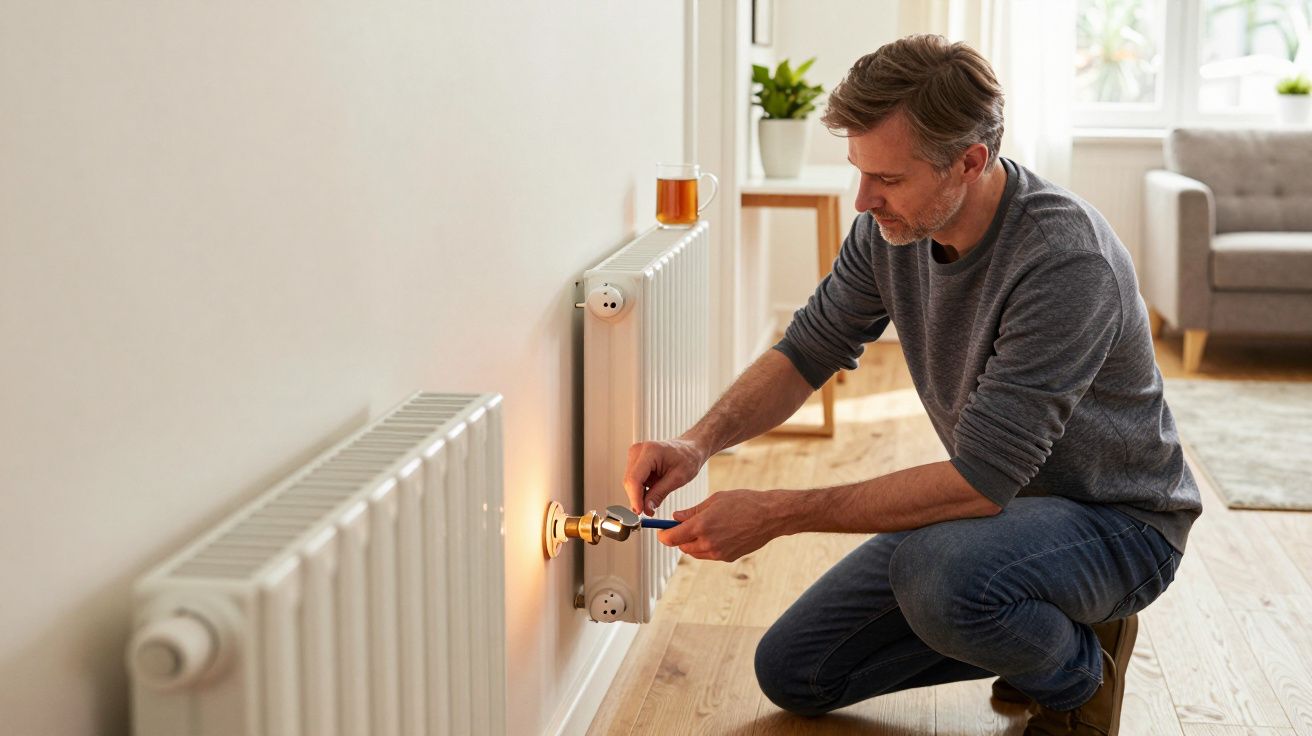
The first time you notice uneven heating, it’s tempting to blame the boiler. But most of the time the real story sits in the pipework: radiators that are starved or overfed because system balancing hasn’t been done (or has drifted over the years). Getting it right matters because it’s the difference between one room feeling like a sauna and another never quite drying your socks.
I got the message on a Tuesday: “Upstairs is roasting, downstairs is freezing. Boiler’s new. What gives?” I stood in the hallway with a mug going cold, listening to the familiar hush-and-gurgle soundtrack of a central heating system trying its best. The house wasn’t broken. It was just unfair.
Uneven heating rarely begins at the boiler
Picture your heating system like a queue that no one is policing. Hot water takes the easiest route first, then whatever’s left meanders to the rest. The radiators closest to the boiler (or on the easiest loop) greedily fill with flow, and the ones at the end of the run get the scraps.
That’s why “the boiler is fine” and “the house is cold” can both be true. The heat exists. It just isn’t arriving evenly.
You can bleed a radiator until you’re blue in the face and still have a cold patch of home, because bleeding fixes trapped air, not unfair distribution. The fix for unfair distribution is boring, precise, and wildly underrated: balancing.
System balancing: the quiet tweak that changes everything
System balancing is simply adjusting each radiator’s lockshield valve so the flow is shared across the house. Not equal turns for every valve-equal outcomes. The goal is that each radiator warms up in a predictable way, rather than the first two doing all the work.
The reason it works is almost rude in its simplicity. Restrict the radiators that hog the flow, and you force hot water to travel further to the radiators that need it. Less drama. More maths.
A useful mental picture: you’re not “making the hot ones hotter”. You’re putting a speed limit on them so the whole street gets served.
The telltale signs your radiators aren’t balanced
You don’t need gauges and lab coats to suspect a balancing issue. Most homes give you a few very human clues:
- One or two radiators get hot fast; others stay lukewarm even with the thermostat up.
- Upstairs heats well while downstairs lags (or vice versa), despite similar radiator sizes.
- Rooms at the end of the circuit are always the last to warm, even after bleeding.
- You keep turning the thermostat up just to make the cold room acceptable.
There’s also a subtler clue: the boiler short-cycles (switching on and off frequently) because the system reaches temperature too quickly near the boiler, while the rest of the house remains under-heated. That’s comfort you can’t trust.
A plain-English way to balance (without pretending it’s fun)
If you’re comfortable adjusting valves, balancing is doable, but it rewards patience. You’re making small changes, then waiting for the system to respond.
Here’s a sensible, low-chaos approach:
- Start from a stable baseline. Turn the heating on, let everything warm up, then turn it off and allow radiators to cool fully.
- Open every thermostatic radiator valve (TRV) fully. TRVs are for room control; balancing is done on the lockshield.
- Find the lockshield valve on each radiator (usually under a plastic cap, opposite the TRV). Note its current position so you can undo mistakes.
- Open all lockshields, then begin restricting the quickest/hottest radiators first. Small turns-often an eighth to a quarter turn-then wait.
- Aim for similar “warm-up behaviour” across the house. You’re looking for the laggards to catch up without the front-runners racing away.
A lot of guides talk about temperature drops across each radiator. That’s a good method if you have clip-on thermometers and the patience of a watchmaker. In real homes, a simpler target often works: stop the nearest radiators from getting everything first.
Let’s be honest: nobody really does this on a calm Saturday with a clipboard. Most people do it once, after months of annoyance, and then wonder why they didn’t earlier.
What not to do when one room won’t heat
Some fixes feel productive but mostly just shuffle the problem around:
- Don’t keep cranking the thermostat to “push” heat to a cold radiator. You’ll just overheat the easy rooms and waste energy.
- Don’t assume bleeding is the cure if the radiator gets warm at the bottom but not really across the room. Air causes top-cold/bottom-hot patterns; poor flow looks different.
- Don’t fully close lockshields unless you’re isolating a radiator for a reason. Balancing is restriction, not punishment.
- Don’t ignore sludge signs (radiators cold at the bottom, dirty water when bleeding, frequent blockages). Balancing can’t fix a blocked radiator.
If the system is dirty, balancing becomes a fight with one hand tied behind your back. Clean flow comes first; fair flow comes next.
When to call someone in (and what to ask for)
If you’ve got microbore pipework, an older system, a recently moved radiator, or a new pump/boiler installed without a proper setup, professional balancing is often worth it. The house stops arguing with itself.
When you book an engineer, don’t just say “a radiator is cold”. Say:
- “The system needs balancing-some radiators heat much faster than others.”
- “Please check pump speed and confirm radiator flow distribution.”
- “Can you confirm the bypass setting and whether TRVs/lockshields are set sensibly?”
Those phrases steer the visit away from quick, superficial tweaks.
| What you notice | Likely cause | What tends to help |
|---|---|---|
| Near radiators hot, far radiators cool | Poor system balancing | Adjust lockshields to share flow |
| Radiator cold at top, warm at bottom | Air trapped | Bleed radiator, check pressure |
| Radiator cold at bottom | Sludge/partial blockage | Flush/clean, then balance |
FAQ:
- What is system balancing, in one line? Adjusting radiator lockshield valves so hot water is distributed evenly, rather than favouring the easiest route.
- Do I need to balance if I have TRVs? Often yes. TRVs control room temperature, but they don’t guarantee fair flow around the whole system.
- Can balancing save money? It can, because you stop overheating “easy” rooms just to make “difficult” rooms livable, and the boiler can run more steadily.
- How often should balancing be done? Typically after changes (new boiler, pump, radiators moved) or when uneven heating shows up; it can drift as valves and pumps age.
- What if only one radiator is cold? Check for air and valve issues first, but if that radiator is at the end of the run, poor balancing is a common culprit-especially if others are scorching hot.
Uneven heating feels like a mystery until you see the pattern: the system is doing what physics encourages, not what comfort requires. The boiler makes the heat. Balancing decides who gets it.

Comments (0)
No comments yet. Be the first to comment!
Leave a Comment