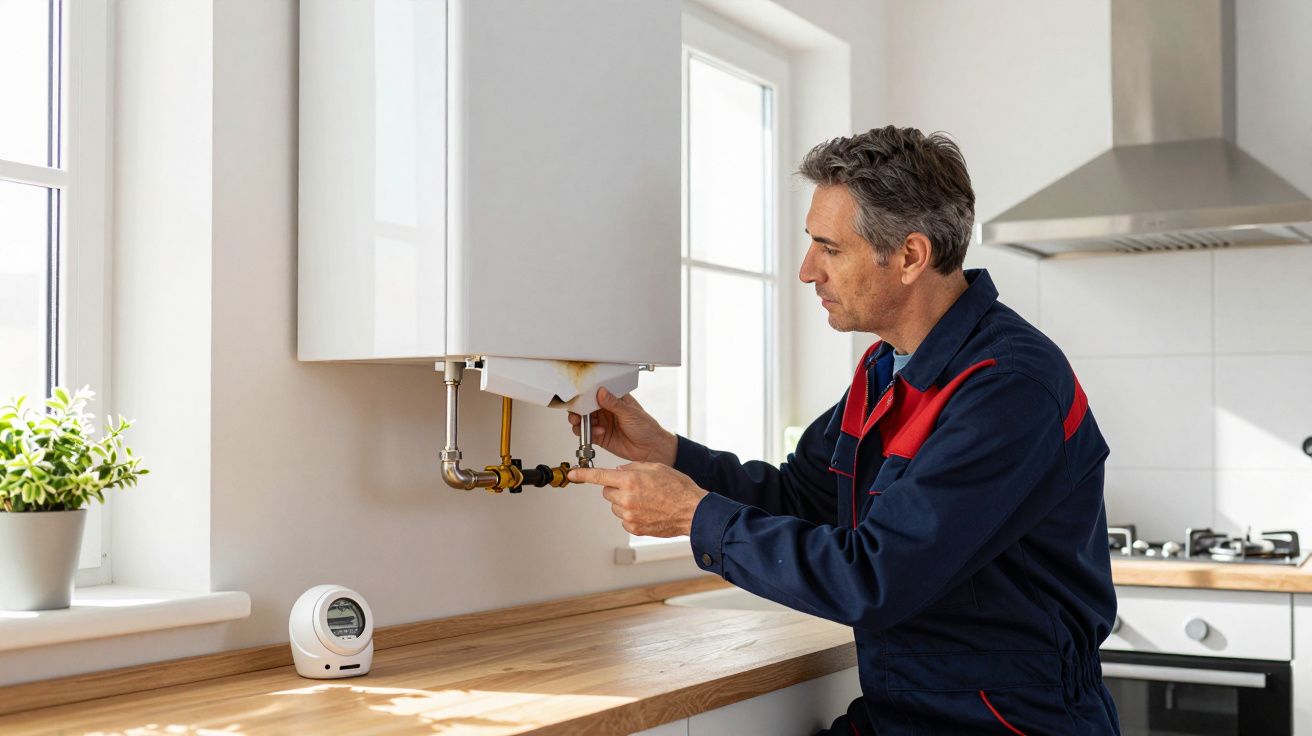
Most people only notice a flue system when something smells odd, a boiler keeps cutting out, or a new stove is being fitted. Engineers notice it because it’s where carbon monoxide prevention either quietly succeeds for a decade or fails in a way that’s sudden, boring, and dangerous. It’s also one of those parts of a building that gets treated like “just a pipe”, right up until the day it proves it isn’t.
If you’ve ever watched a gas engineer pause, go quiet, and stare at a run of ducting longer than feels polite, you’ve seen the moment. They’re not being dramatic. They’re doing mental arithmetic with airflow, temperature, pressure, and the ways real homes sabotage neat diagrams.
The bit you don’t see is the whole point
A flue isn’t just a route for smoke. It’s a controlled pathway for combustion products to leave the appliance and the building without leaking into the room, condensing in the wrong place, or being pulled back by wind or fans.
Engineers think in “systems”, not components. That means they’re looking at how the appliance, the flue route, the terminal outside, and the room’s ventilation all behave together. A flue that’s perfect on paper can be wrong in a kitchen with a powerful extractor and a sealed-up window.
When it goes wrong, it rarely announces itself with a cinematic cloud. More often it’s subtle: a staining mark, a damp patch, an intermittent lockout, a reading on a flue gas analyser that doesn’t sit right. The job is to spot those weak signals before they become an incident.
What engineers are scanning for in the first minute
There’s a certain rhythm to a proper look at a flue installation. Tools come out later; the first pass is pattern recognition.
They’re clocking:
- What kind of appliance it is (room-sealed, open-flued, condensing).
- Whether the flue route matches what the manufacturer permits.
- If the visible joints, supports, and clearances suggest careful work or “made it fit”.
- Whether the terminal position outside looks like it can actually breathe.
They’re also reading the room. Trickle vents taped over. An extractor fan that could pull a hat off your head. A tumble dryer venting indoors. Little household choices that change pressure conditions and can turn an edge-case flue into a problem.
This is why two homes with the “same boiler” can behave completely differently. Buildings have personalities, and flues have to live in them.
The quiet physics that decides whether it’s safe
A flue system is trying to maintain one basic promise: keep combustion products moving the right way, all the time. That promise depends on forces you can’t see, and that’s what engineers tend to trust more than appearances.
Draft, dilution, and why fans matter
Natural draft appliances depend on warm gases rising. Anything that cools those gases too early, disrupts the path, or creates negative pressure in the room can weaken that lift.
It’s not just open windows and “a bit of breeze”. Modern homes have extractors, MVHR systems, bathroom fans, and sometimes a kitchen hood that behaves like a small aircraft engine. If the room is too tight and air can’t replace what’s being pulled out, the flue can spill. That’s where carbon monoxide prevention stops being a slogan and becomes a ventilation calculation.
Condensing reality: water is part of the design
Condensing boilers produce condensate. That means the flue gases are cooler, and water will form inside the flue by design. Engineers pay attention to:
- Correct fall back to the appliance (so condensate drains where it should).
- Whether the flue material is appropriate for wet, acidic conditions.
- Signs of pooling, gurgling, or staining that suggest the fall is wrong.
A flue can be “tight” and still be wrong if it’s holding water in a low spot. Over time that can corrode components, obstruct flow, and create leak paths. It’s slow failure, not dramatic failure-which is exactly why it’s missed.
The common mistakes that make engineers wince
Most dangerous flue issues aren’t exotic. They’re ordinary shortcuts, misunderstandings, or “it passed once” complacency.
A few repeat offenders:
- Improvised extensions or mixed parts that aren’t manufacturer-approved as a set.
- Too many bends or an excessive equivalent length, reducing effective flow.
- Poorly supported runs that sag and create condensate traps.
- Terminals placed badly-too close to opening windows, corners, eaves, or where wind can cause recirculation.
- Sealed-up ventilation because someone was cold or annoyed by draughts.
- Shared or boxed-in routes where inspection is impossible and small leaks go unnoticed.
Engineers also pay attention to the “history” of the installation. Fresh sealant where it shouldn’t be. A new section of ducting that doesn’t match. Sooting that’s been wiped but not explained. These are the building’s little tells.
How a safety check actually works (when it’s done properly)
From the outside, a service can look like a quick tidy-up. In reality, the core is measurement and verification: does the appliance burn correctly, and do the products of combustion leave correctly?
A conscientious engineer will typically:
- Confirm the appliance type and flue specification from the manufacturer instructions.
- Visually inspect the full accessible flue route and terminal position.
- Check ventilation provisions and any relevant room conditions.
- Perform combustion analysis and compare readings to expected ranges.
- Where appropriate, carry out spillage/draft checks and safety device checks.
What matters is not one test in isolation, but the story they tell together. A borderline reading doesn’t automatically mean panic; it means “something in this system is drifting”, and drifting is where risk lives.
What this means for homeowners (and why “it seems fine” isn’t a test)
Most people only want one answer: “Is it safe?” Engineers tend to answer a slightly different question: “Is it safe under the conditions this home actually creates?”
You can help by treating the flue system as part of the home’s safety equipment, not part of the décor. Practical habits that support carbon monoxide prevention are unglamorous, but they work:
- Don’t box in flues or terminals in a way that prevents inspection.
- Don’t block air vents, even if they’re annoying.
- If you change the room (new extractor, new windows, a renovation), assume the combustion conditions changed too.
- Fit a CO alarm in the right place as a backstop, not as permission to ignore servicing.
A well-designed flue is meant to be boring. The moment it becomes “interesting”, you want someone trained to read the signs.
| What engineers look for | Why it matters | What you might notice |
|---|---|---|
| Terminal siting and clearance | Prevents recirculation and re-entry | Smells near windows, staining outside |
| Flue integrity and support | Stops leaks and condensate traps | Damp patches, odd noises, corrosion |
| Ventilation and room pressure | Reduces spillage risk | Boiler acting “temperamental” with fans on |
The reassuring part: most issues are fixable when found early
In plenty of call-outs, the outcome isn’t a horror story. It’s a minor correction: re-routing a section to the correct fall, replacing an incompatible part, adding proper support, restoring ventilation, relocating a terminal, or updating an old appliance.
The real risk is delay. Carbon monoxide is at its most dangerous when it’s treated as a distant, dramatic thing that happens to other people. Engineers treat it as a practical possibility managed by correct design, correct installation, and checks that don’t cut corners.
FAQ:
- Is a carbon monoxide alarm enough on its own? No. It’s a last line of defence. A safe flue system and properly installed appliance are the primary controls; the alarm is there in case those controls fail.
- Can I box in a flue for aesthetics? Often you can, but only if access and inspection requirements are still met and you’re not restricting clearances or creating hidden joints. Check the manufacturer guidance and get advice before altering anything.
- Why does my boiler act up when the kitchen extractor is on? Strong extractors can change room pressure and airflow. If ventilation is marginal, that can affect combustion and flue performance, especially in tighter homes.
- Do flues need checking even if the appliance seems to run fine? Yes. Many flue faults develop slowly and don’t show obvious symptoms until they’re serious. Regular servicing is about catching drift early.






Comments (0)
No comments yet. Be the first to comment!
Leave a Comment