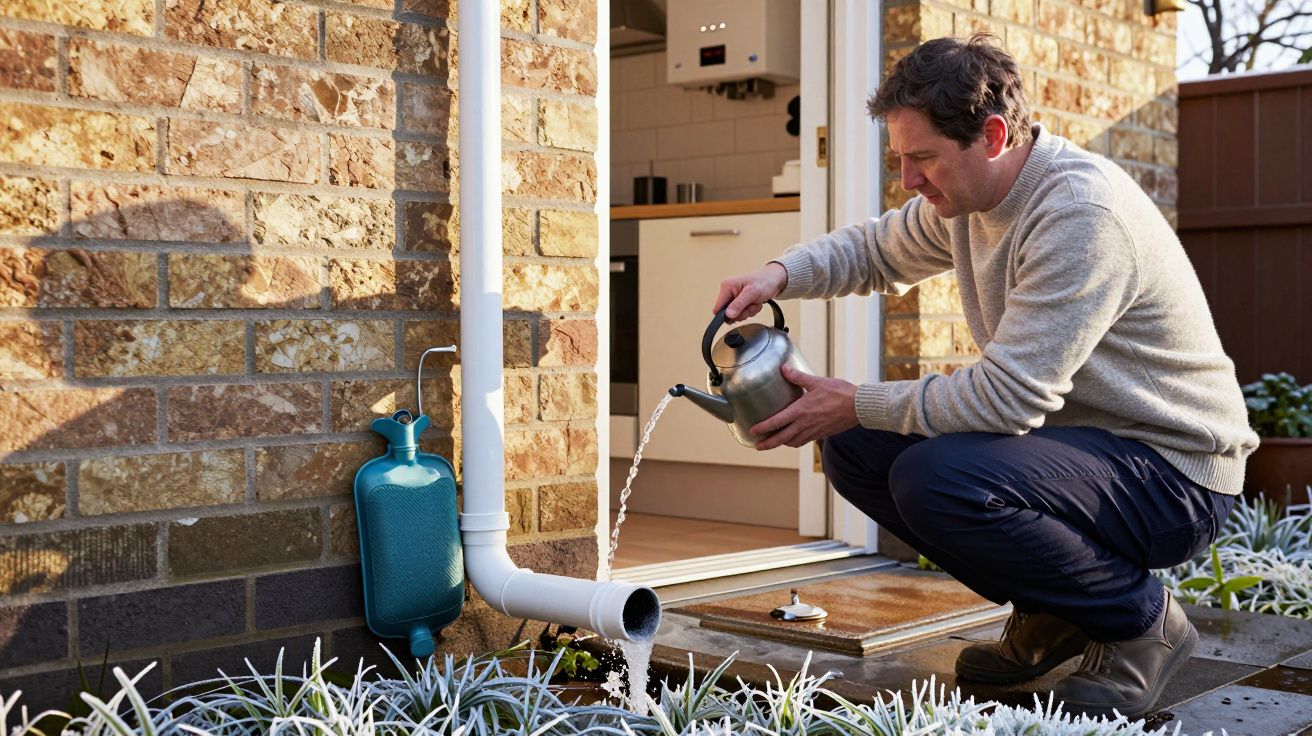
A condensate pipe is the small plastic waste pipe that carries acidic water away from your condensing boiler, usually to a drain outside or into a soil stack. When you end up with a frozen condensate pipe, the boiler can’t get rid of that water, so it shuts down for safety-often on the coldest morning, when you need heat the most.
It feels like a mystery fault because nothing looks “broken”. The radiators just go cold, the hot water stops, and the boiler starts flashing an error code like it’s offended by the weather.
The quiet job your condensate pipe does, every day
A condensing boiler pulls extra heat out of the flue gases. That efficiency creates condensate: a steady trickle of water that has to go somewhere. The condensate pipe is the exit route, and when it’s free-flowing, you never think about it.
In mild weather it’s uneventful. In a proper UK cold snap, it becomes the weak link-because the pipe is often small in diameter, uninsulated, and routed outside where the wind can get at it.
What “freezing” actually means inside the pipe
A frozen condensate pipe isn’t usually a pipe that has split wide open like a burst mains. Most of the time, it’s an ice plug. A small section-often the first exposed bend, or the end near the outlet-freezes first, then the next bit backs up behind it.
Condensate keeps coming. It trickles down from the boiler, meets the blockage, and starts pooling in the internal trap and pipework. That’s when the boiler protects itself by stopping, because it’s designed not to run if it can’t dispose of condensate safely.
If you’ve ever noticed a boiler working fine, then failing after a few heating cycles, that’s the pattern: thaw a little, run a bit, refreeze, block again.
How the boiler behaves when the pipe is blocked
Manufacturers vary, but the story is similar. The boiler detects a problem with the condensate level or pressure switch and locks out. You’ll see a fault code that often mentions “condensate”, “flue”, “drain”, or a generic “lockout” message that’s not very kind to non-engineers.
The key point is this: the boiler isn’t being temperamental. It’s avoiding a scenario where condensate backs up into places it shouldn’t, or where freezing causes damage during operation.
Signs people often notice at home:
- Boiler display shows a fault code and won’t fire
- No heating and no hot water, but power is on
- Gurgling sounds near the boiler (trapped water struggling to move)
- An outside pipe or outlet looks iced over
Why it freezes there (and not somewhere more sensible)
Freezing usually happens where the pipe is most exposed and least protected. That tends to be:
- A long horizontal run outdoors
- A section in the wind (north-facing walls are classic)
- A shallow fall (not enough slope for water to keep moving)
- A pipe that terminates into a gully where standing water freezes around the end
Even a short outside section can freeze if it’s thin, uninsulated, and gets a constant trickle in sub-zero temperatures. Condensate doesn’t come out hot-it’s cool enough to freeze readily once it’s in the open air.
The risk isn’t just “no heating”
The immediate pain is obvious: a cold house. But repeated freezing and thawing can create a longer-running nuisance.
A persistent blockage can lead to:
- Internal leaks around the condensate trap or joints (water looking for an escape)
- Stress on plastic fittings if ice forms in awkward spots
- Corrosion risk if condensate ends up where it shouldn’t (it’s mildly acidic)
- A cycle of lockouts that wears down patience and invites unsafe DIY resets
Most of the time, once thawed properly, everything returns to normal. The bigger issue is recurrence-because the pipe layout is still the same, and the next cold night will do it again.
What to do if you suspect a frozen condensate pipe
If you’re comfortable and it’s safe to do so, you’re looking for the outside section of white/grey plastic pipe from the boiler. The frozen point is often close to the end, where the pipe meets the drain, or at an exposed bend.
A practical, cautious approach looks like this:
- Turn the boiler off (or follow the manual’s safe shutdown guidance).
- Check the pipe route and find the likely frozen section outside.
- Thaw gently using warm (not boiling) water poured along the pipe, or a hot water bottle held against it.
- Dry and reset: once you think it’s flowing, dry the area and then reset the boiler according to the manufacturer instructions.
Avoid direct high heat (blowtorches, heat guns on full blast) on plastic pipework. It’s very easy to soften a joint, create a sag that holds water, or cause a leak that only shows up later.
If you can’t access the pipe safely, or you’ve thawed it and it immediately refreezes, that’s the moment to call an engineer-because the real fix is often about rerouting, insulating, or increasing protection, not heroic defrosting at 6am.
How to stop it happening again (without turning your house into a building site)
Prevention is usually simple, but it needs to be deliberate. The goal is to keep condensate moving and keep the cold off the pipe.
Common improvements include:
- Insulating the outside run with weatherproof lagging
- Shortening the external section where possible
- Increasing pipe diameter on the outside section (engineer job, but very effective)
- Improving the fall so water doesn’t sit in a low spot
- Rerouting to an internal drain where feasible
A small change can make a big difference. People often assume they need a new boiler, when what they actually need is a better path for a cupful of water an hour.
“It’s not the cold that breaks your heating,” an engineer once told me. “It’s the centimetre of pipe that the wind owns.”
The quick “why it matters” recap
When a condensate pipe freezes, the boiler usually isn’t broken-it’s blocked. The frozen plug stops drainage, the boiler detects the problem, and it shuts down to protect itself. Thawing restores flow, but insulation and proper routing are what stop the same drama repeating.
If your boiler locks out every time temperatures drop, you’re not unlucky. You’re being shown exactly where the system is most exposed.
FAQ:
- What fault code means a frozen condensate pipe? It depends on the boiler model, but codes mentioning condensate, drainage, flue, or a lockout during freezing weather are common. Check your manual for the specific code meaning.
- Can I pour boiling water on the pipe to thaw it faster? It’s better to use warm water. Boiling water can stress or soften plastic pipework and joints, creating leaks later.
- Will the boiler start working again immediately after thawing? Often yes, once the blockage clears and the boiler is reset. If it keeps locking out, the pipe may be refreezing or there may be another issue.
- Is a frozen condensate pipe dangerous? It’s usually not dangerous in itself, but repeated lockouts can tempt unsafe tinkering. If you smell gas, suspect flue issues, or can’t access the pipe safely, stop and call a qualified engineer.
- What’s the best long-term fix? Insulate and minimise external pipe runs, and ensure the outside section has the correct diameter and fall. An engineer can assess the route and adjust it to meet best practice.






Comments (0)
No comments yet. Be the first to comment!
Leave a Comment