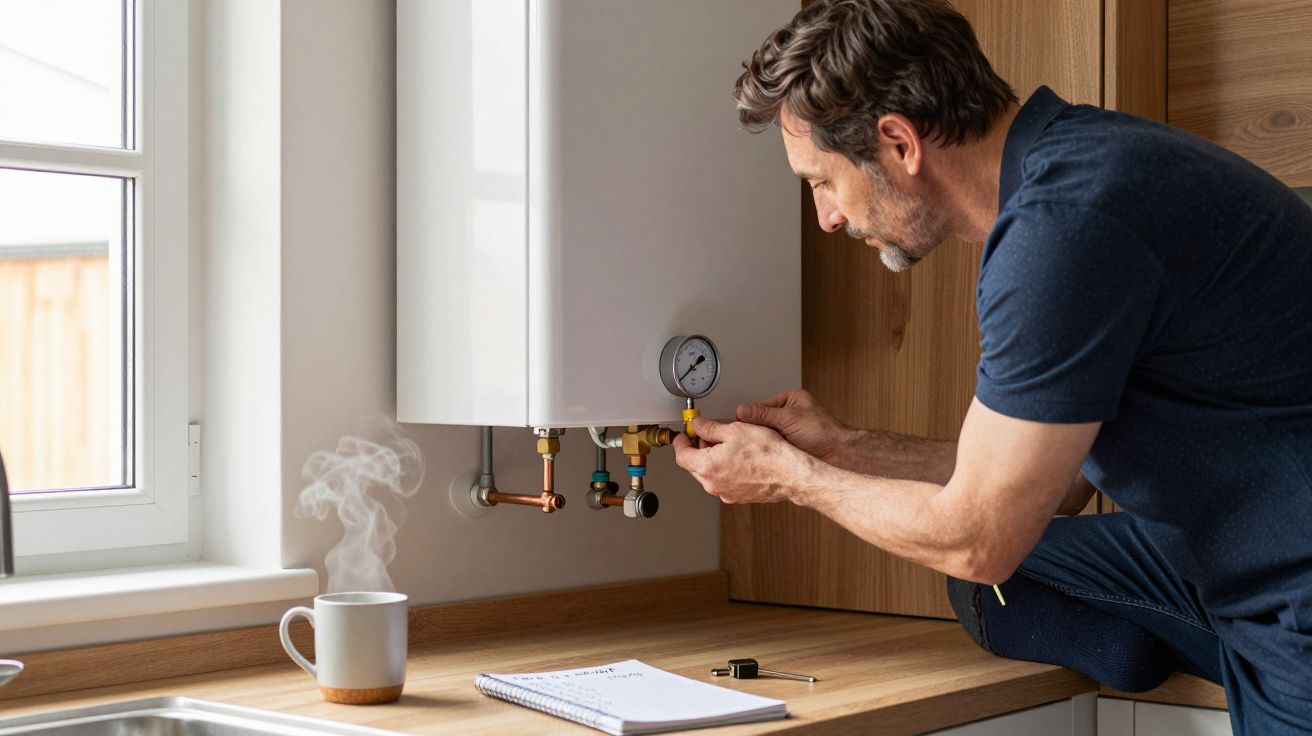
The first cold snap always reveals the truth. A gas boiler can look perfectly fine in a British kitchen cupboard-hot water on tap, radiators warm-while hidden failures quietly stack up behind the casing. That matters because boilers don’t tend to “half-fail” politely; they often limp along until the day you need them most, then stop with a sulk, a bang, or a flashing fault code at 6:30am.
If you’ve ever stood in socks on freezing tiles, listening to a fan whirr that never quite catches, you already know the feeling. The system is technically working. The margin is what’s gone.
When “working” is just a narrow corridor
Boilers are good at compensating. Modern controls will adjust the gas-air mix, modulate the burner, ramp a pump, retry ignition, and smooth over small weaknesses that would have stopped older appliances dead. For weeks or months, you get heat-just with a little more effort, a little more noise, a little more time.
That compensation is the corridor. The moment the corridor narrows-weather turns colder, pressure drops, a component drifts a bit further out of spec-you fall out of it. What looked stable was simply the boiler doing extra work to hide the problem.
A useful way to think about it: the boiler isn’t a light switch, it’s a tight choreography. Flame, airflow, water flow, sensors and safety controls all have to agree, every cycle, often dozens of times a day.
The quiet warning signs people rationalise away
Most near-failures announce themselves, just not in a dramatic way. They show up as tiny bits of friction you learn to live with because everything else is busy.
Look out for patterns rather than one-off weirdness:
- Hot water takes longer to arrive than it used to, especially on mornings.
- Radiators heat unevenly, or the system needs frequent bleeding.
- The boiler cycles on and off more often (short-cycling), even when demand is steady.
- New noises: kettling/rumbling, whistling, clicking, or a fan that sounds strained.
- You’re topping up pressure more than once every few months.
- Occasional lockouts that “fix themselves” after a reset.
None of these proves imminent failure on its own. Together, they’re often the story.
Hidden failures that keep heat flowing-until they don’t
1) The heat exchanger slowly furred up
Limescale (hard water areas) and sludge (magnetite from corrosion) don’t usually stop heating overnight. They reduce heat transfer and restrict flow, which forces the boiler to run hotter internally to achieve the same output. That’s when you get kettling, short-cycling, and stress on seals, pumps and sensors.
Your shower still feels hot. The exchanger is just working harder than it should, and components age faster in that extra heat.
2) Fan and flue problems that start as “slightly off”
The fan proves safe combustion by moving air through the sealed chamber and flue. As it wears-bearings, dust ingress, condensate exposure-it may still spin, but not at the right speed or with the right stability. The boiler might retry ignition, run rough, or lock out intermittently.
Flue issues can be even sneakier: partial blockage, poor termination, a loose connection, or a condensate trap problem. You might only notice it on windy days, or only when the boiler is under high load.
3) Ignition and flame sensing that’s living on second chances
Ignition electrodes and flame sensors live in a harsh environment. They erode, get contaminated, and drift. The boiler can often compensate by sparking longer, retrying, or modulating differently. That’s when you see the classic “it works after a reset” behaviour.
Resets are not a fix. They’re a clue that the system is using its backup attempts more often than it used to.
4) Pressure loss that the filling loop is masking
If you’re topping up the pressure regularly, something is letting water escape: a small leak on pipework, a weeping radiator valve, a failing pressure relief valve, or an expansion vessel that’s lost its charge.
A tired expansion vessel is a frequent culprit. The boiler still heats, but pressure swings become more extreme as the system warms and cools. Eventually you get nuisance trips, discharge outside, or stress on joints and seals.
5) Sensors and controls that are “close enough” until winter
NTC thermistors, flow sensors, diverter valves, PCB relays-many failures start as drift, not death. A sensor can read slightly wrong and the boiler will still run, just less efficiently and with more cycling. A sticky diverter valve can still send hot water, but not cleanly, leading to temperature swings or radiators warming during a shower.
Cold weather is the amplifier. Higher demand exposes the weak link.
The 90-second home check (no tools, no heroics)
You don’t need to take the cover off to learn something useful. Do a quick, calm check when the boiler is running for hot water and again when it’s running for heating.
- Watch the pressure gauge: is it stable, or does it climb sharply when heating?
- Listen at ignition: does it light cleanly, or does it hesitate, click repeatedly, or “whoomp”?
- Note the rhythm: steady run is usually healthier than frequent on/off bursts.
- Check the condensate pipe (in cold weather): any signs of freezing risk outside?
- Walk a radiator circuit: are some radiators cold at the bottom (sludge) or top (air)?
If anything feels new or worsening, write it down. Engineers diagnose faster when symptoms are specific and repeatable.
“A boiler rarely surprises you,” one heating engineer told me. “We’re usually just the first person you tell the truth to.”
What to do before it becomes a no-heat day
The goal isn’t panic; it’s margin. Small interventions early can prevent a bigger failure later.
- Book an annual service with combustion checks, not just a quick look-over.
- If you’re in a hard water area, ask about scale risk and exchanger condition.
- Consider a system filter (magnetic) if you don’t have one, and get it cleaned.
- If pressure is dropping, don’t keep topping up indefinitely-find the cause.
- If the boiler is 10–15+ years old, plan replacement on your terms, not during an emergency.
A “working” boiler is not the same as a healthy boiler. Healthy means it can meet demand without constantly compensating, retrying, or running on stressed components.
| Sign you notice | Likely hidden issue | Why it matters |
|---|---|---|
| Frequent top-ups | Leak/PRV/expansion vessel | Pressure swings stress parts and trigger lockouts |
| Kettling/rumbling | Scale or restricted flow | Overheats exchanger; accelerates wear |
| Works after reset | Ignition/flame-sensing drift | Retries eventually fail; unsafe conditions lock out |
FAQ:
- Is it safe to keep resetting my boiler when it locks out? A one-off reset can be reasonable, but repeated resets are a warning sign. If it happens more than once, book an engineer and describe exactly when it fails.
- My boiler is heating fine-do I really need a service? Yes. Many issues (combustion quality, fan performance, safety checks) aren’t obvious from “it makes hot water”, and servicing catches drift before it becomes failure.
- Why does my boiler fail more often in cold weather? Demand is higher, return temperatures change, and components run longer and harder. Weak fans, sensors, pressure issues and sludge problems show up under load.
- Does low pressure always mean a leak? Usually, but not always. It can also be an expansion vessel problem or a pressure relief valve letting by. Either way, frequent pressure loss needs proper diagnosis.
- When should I replace rather than repair? If repairs are recurring, parts are becoming hard to source, efficiency is poor, or the boiler is nearing end-of-life, replacing proactively is often cheaper than a winter breakdown plus emergency call-outs.






Comments (0)
No comments yet. Be the first to comment!
Leave a Comment