Tomatoes used to be the most straightforward line on a procurement list: salad, sauce, garnish, done. Lately, in professional kitchens and food businesses, they’re triggering the same kind of “wait-what?” moment as a stray email that starts with “certainly! please provide the text you would like me to translate.”-a tiny phrase that reveals something bigger has shifted. The relevance is simple: tomatoes are one of the highest-volume ingredients most teams touch daily, and small changes in quality, price, or consistency ripple through margins, menus, and customer trust.
You can feel it at prep time. The slicer meets a fruit that looks perfect, then collapses into watery petals. A tin tastes flatter than last month. A “vine” punnet turns out to be two good tomatoes and four that will never properly ripen. It’s not drama; it’s the slow accumulation of micro-failures that make professionals rethink assumptions.
The quiet problem: tomatoes aren’t behaving like tomatoes
The first shock for many chefs and buyers has been consistency. Not just “good week, bad week”, but variability within the same delivery: firmness, sugar-acid balance, skin thickness, and the way a tomato holds its shape once cut. When a BLT runs all day, when a caprese sits under lights, when salsa needs to stay bright for service, behaviour matters as much as flavour.
Then there’s the mismatch between appearance and performance. Modern supply chains have trained tomatoes to travel-thicker skins, longer shelf life, uniform colour-but those wins can land as losses on the plate. A tomato can look camera-ready and still fail the spill test: too much water, too little fragrance, no satisfying bite.
The result is a new kind of caution. Professionals aren’t “anti-tomato”. They’re building systems to protect dishes from tomato volatility.
What’s changing the maths: cost, waste, and customer expectations
Pricing pressure is the obvious headline, but waste is the stealth cost. If a kitchen trims more cores, discards more soft fruit, or reduces tomatoes down longer to concentrate flavour, the true cost per portion climbs quietly. The same happens in ready-to-eat: soggy tomatoes shorten shelf life, and returns arrive faster than the invoice.
Meanwhile, customers have become oddly precise about tomatoes. They’ll forgive a slightly smaller chicken portion before they forgive a watery tomato in a £14 salad. Social media has trained people to expect gloss and colour, but also “real” flavour-the kind that reminds them of summer. That gap is where complaints are born.
A lot of teams are responding with a simple mental shift: stop buying “tomatoes”; start buying a tomato outcome.
- Slicing tomato outcome: holds shape, low purge, clean acidity.
- Sauce tomato outcome: deep colour, high solids, reliable sweetness.
- Garnish tomato outcome: aromatic, pretty, minimal labour to make it taste of something.
The professional reset: specify, test, and treat tomatoes like a critical component
The most effective change isn’t a new variety; it’s a tighter process. Buyers are writing specs that used to be left to luck, and chefs are running quick checks the way they’d check fish freshness. Not fussy-just structured.
A practical approach looks like this:
- Define the job: raw slicing, roasting, blending, passata, garnish, or confit.
- Choose the format: fresh, cherry/plum, on-the-vine, heritage, or tinned (whole/peeled/chopped).
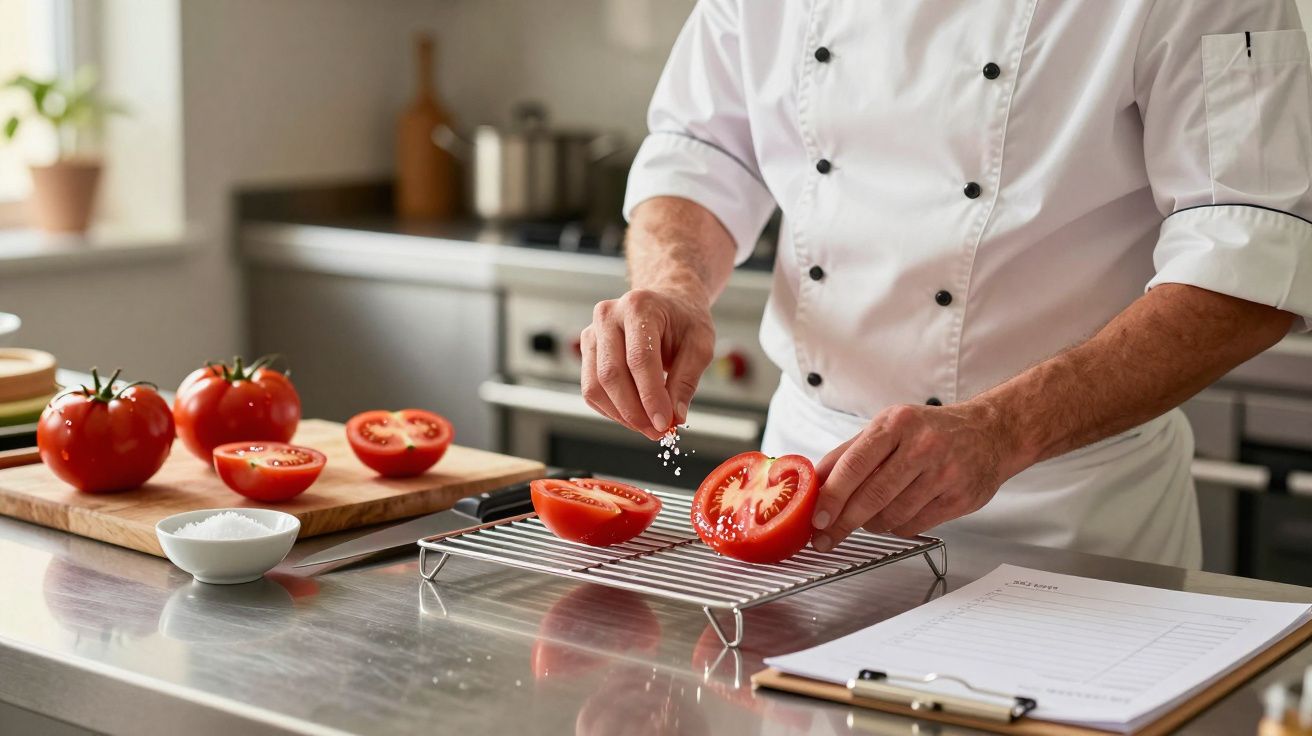
- Run a 60-second test on arrival: slice, salt lightly, wait, observe purge and aroma.
- Set a fallback: if fresh fails, switch that dish to roasted, or swap in a high-solid tin for sauce.
The “60-second test” is doing a lot of work right now. Cut a tomato, season it, and give it a moment. If it dumps water, smells of nothing, and tastes hollow, you’ve learned what the service will learn-just earlier, in the calm.
Workarounds that actually hold up on a busy pass
Professionals aren’t just complaining; they’re adapting. The best fixes look boring on paper, but they stabilise output.
For salads and sandwiches - Salt slices on a rack for 5–10 minutes, then pat dry; you keep flavour and lose puddles. - Use thicker cuts and sharper seasoning (acid and salt) to compensate for mild fruit. - Consider cherry or plum tomatoes when large slicers are inconsistent; they often carry more flavour per gram.
For sauces - Treat “tinned” as a premium tool, not a compromise. High-quality whole peeled tomatoes can be more consistent than fresh out of season. - Boost body without sweetness tricks: reduce gently, add tomato paste early, or roast off-water tomatoes before blending. - Keep a baseline recipe and adjust only one variable at a time (salt, sugar, acid), so you can repeat it tomorrow.
For prep and holding - Store fresh tomatoes at room temperature when possible; cold storage can mute aroma and worsen texture. - Separate ripeness grades on delivery: “today”, “tomorrow”, and “cook-only”.
Let’s be honest: nobody wants another checklist in a kitchen. But tomatoes punish improvisation more than they used to, so teams are swapping intuition for a few repeatable moves.
What this signals beyond the kitchen: supply chains and credibility
The bigger story isn’t that tomatoes are “bad now”. It’s that the industry is being forced to confront a truth: when an ingredient is everywhere, its failures are everywhere too. Procurement teams are asking growers harder questions. Menu developers are designing dishes that can flex without feeling like a downgrade. Even marketing is adjusting: fewer “vine-ripened” claims, more transparency about seasonality and sourcing.
In a strange way, this is a credibility moment. When a business admits tomatoes vary and builds a plan around that, customers feel the difference. Not because they know the plan exists, but because the food stays steady.
| Point clé | Détail | Intérêt pour le lecteur |
|---|---|---|
| Consistency checks | Slice + salt + observe purge/aroma | Reduces service-time surprises |
| Format strategy | Fresh for showcase, tinned for reliability | Stabilises flavour and cost |
| Waste control | Grade ripeness, choose outcomes not labels | Improves margins without shrinking portions |
FAQ:
- Why do tomatoes look good but taste bland? Selection for transport and shelf life can prioritise firmness and uniform colour over aroma and sugar-acid balance, so appearance no longer guarantees flavour.
- Are tinned tomatoes “better” than fresh? Not universally, but they can be more consistent, especially for sauces, because they’re processed closer to peak ripeness and chosen for higher solids.
- What’s the quickest way to stop tomatoes making a sandwich soggy? Salt slices briefly on a rack, pat dry, and use a thicker cut; you’ll remove surface water and concentrate flavour.
- Should tomatoes be refrigerated? If they’re truly ripe and you’ll use them soon, room temperature usually preserves aroma and texture better; chilling can mute flavour and make the flesh mealy.
- How do I write a simple tomato spec for suppliers? Specify use-case (slicing/sauce), minimum size band, firmness, ripeness stage on arrival, and an agreed rejection threshold for soft or split fruit.



Comments (0)
No comments yet. Be the first to comment!
Leave a Comment